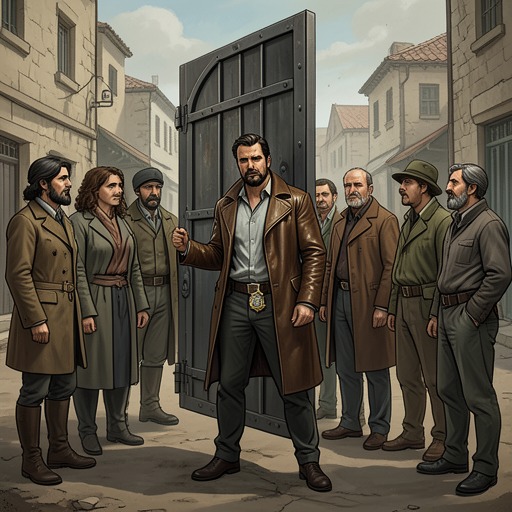
Tom White and Emmett White’s father–son relationship
Killers of the Flower MoonThe father-son relationship between T. B. White and Robert Emmett White was forged inside the working life of a county sheriff. Robert Emmett White raised his children amid poverty, bereavement, and the daily presence of prisoners; his son grew up watching him exercise authority over people in his custody and, as a boy, witnessed him carry out an execution. The relationship thus joined practical care to a difficult inheritance: T. B. White learned about the law not as an abstraction but through his father’s example and through the violence the law could authorize.
Family and Early Loss
Robert Emmett White had migrated from Tennessee to central Texas at eighteen, married Maggie four years later, and lived with her in a log cabin outside Austin, where they herded cattle and worked the land for food. T. B. White, born in 1881, was the third of their five children. The household included his younger brother Doc and his older brother Dudley, to whom T. B. White was especially close. The nearest one-room schoolhouse was three miles away, and the children walked there.
When T. B. White was six, Maggie died, apparently from complications after childbirth. Robert Emmett White was left to raise five children, all under ten. The loss made their father the surviving parent as well as the household’s provider. In 1888, after local residents urged him to run, Robert Emmett White was elected sheriff of Travis County. His public office soon became inseparable from family life: he moved his children into a house adjoining the county jail in Austin.
Growing Up Beside the Jail
The jail’s barred windows, stone passages, and tiered cells were not a distant workplace to T. B. White. In the sheriff’s first year, nearly three hundred prisoners passed through it, including people charged with murder, theft, arson, burglary, and other crimes. T. B. White later recalled being raised practically inside the jail, able to look from his bedroom window down into the corridor and toward the cell doors. His father’s duties were therefore part of the boy’s everyday surroundings, not merely stories brought home from work.
A violent jail melee made that proximity especially stark. As Robert Emmett White tried to stop the riot, his children ran to the nearby courthouse to summon help; five men were badly injured. Afterward, Robert Emmett White became a firm sheriff, but firmness did not mean indiscriminate force. He insisted on making arrests without displaying his six-shooter and treated prisoners consistently whether they were Black, white, or Mexican. When he heard that a mob was planning a lynching, he went out to try to prevent it. His conduct offered his son a model of law enforcement opposed to mob violence, at a time when lynchings were a grave failure of the legal system.
That model was also expressed in small acts of custody. Robert Emmett White refused to put young, nonviolent prisoners in cells with older, more dangerous convicts. With no other place for some of them, he let them stay in his own house among his children; one girl remained there for weeks. He never explained to T. B. White why she had been jailed. The episode shows a father who protected his children while also extending a measure of domestic shelter to people under his authority, without making the reasons for their confinement a family subject of discussion.
Violence, Authority, and the Execution
T. B. White also saw the physical risks his father faced. On one occasion, a prisoner stabbed Robert Emmett White from behind in the jail. T. B. White saw the knife in his father’s back and the blood on the floor as the prisoner tried to twist the blade. Robert Emmett White fought back, subdued the man, and survived, but the boy retained the image throughout his life. The scene brought danger into the father-son relationship in a particularly direct form: the sheriff whose work exposed his family to uncertainty could himself be attacked within the jail beside their home.
In January 1894, when T. B. White was twelve, he witnessed his father carry out the first county hanging in a decade. The condemned man, Ed Nichols, was nineteen, Black, convicted of rape, and maintained his innocence while hoping the governor would grant a reprieve. Robert Emmett White arranged for a carpenter to build the gallows near the prison’s southern wall, the only location with enough ceiling height. Nichols’s cell was only ten feet away, so he could hear the planks being cut and nailed. Robert Emmett White tested the apparatus repeatedly with sandbags, determined to make the execution swift.
After the governor rejected Nichols’s appeal, Robert Emmett White told him the decision. Nichols asked to be clean-shaven and dressed in a fine black suit, and the sheriff agreed. T. B. White watched from a tier inside the jail as his father led Nichols to the scaffolding, read the death warrant, and released the trapdoor at two minutes before four in the afternoon. The fall did not bring an immediate death: Nichols continued to move for a long time before his body was cut down. The boy saw both his father’s careful preparations and the execution’s failure to be swift in practice.
A Lasting Inheritance
T. B. White’s later opposition to what was called judicial homicide was connected in the account to his experience of this hanging, to what the ordeal did to his father, and to his fear that the system might condemn an innocent person. The evidence does not reduce that opposition to a single cause. It does show how the relationship placed him close to the law’s conflicting roles: Robert Emmett White tried to protect prisoners from mobs and unnecessary danger, yet his office also required him to carry out a state execution that became prolonged and distressing to witness.
For T. B. White, the law came to mean a struggle to subdue violent passions not only in other people but in oneself. That understanding carried the imprint of his father’s conduct—his restraint in making arrests, his efforts to stop lynchings, and his care for vulnerable prisoners—as well as the troubling spectacle of the gallows. In 1905, T. B. White enlisted in the Texas Rangers, joining Dudley and later Doc in law enforcement. His father’s household had introduced him early to the closeness of justice and violence; the execution made clear that the distinction between them could not be taken for granted.