Whizbang
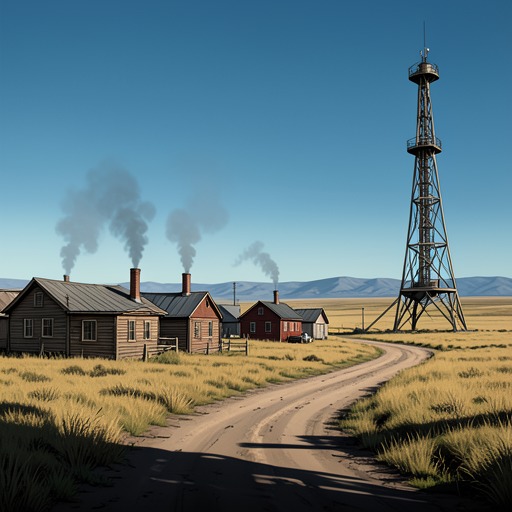
Killers of the Flower MoonWhizbang was one of the turbulent boomtowns that grew in the Osage Reservation to house and entertain oil workers. Its name captured the town’s reputation for round-the-clock commotion, while its concealed drinking places and streets at the edge of respectability made it both a social refuge and a useful setting for secrecy. William K. Hale’s effort to replace the name with Denoya could not erase the town’s association with the unruly side of the oil economy.
A Boomtown on the Reservation
Whizbang belonged to a landscape transformed by oil. New discoveries drew workers and wealth into the reservation, and boomtowns arose to serve the population around the fields. In 1917, workers drilling on Lot 185 saw the ground erupt in a towering column of oil; three years later, E. W. Marland’s Burbank field produced 680 barrels from a new well in its first twenty-four hours. Such gushers helped bring the oil workforce—and the businesses catering to it—into the region.
The oil economy also brought periodic lease auctions to Pawhuska, where a single tract could cover 160 acres and bidding had climbed sharply since auctions began in 1912. The fortunes generated by drilling were visible across the community, but Whizbang represented a different face of that expansion: a town built not only around extraction, but around the appetite for diversion that followed it.
Hidden Rooms and Anna Brown
Anna Brown had recently divorced Oda Brown, a settler who owned a livery business, and was spending more time in the reservation’s boomtowns. Whizbang especially attracted her with establishments that looked proper from the outside but hid rooms stocked with moonshine. One of Anna’s servants later described her as drinking heavily and having loose morals with white men, an account that reflects the judgment cast on her as well as her growing association with the town’s nightlife.
At a luncheon at Mollie Burkhart’s house, Anna arrived with bootleg whiskey and offered it to the guests, saying she needed to finish it before the authorities caught her. The episode took place a year into nationwide Prohibition and brought the boomtown culture into a family gathering. Anna also flirted with Bryan Burkhart, whom she had sometimes dated; when he asked a servant to go dancing, Anna threatened to kill him if he fooled around with another woman. Her conduct made her a source of anxiety in a household already strained by racist remarks from Ernest Burkhart’s aunt.
A Name for Respectability, a Place for Secrecy
Local civic leaders, including Hale, considered Whizbang an undignified name and preferred Denoya, after a prominent Osage family. The proposed name offered a more respectable public face for a town whose notoriety was difficult to conceal. The contrast was sharp: Whizbang’s reputation rested on noisy excess, while Denoya invoked an established Osage family.
Hale used the town’s outskirts for a private meeting with a detective known as Pike. They met at a concealed spot near Whizbang; Pike smoked a corn pipe and wore a smudge of a mustache, and after conferring with Hale he slipped away to pursue his investigation. The scene makes the town’s margins part of its narrative geography: a place associated with hidden rooms and illicit pleasures also offered cover for covert business.
The Boomtown Economy and Its Costs
Whizbang’s nightlife belonged to a wider system in which oil wealth and local power were tightly entangled. As Tom White investigated the flow of headright money, he found guardians who overcharged their wards, steered their business toward favored stores and banks, claimed their property for themselves, or stole outright. A government study estimated that guardians had taken at least $8 million from restricted Osage accounts before 1925. Whizbang was not identified as the center of that theft, but its boomtown setting arose from the same oil economy whose revenues were contested and exploited.
The boom did not last unchanged. The Great Depression and the depletion of oil fields diminished Osage fortunes, and many boomtowns began to die off over the following decades. Whizbang’s account captures the earlier moment of expansion, when oil drew workers into new settlements and the town’s concealed rooms offered one kind of escape, even as the larger wealth around them was subject to control and appropriation.