William K. Hale
Killers of the Flower MoonWilliam K. Hale was a powerful rancher and public benefactor in Osage County whose carefully cultivated image as a friend of the Osage collapsed under the investigation into a series of murders. The contrast was not incidental: Hale’s local authority, charitable reputation, and apparent intimacy with Osage families helped conceal a system in which murder and inheritance could work together to divert their wealth. His conviction for Henry Roan’s murder brought that contradiction into the courtroom, though the evidence left other suspected crimes unresolved.
From cattle hand to county power
Hale arrived in the territory with little more than the clothes on his back and a worn Bible, and with no known past. He began as a cowboy, driving cattle from Texas through Osage territory toward Kansas. The work was punishing: he rode through storms and stampedes, earned little, and endured frequent injuries. He eventually saved and borrowed enough to acquire his own herd. As he became adept at raising and selling cattle, he expanded his holdings by buying land from the Osage and neighboring settlers. He ultimately amassed about forty-five thousand acres of grazing land and a substantial fortune.
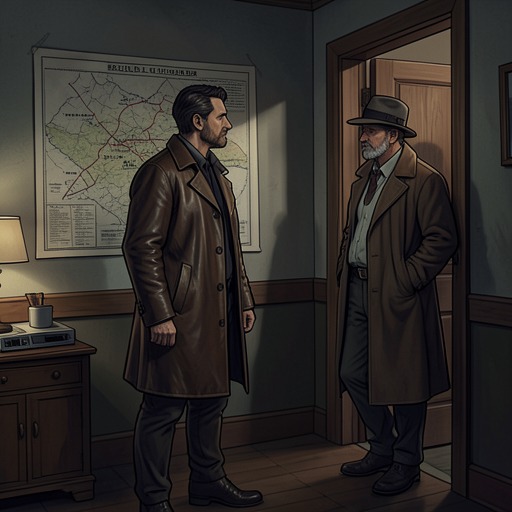
Hale then recast himself. The battered cowboy’s clothes gave way to a suit, bow tie, felt hat, and round-rimmed glasses. He married a schoolteacher, had a daughter, and recited poetry; one prominent Wild West showman described him as a gentleman of high standing. The transformation was more than sartorial. In Fairfax, Hale became a reserve deputy sheriff, a largely honorary position that nevertheless gave him a badge, the ability to lead posses, and the appearance of official authority. He sometimes carried two pistols, presenting them as emblems of his law-enforcement status.
By the time Mollie Burkhart sought help after Anna Brown’s murder, Hale’s business interests and influence had made him a formidable local figure. Politicians courted his support, and he had outworked and outmaneuvered rivals, some of whom hated him. His wealth and public standing were rooted in cattle, land, political access, and a reputation for helping the community—a combination that made his authority difficult to separate from the county’s structures of business and law.
The benefactor and the supposed protector
Hale’s benevolence was not simply a later cover story in the account of his life. Before the Osage had become wealthy from oil, he donated to charities, schools, and a hospital. A local doctor recalled the sick people treated at Hale’s expense and the hungry people who received his generosity. Hale also adopted the language of religious service in his correspondence, signing himself as Reverend W. K. Hale. Many people, including Mollie, regarded him as one of the county’s greatest benefactors; he was celebrated as the King of the Osage Hills.
That public identity shaped the response to Anna’s death. Mollie pressed officials to investigate, but many appeared indifferent to the murder of an Osage woman. She then turned to Ernest Burkhart’s uncle, Hale, who had made himself an advocate for law and order and protection of the upright. After Anna’s burial, he visited Mollie and her mother, offered condolences, and promised to secure justice. He had no formal position in the investigation, yet his confidence and command of the local world gave him an informal presence in it. He had described Anna as a friend, and Mollie saw him talking with Ernest about finding her sister’s killer.
Hale’s authority also ran through his family. Ernest, a poor Texas farm boy, had come to live with him in Fairfax in 1912, when Ernest was nineteen. Hale was not merely an uncle but a surrogate father and a commanding employer: Ernest ran errands for him and later became his nephew by marriage to Mollie. An agent would describe Ernest as entirely controlled by Hale. That relationship gave Hale an indirect connection to the family whose headrights became central to the suspected murder scheme.
Friendship, insurance, and inheritance
Hale’s relationship with Henry Roan similarly joined personal trust to financial advantage. Roan considered Hale a close friend and repeatedly sought advances when his allowance was restricted. Hale later said he had lent Roan money so often that Roan named him beneficiary of a $25,000 life-insurance policy. Shortly before his death, Roan had learned that his wife was having an affair; Hale visited and tried to console him. Such details helped explain why Hale’s connection to Roan could initially appear protective rather than suspicious.
Investigators, however, found that Hale had tried to buy Roan’s headright before taking out the insurance policy. The law prohibited the purchase or sale of a headright, but Hale believed that political pressure might eventually remove the restriction. When that did not happen, T. B. White suspected that Hale had turned to an insurance murder plot instead. The policy gave Hale a direct financial interest in Roan’s death, though investigators initially lacked proof that Hale had personally killed Roan or ordered the killing.
The wider pattern became clearer when T. B. White examined probate records. Because headrights could pass by inheritance, successive deaths in Mollie’s family concentrated more of the family’s wealth in her hands. Anna, who had no children, left most of her property to her mother, Lizzie; Lizzie’s will directed much of her headright to her surviving daughters, Mollie and Rita. Rita and her husband, Bill Smith, were then killed in a house bombing. Their wills made the timing of their deaths consequential: had they died simultaneously, much of Rita’s headright would have passed to Mollie. Bill survived Rita by several days, so he inherited much of her wealth before his own death redirected it to a relative. Despite that complication, much of the family’s headright wealth ended up with Mollie, whose finances were controlled by Ernest. T. B. White concluded that Mollie was the channel through which Hale could reach the family’s assets.
Exposure and conviction
The investigation exposed a sharp divide between Hale’s public conduct and the allegations against him. Undercover agents posing as cattlemen gained his confidence; Hale treated them as fellow Texas cowboys and introduced them to prominent local people. Pike, a man initially used to provide a lead in Anna’s case, later told agents that Hale had hired him not to solve the murder but to conceal Bryan Burkhart’s whereabouts. Pike said his task was to manufacture evidence and false witnesses to create an alibi. He also placed Ernest in meetings with Hale and Bryan, while saying Ernest avoided discussing the case in Mollie’s presence. Pike’s account implicated Hale in an effort to protect Bryan, though it did not by itself resolve whether Hale was shielding him or directing a larger plan.
The case against Hale extended beyond Anna’s murder. After obtaining signed statements from Ernest and John Ramsey, T. B. White confronted Hale, telling him that the statements implicated him as the principal in the murders of Roan and the Smith family. White also learned of claims from people close to Anna that Hale had had an affair with her and was the father of her unborn child. If true, that allegation made the suspected motive more disturbing still; it remained an allegation rather than an established fact in the account.
In the Roan trial, the jury found Hale and John Ramsey guilty of first-degree murder. The verdict carried a possible death sentence, but the jury qualified its decision with life imprisonment. The judge sentenced both men to prison for the rest of their natural lives. Hale, asked whether he had anything to say, answered no. The man once praised as a local guarantor of law and order received a conviction for murdering an Osage man, but the jury’s refusal to impose death also revealed the limits of the justice delivered.
Imprisonment and the limits of the record
A letter Hale sent from prison in 1931 preserved his confidence in the identity he had cultivated. He claimed to be in perfect health, gave his weight as 185 pounds, and said he had no gray hair. He hoped to return to Gray Horse settlement after his release and continued to insist that he was a true friend of the Osage. The letter’s buoyant self-presentation sits uneasily beside his conviction and the evidence that had made him appear, to investigators, a central figure in a network of violence and financial exploitation.
The record did not settle every suspicion surrounding Hale or the murders. Investigators never established his involvement in Charles Whitehorn’s killing, which occurred in May 1921, around the time Anna Brown was murdered; later research described it as bearing the marks of a Hale-orchestrated attack while acknowledging that no evidence had surfaced tying Hale or his men to it. Nor did suspicion concerning the wider network translate into prosecution for every death. A grand-jury record indicated that H. G. Burt had recommended another potential target for an insurance scheme, and Bureau of Investigation reports described Burt as closely associated with Hale. Yet the financial incentive in the George Bigheart case appeared less compelling than the headrights and insurance involved in other killings, and the United States Department of Justice did not prosecute Hale for Bigheart’s death.
Hale’s narrative significance lies in the way his standing linked respectability to coercive power. His land, deputy’s badge, donations, and friendships made him legible as a protector; those same connections gave him influence over the people and institutions through which Osage property was administered and investigated. The investigation did not make every suspected crime provable, but it revealed how the appearance of civic benevolence could coexist with an effort to profit from inherited wealth through murder. His silence at sentencing and his later declaration of friendship leave the public persona intact in his own words, even as the conviction permanently changes what that persona can mean.