
Marriage Under Unequal Expectations
Kim Ji-young, Born 1982This flow traces how affection and mutual support in Kim Jiyoung and Jung Daehyun’s marriage are tested by inherited gender roles, parenthood, and the unequal costs each partner bears.
increasing Bearing strength in each event
 decreasing
Bearing strength in each eventdecreasingA Shared Domestic Beginning

A Home Built Together
Early companionship
Kim Jiyoung and Jung Daehyun begin married life with affection and practical optimism. Their demanding jobs often keep them from sharing meals, but late-night films, delivered food, and slow weekend mornings let them treat ordinary domestic life as a private date.
Uneven assumptions
They have managed to marry without asking their parents for financial help, yet Daehyun has saved considerably more. The difference reflects his higher income and Jiyoung’s lower-paid field, quietly showing how their shared future rests on unequal economic ground.
Their tenderness is real, but it has not yet been tested by the daily labor of a household. The early ease of their marriage makes the coming negotiations over care more consequential: both love each other, while the surrounding expectations already assign them different burdens.
The Marriage Registration

The Form on the Table
A gesture of commitment
Jung Daehyun brings home the marriage-registration form after doing chores and waiting for Kim Jiyoung. He says that making the marriage legal will change how they feel, and his urgency initially moves her; she experiences his action as a sign of dependable devotion.
A small fracture
His words also unsettle her. Kim Jiyoung does not believe that a legal procedure determines the strength of their feelings, and she sees him as both more dependable and more alien than before. Their difference is not a lack of love but a difference in how each understands commitment.
The form makes the private relationship answer to public customs. When they reach the question of the future child’s surname, the couple’s conversation shifts from romance toward the rules that will shape their family, exposing how intimacy and social convention are already intertwined.
A Conversation About Parenthood

Two Different Costs
An apology and a proposal
After relatives speculate about fertility and Daehyun stays silent, Kim Jiyoung and Jung Daehyun argue on the drive home. Daehyun later apologizes and says he should defend her when his family treats her unfairly, an important recognition that his greater ease with them gives him a responsibility to speak.
Unequal stakes
He then suggests having a child partly to end his parents’ questions. Jiyoung considers the decision far less casually: she worries about pregnancy, childcare, and whether she can keep her career. Daehyun promises to change diapers and help with household tasks, but Jiyoung questions why shared responsibilities are framed as his assistance.
When she asks what he will give up, his examples—fewer outings, less time with friends, and added household work—seem slight beside the health, work, and future she may surrender. The conversation reveals genuine care alongside a deep imbalance in how each partner imagines parenthood’s costs.
Leaving Work and Giving Birth
A Shared Decision With Different Consequences
The narrowing options
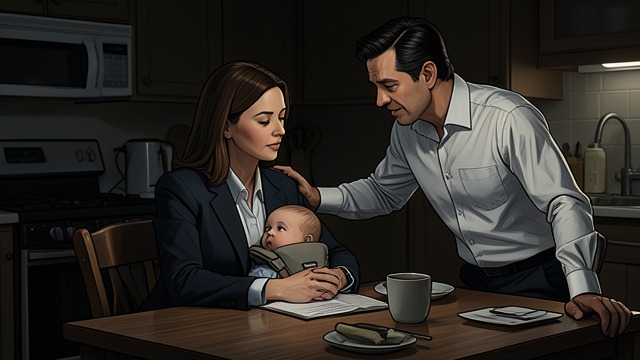
Kim Jiyoung and Jung Daehyun discuss possible childcare arrangements and conclude that one parent must stay home. Daehyun’s job is more stable and pays more, while the familiar social pattern makes Jiyoung the expected caregiver. She knows the likely result but still feels depressed when their discussion confirms it.
Support that sounds like help
Daehyun sincerely offers to help her find new work and care for their child. Jiyoung objects to the word help: the home and child belong to both of them, so his participation should not sound like volunteering for someone else’s duties. She apologizes for snapping, and he accepts the apology without pressing her.
As Jiyoung leaves her marketing job, the loss becomes immediate. Her work had offered income, accomplishment, colleagues, and a sense that she directed her own life. Daehyun’s affection cannot undo the unequal structure of their decision, but their disagreement gives it a voice rather than letting it pass as a natural consequence of marriage.
A Husband’s Reassurance

Comfort Without an Answer
The wound is named
After office workers call Kim Jiyoung a mom-roach at the park, she tells Jung Daehyun that the insult has made her feel like vermin. She describes the pain of giving birth and surrendering her work, dreams, and independence, then asks what she is supposed to do now.
Loving presence
Daehyun draws her close, puts an arm around her, and repeats that the insult is not true. His embrace is an intimate response from a husband who wants to protect her, but he cannot offer a remedy for the public contempt and lost opportunities she is describing.
The moment holds both closeness and limitation. Kim Jiyoung can turn to him with her anguish, yet reassurance alone cannot return the life she gave up or change the world that made her feel ashamed for resting. Their bond remains a source of care inside a problem neither can solve by affection alone.
After their wedding in 2012
One month after their wedding ceremony
After the couple returns from a family visit to Busan
In the final weeks before Jung Jiwon’s birth
Autumn 2015, after the park incident
