
A School Lunch Protest
Kim Ji-young, Born 1982This thread follows a small student protest against an unfair lunch queue, showing how a practical adjustment gives girls a first experience of questioning the rules around them.
increasing Bearing strength in each event
 decreasing
Bearing strength in each eventdecreasingThe Roster-Number Queue
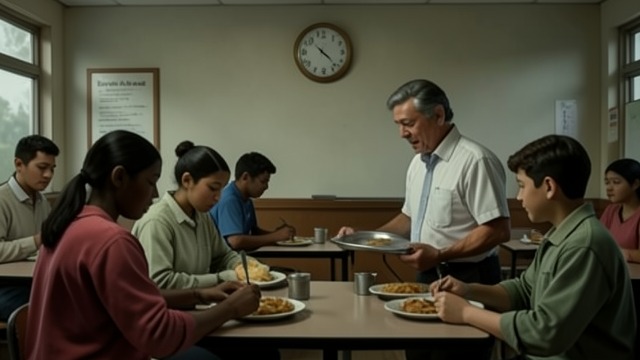
The Roster-Number Queue
Lunch by Assigned Order
At Kim Jiyoung’s school, students went to the cafeteria in roster-number order. The system meant that higher-numbered pupils received food later and had less time to eat before the next class needed the dining space.
The numbers were arranged by birthday, but boys occupied the first part of the roster and girls followed them. Slow eaters were routinely hurried by their teacher, who struck the metal trays with a spoon as the lunch period ran down.
Unequal Time at the Table
Kim Jiyoung was a slow eater and felt each hurried mouthful catch in her throat. Girls with later birthdays faced an even tighter interval, so the students most often pressured to finish quickly were girls.
The rule looked like a neutral procedure, yet its consequences were uneven. The queue turned a simple administrative order into a daily experience of rushed eating and unequal treatment.
The Slow Eaters Gather

The Slow Eaters Gather
A Day of Accumulated Frustration
After a tense day of classroom punishments, the teacher again hit students’ trays and demanded that the slowest eaters hurry. Some children cried with their mouths full, and the students who struggled with lunch found one another during cleanup.
They arranged to meet after school at a local tteokbokki shop. Their complaints came quickly: they were not eating slowly on purpose, and being watched and forced to eat made the meal harder, not easier.
From Feeling to Diagnosis
Kim Jiyoung shared their anger but found it difficult to state her own thoughts. She was accustomed to nodding along rather than challenging an authority figure directly.
The group’s gathering mattered because it made a private difficulty collective. The students could compare experiences and begin to identify a rule—not their individual shortcomings—as a source of the problem.
Yuna Names the Problem

Yuna Names the Problem
A Proposed Change
At the students’ gathering, Yuna stated calmly that the unfairness lay in always eating by roster number. If the order changed periodically, pupils with higher numbers would not always be served last.
Kim Jiyoung wondered whether students were even allowed to suggest a change to their teacher. Yuna appeared able to take that risk: she did well academically, and her mother was head of the school board.
A Public Argument
At the Friday class meeting, Yuna raised her hand and formally proposed changing the lunch order. She explained that the ascending sequence repeatedly disadvantaged the higher-numbered students and asked that the order be reversed from time to time.
Her intervention translated the group’s frustration into a specific, answerable demand. It was a modest proposal, but it required the students to treat classroom procedure as something open to reason and revision.
The Order Is Reversed

The Order Is Reversed
A Rule Changes
The teacher responded that the class would eat in reverse order from the following week and switch the sequence each month. The students who had previously been last cheered at the prospect of getting served earlier.
The answer brought relief, but it did not change the teacher’s impatience with slow eaters. The same pressure to finish quickly remained, and the difference in queue order only partly eased it.
A Limited Remedy
Of the girls who had met after school to complain, some continued to be identified as slow eaters. Kim Jiyoung’s own position near the middle of the roster meant the change made less practical difference to her than to the highest-numbered students.
The adjustment nevertheless showed that collective pressure could alter a classroom routine. Its limits were just as revealing: a revised order could address one unfair feature without changing the broader impatience that made the lunch period distressing.
A First Critical Habit

A First Critical Habit
Confidence Through Action
The students had raised a concern with a figure of authority and won a change. For Yuna, Kim Jiyoung, and the other high-numbered girls, the result offered a small sense of achievement: an arrangement that had seemed fixed could be questioned.
Kim Jiyoung tried to eat faster and eventually left the slow-eaters group. Her individual adaptation solved her immediate problem, even though it did not remove the pressure placed on children who ate at a different pace.
An Assumption Left Untouched
The girls did not yet question why the boys occupied the first positions on the roster, or why boys routinely led lines and presentations. The protest challenged the sequence within the queue but left its gendered starting point unexamined.
That partial awareness marks the episode’s lasting significance. The students learned that rules could change while still taking other conventions as natural, showing how resistance often begins by correcting a visible unfairness before its surrounding assumptions become legible.
From Kim Jiyoung’s third grade onward
During a particularly harsh school lunch period
At a Friday class meeting in third grade
The week after Yuna’s proposal
After the monthly lunch rotation began
