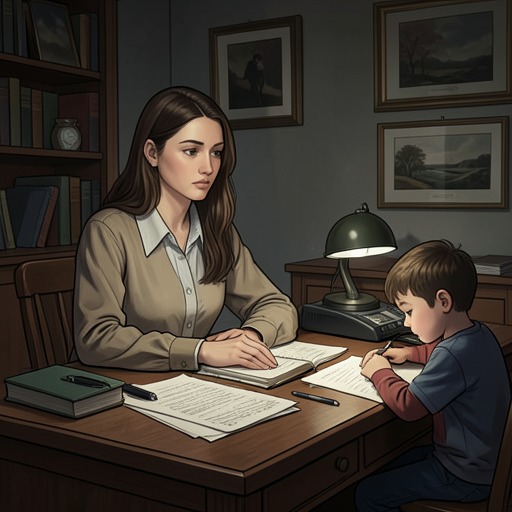
A woman helps Jiyoung escape a stalker on the bus
Kim Ji-young, Born 1982A woman helps Jiyoung escape a stalker on the bus is a formative episode in Kim Jiyoung’s youth: after a male student follows her from a bus stop onto a bus and then off into a deserted area, an alert passenger helps interrupt the pursuit and stays with her until her father arrives. The danger does not end with the student’s departure. Jiyoung is blamed at home for the circumstances around the encounter, while the stranger’s reassurance that she was not at fault gives her a different account of what happened—one she carries into the long period of fear that follows.
Background and approach
The encounter comes after a late day at cram school. Kim Jiyoung has finished both her regular classes and a special seminar, and is waiting beneath the bus-stop sign when a male student makes eye contact and greets her. He seems familiar, but she cannot identify him; she gives an awkward nod, assuming he is another student from the cram school. He moves closer by degrees. Once the other people waiting have left, he is standing beside her.
His questions about which bus she will take and whether she attends the same classes give Jiyoung an opportunity to answer, but she does not feel safe continuing the conversation. She avoids his gaze and looks toward distant headlights. When her bus arrives, she initially acts as if it is not hers, then boards at the last moment. The student follows her on. Watching his reflection in the window, she fears that he is watching her as well. Her evasive choices are not evidence of consent or encouragement; they are attempts to manage an encounter whose meaning and direction she cannot control.
The pursuit and the intervention
On the bus, a tired woman who appears to be returning from work notices that Jiyoung is pale and sweating, and offers her seat. Jiyoung tries to communicate that she needs help without alerting the student. When the woman does not understand her first gesture, Jiyoung makes a phone sign with her hand. The woman lends her a large mobile phone, and Jiyoung bends over it to conceal what she is doing as she urgently texts her father to meet her at the stop.
When the bus reaches that stop, her father is not there. The male student is immediately behind her as the doors open. Jiyoung is afraid to get off, but cannot keep riding into an unfamiliar neighborhood late at night. She steps onto a deserted street beneath a broken streetlight, and the student gets off too. He approaches and accuses her of having acted as if she were flirting: in his account, sitting in front of him, smiling while passing handouts, and exchanging greetings had all signaled interest. Jiyoung, however, does not remember who sat behind her or what she may have said in ordinary moments at school. The gap between his interpretation and her recollection exposes how he has treated routine politeness as a claim on her.
The woman from the bus suddenly gets off farther along the road and runs back, calling out that Jiyoung has forgotten her scarf. The scarf is plainly not something a girl of Jiyoung’s age would wear; its implausibility makes the interruption an unmistakable pretext. The student curses and walks away. The woman’s quick decision to create a distraction turns a stranger’s offer of help into active protection, without requiring Jiyoung to confront her pursuer alone.
Immediate aftermath
Once the woman reaches the stop, Jiyoung collapses and cries. Her father runs out of an alley, and Jiyoung explains that the student may have been in one of her classes but that she has no memory of noticing him; he appears to have convinced himself that she was flirting. The three sit together on the bus-stop bench and wait for the next bus. Her father says he came out in such a hurry that he brought nothing, apologizes that he cannot at least pay for the woman’s cab, and promises to reward her kindness.
The woman declines that framing of the encounter. She says a cab would be worse and urges Jiyoung’s father to comfort his daughter. Later, Jiyoung’s mother calls to offer compensation, a small gift, coffee, or tangerines, but the woman refuses. Jiyoung calls again because she wants to thank her. The woman tells her that what happened was not her fault: there are men who behave this way, she has had her own encounters with them, and responsibility belongs to the men rather than the women they target. Jiyoung begins to cry and cannot answer. The woman also insists that there are many good men, offering reassurance without denying the danger Jiyoung has experienced.
Lasting consequences
At home, Jiyoung’s father responds with questions about why her cram school was so far away, why she spoke to strangers, and why her skirt was short. The focus shifts from the student’s conduct to Jiyoung’s choices and appearance. That reaction echoes the rules she has grown up hearing: be cautious, dress conservatively, behave in a ladylike way, and avoid dangerous places, times, and people. The episode thus contains two competing explanations. Her father’s response makes safety seem like a responsibility she failed to discharge; the woman’s response locates the wrongdoing with the person who followed and threatened her.
Kim Jiyoung quits the cram school and, for a long time, cannot approach a bus stop after dark. She stops smiling at people and avoids eye contact with strangers. Her fear extends beyond the incident’s setting: she becomes afraid of men and sometimes screams when she encounters her younger brother in the stairwell. Against this withdrawal, the woman’s words recur in her thoughts. Jiyoung believes she would have lived in fear even longer if she had not been told that she was not to blame and that the world also contains good men. The intervention does not erase the effects of the pursuit, but it gives her a way to resist the victim-blaming that compounds them.