Boys are meaner to the girls they like
Kim Ji-young, Born 1982“Boys are meaner to the girls they like” is a teacher’s explanation for a boy’s repeated pranks against eight-year-old Kim Jiyoung. Its decisive effect is to recast conduct that makes school life difficult for her as a sign of affection, asking her to reinterpret the harm instead of taking her account of it at face value. The book places this saying within a wider pattern of language that minimizes women’s objections and makes unequal treatment seem ordinary.
Meaning and First Use
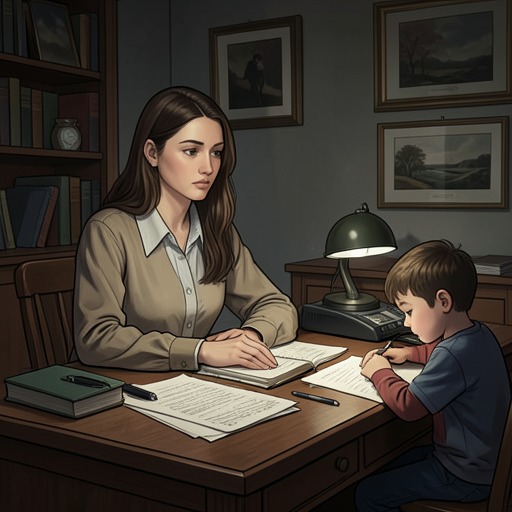
The teacher introduces the idea after apologizing for reprimanding Kim Jiyoung without finding out what had happened. When Kim Jiyoung asks for a new desk-mate, the teacher tells her that the boy likes her and says, “Boys are like that,” before adding, “They’re meaner to the girls they like.” She promises to talk to him, but also urges Kim Jiyoung to treat the incident as an opportunity for friendship rather than insisting on separation.
That response makes the saying more than a casual observation: it supplies an interpretation that competes with Kim Jiyoung’s experience. She is aghast and answers, “He hates me,” pointing to the way he has treated her. In her reasoning, affection means being friendly and kind—to friends, family, and even pets. The mismatch between that straightforward standard and the teacher’s explanation leaves Kim Jiyoung confused and makes her feel that she is being cast as the child who misunderstood a friend.
Kim Jiyoung’s Refusal
The saying does not persuade Kim Jiyoung to accept the boy’s treatment. She reviews the incidents she has endured and cannot make them fit the teacher’s account; what he has put her through is still awful, regardless of the feeling the teacher attributes to him. She refuses the proposed reconciliation and repeats that she does not want to remain desk-mates with him. The next day, the class receives new desk-mates. Kim Jiyoung sits with a boy who had usually sat alone at the back because he was the tallest, and they do not argue.
The outcome gives Kim Jiyoung’s objection practical force: the arrangement changes rather than requiring her to turn unwanted treatment into friendship. It also exposes what the saying risks doing. By treating meanness as a customary expression of boys’ affection, the adult explanation can displace the question of whether the behavior is acceptable and whether the girl wants to remain close to the boy.
Related Language of Gendered Treatment
The book later presents other phrases that similarly dress unequal relations in benign or joking language, though they are not repetitions of the same saying. In the hiking club, women are called “flowers among weeds” and receive preferred meals, the larger rooms on trips, and offers to carry their things. Such favors coexist with men holding the club’s leadership positions and a boys-only alumni group. When Cha Seungyeon argues that women want equal responsibilities and opportunities rather than special treatment, a male member insists that the work is too much for women and that their mere presence brightens the club. The contrast shows how flattering language and apparent consideration can accompany exclusion from authority.
In Kim Jiyoung’s marketing work, a client-company head calls her a Doenjangnyeo after she orders soybean-paste sauce with rice. The word is part of a misogynistic vocabulary of labels ending in “nyeo,” and the client’s laughter makes it difficult for her to tell whether she is expected to take the remark as a joke or an insult. In a different setting, Jung Daehyun describes his proposed contribution to chores, childcare, and her job search as helping out. Kim Jiyoung challenges that wording: these are their shared home, child, and household responsibilities, not somebody else’s work to which he volunteers assistance. Across these scenes, language can soften, disguise, or shift responsibility for gendered inequality.
The Saying’s Limits
The later park episode sharpens the distance between an imposed explanation and a woman’s account of what she hears. Office workers call Kim Jiyoung a “mom-roach” as she sits with her sleeping daughter and coffee; she rushes home, spills the drink on her hand, and only later tells Jung Daehyun what happened. He initially dismisses the term as something used by foolish teenagers online, but she insists that she heard suited men around her own age say it in person. The episode is not another instance of the childhood saying, but it echoes its central tension: a man’s reassuring or minimizing account does not cancel what Kim Jiyoung has experienced.
The expression therefore operates as a compact example of how gender assumptions enter ordinary conversation. In childhood, it recasts a boy’s hurtful actions as affection; in the adult scenes, other labels, jokes, and offers of help obscure women’s exclusion or assign them the burden of interpreting and absorbing it. Kim Jiyoung’s refusal to accept the teacher’s explanation establishes an early instance of her insistence that conduct be judged by its effects, not excused by a familiar story about what boys are like.