Help out
Kim Ji-young, Born 1982The expression help out becomes a small but revealing measure of how responsibility is divided between Kim Jiyoung and Jung Daehyun. Daehyun means to reassure his wife that he will take part in caring for their child and supporting her career; Jiyoung hears a promise that still casts the work as hers. Her objection is not to his willingness to act, but to the assumption built into the offer: a parent and householder can be described as helping with work that is already his own responsibility.
An offer before parenthood
When Daehyun raises the prospect of having a child, he does so casually, while the couple have not yet discussed family planning or when they might become parents. For Jiyoung, the decision is weightier. She has little firsthand experience of pregnancy or newborn care, and worries that her body, career, and time may all change. Daycare and babysitters seem insufficient because both spouses work late and on weekends, while neither set of parents is able to help. She also feels guilty for imagining care by someone else before the child has even been born.
Watching her worry, Daehyun offers to change diapers, feed the baby, and boil the baby’s clothes. He listens as she explains her fear that motherhood will endanger her career, and her guilt about relying on another caregiver. He asks her to consider what parenthood might add to their lives, and says that if they cannot find childcare, she need not keep working because he will support the family. The offer is sincere and intended to ease her anxiety. Yet it describes his participation as assistance, while leaving the central burden of finding a way to combine work and parenting with her.
When the wording becomes visible
The couple eventually conclude that one of them must stay home with the child. Daehyun’s work is more stable and better paid; beyond that financial difference, they are following the more familiar arrangement in which a husband earns and a wife raises the children and manages the home. Jiyoung had anticipated this outcome, but expectation does not make it less depressing. Daehyun again says he will help out: they can hire a sitter occasionally and send the child to daycare, giving her time to study and seek other work.
This time Jiyoung challenges the repeated wording directly. Household chores, raising their baby, and helping her find a new job are presented as tasks he will lend a hand with, although the home and child are his as well, and any income she earns would be spent within their family. Her questions shift the issue from his intention to the structure of the offer: help implies that the work belongs to someone else. She regrets snapping after the two have made a difficult decision together, apologizes, and receives Daehyun’s reassurance that he is not upset. The exchange does not undo their decision that she will leave work, but it gives the couple’s ostensibly shared choice a sharper outline.
The consequences appear in the ordinary schedule that follows. Jiyoung does not cry when she tells her company she is resigning, or when she collects her belongings and attends her farewell gathering. The tears arrive the day after she leaves, when she wakes and begins planning a commute, lunch, errands, and perhaps a movie, then realizes that she no longer has an office to go to. The contrast makes the loss concrete: Daehyun’s offer of support has not prevented her career from stopping, and the daily structure that disappears with the job is hers to reconstruct.
The labor that the phrase can obscure
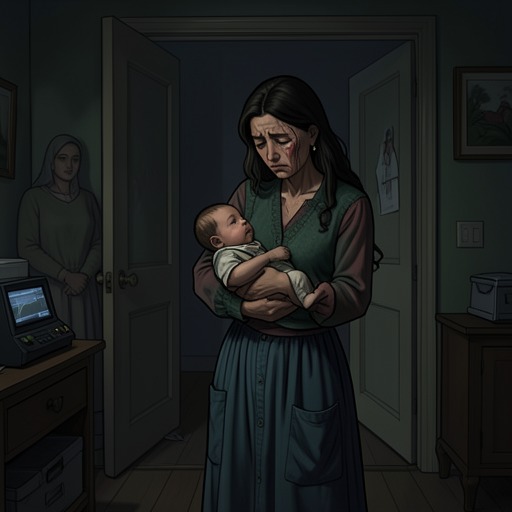
After Jiwon is born, care is not an occasional task set apart from the rest of the day. Jiyoung breastfeeds every two hours, cannot sleep for more than two hours at a time, holds the baby while trying to do chores and rest, washes baby clothes and household fabrics, and prepares food for herself to support breastfeeding. She cries more than she ever has and experiences pain throughout her body. When her wrists become inflamed, an orthopedist tells her to rest, but she explains that she must care for the baby, wash clothes, and clean the home.
The doctor’s reply—that earlier generations did more domestic work without modern appliances—treats technology as if it had removed the work itself. Jiyoung’s reflection distinguishes the machine from the labor around it: laundry still has to be gathered, moved through the wash, taken out, and hung up; a vacuum does not independently wipe floors or clean its own cloths. She observes that domestic labor is either dismissed as idleness or praised as life-sustaining work, while its monetary value goes uncalculated. The phrase help out belongs to this same field of invisibility when it frames ongoing shared work as a favor performed for the person most burdened by it.
The costs are not confined to the couple. Oh Misook cannot stay to help Jiyoung recover because the porridge shop is struggling amid new competition, and fewer workers mean longer hours for her. She brings leftovers when she can, while the shop’s income supports Jiyoung’s younger brother as he prolongs his education. Maternal care thus appears alongside paid work and family support, but is constrained by them. When Oh Misook praises her daughter’s strength in raising a baby without help, Jiyoung asks whether raising her own children had been hard and whether her mother had ever regretted having so many. The exchange resists turning endurance into proof that the burden is natural or costless.
Sharing in practice and in hindsight
A visit from Kang Hyesu offers a modest contrast between an abstract promise and practical participation. While the friends talk, Jiyoung feeds and changes Jiwon, comforts her when she cries, and puts her down for a nap. Hyesu is initially nervous about holding the baby, but warms the baby food, fetches clean diapers, and does the dishes. The scene does not present care as effortless or erase Jiyoung’s greater share, but it specifies the actions involved instead of treating them as a single undifferentiated maternal duty.
When Jiwon starts daycare a little after her first birthday, she adjusts well and spends the morning there. Jiyoung gains roughly three hours between drop-off and pick-up, yet most of that time goes to laundry, dishes, tidying, and preparing food. A cited comparison puts a mother with a child under two at four hours and ten minutes a day to herself, against four hours and twenty-five minutes for a mother whose baby attends daycare: a difference of only fifteen minutes. Daycare changes whether housework is done with the baby beside her, not whether the work remains. The teacher’s suggestion that Jiwon might stay later awakens Jiyoung’s interest in starting something new, while a rent-deposit increase of 60 million won and the family’s growing housing and education expenses intensify her wish to earn money.
The novel later places this family arrangement beside a psychiatrist’s account of his own wife’s career. He recognizes that she moved from pursuing a university position in ophthalmology to contract work and then gave up her career, and says that following those compromises taught him what it can mean to live as a woman and mother in Korea. When their son’s school behavior leads his wife to suspend her medical work, she challenges the psychiatrist’s confidence about a child he spends little time attending to. These reflections do not repeat Jiyoung’s exchange with Daehyun, but extend its central problem: a person may sincerely intend to support a family and still fail to see who is carrying the daily responsibility. In this context, help out names more than a choice of words. It makes the boundary between assistance and shared obligation audible, and exposes how easily unequal care can persist inside a relationship that considers itself cooperative.