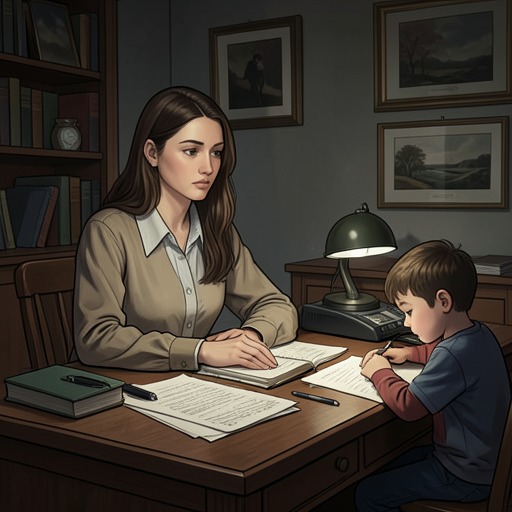
Jiyoung’s dissociative episodes
Kim Ji-young, Born 1982Kim Jiyoung’s dissociative episodes are moments in which she becomes other women she knows, living or dead, with a completeness that makes the experience more than imitation or play. They become central to her psychiatric treatment and to the book’s account of what can be missed when distress is judged without fully understanding the conditions of a woman’s life.
Manifestation and Recurrence
The account describes Kim Jiyoung as becoming different people from time to time. The women she takes on are not all living, and they are not strangers: they are women she knows. The transformation is presented as complete, not as a joke or a prank. The episodes therefore unsettle any easy distinction between a person’s ordinary identity and the voices or selves that surface during her illness.
The evidence does not provide a timetable for the episodes or detail each one separately. It does establish that they recur, and that they remain clinically significant even as other symptoms lessen. By 2016, Kim Jiyoung attends 45-minute treatment sessions twice a week. Her symptoms have decreased in frequency but have not disappeared; her psychiatrist has prescribed antidepressants and sleeping pills to address depression and insomnia.
Diagnosis and the Psychiatrist’s Reassessment
When Jung Daehyun first described the symptoms, the psychiatrist suspected dissociative disorder, a condition he had previously encountered only in case studies. After his initial session with Kim Jiyoung, however, he judged her to have a typical case of postnatal depression that had progressed into childcare depression. As treatment continued, his confidence in that diagnosis weakened.
His reassessment does not arise because he finds Kim Jiyoung evasive or antagonistic. She does not spontaneously complain about the suffering and injustice of her present circumstances, nor does she continually return to childhood trauma. She needs encouragement to begin speaking, but once she does, she brings up long-buried memories herself and describes them calmly and logically. The psychiatrist comes to question whether he diagnosed her too hastily. Her composed manner does not settle the meaning of her illness; instead, the memories she chooses to tell make his first explanation less secure.
That uncertainty is part of the episodes’ significance. The psychiatrist does not simply replace one confident label with another in the evidence presented here. He acknowledges that he has encountered a world he did not know, and that the scenes Kim Jiyoung recounts have changed how he understands what he is treating.
The Social Circumstances Around the Illness
The account sets Kim Jiyoung’s experience within a life shaped by gendered barriers, rather than presenting the episodes as detached from her circumstances. During her job search, Yun Hyejin pointed out that women were absent from the alumni recruiting events Kim Jiyoung had attended. In 2005, women made up only 29.6 percent of new employees at 100 companies, a figure reported as a major improvement; in a separate survey, 44 percent of recruiting managers at fifty large corporations said they would rather hire a male candidate when qualifications were equivalent. The numbers describe an environment in which Kim Jiyoung’s prospects were constrained before motherhood entered the picture.
The decisions around her pregnancy and work likewise show how care became a practical and financial pressure. Kim Jiyoung and Jung Daehyun compared three plans on a large sheet of paper: returning to work immediately, returning after a year of maternity leave, or not returning. They considered childcare responsibilities, costs, and the advantages and disadvantages of each option. Sending their daughter to Jung Daehyun’s parents in Busan was not feasible: they were elderly, and his mother had recently undergone back surgery. A live-in nanny seemed costly and would share the household’s daily life, not merely care for the child during working hours. They concluded that one parent would have to stay home, and Kim Jiyoung was the one who left work.
Later, the financial strain remained. After the couple’s two-year lease ended, the landlord raised the required deposit by 60 million won, forcing them to take out another loan. Kim Jiyoung felt pressure to earn money, but returning to employment after a career break was far from straightforward. Reports cited in the account found that more than half of women who left work could not find new employment for over five years; those who did return commonly took more menial jobs, often at lower pay. These circumstances do not, by themselves, explain the episodes. They do show the material and social world in which Kim Jiyoung’s illness and treatment unfold.
Significance in the Narrative
The episodes expose a limit in the psychiatrist’s first reading: a familiar diagnostic category may not account for the life that brought a patient into the consulting room. His recognition is personal as well as professional. He reflects that, as an average man in his forties, he might have gone through life unaware of what women experience, and attributes his own changed understanding to watching his wife make repeated compromises in her medical career, eventually giving it up. His admission gives the reassessment a wider reach without making his perspective a substitute for Kim Jiyoung’s.
The narrative keeps the episodes’ force in tension with what remains unknown. It establishes their completeness, their recurrence, the treatment’s partial effect, and the psychiatrist’s growing uncertainty; it does not reduce them to a single cause or claim that a new diagnosis has resolved them. Instead, Kim Jiyoung’s articulate recollections compel the clinician—and the reader—to reconsider the gap between an apparent symptom and the life it belongs to.