Kim Eunyoung
Kim Ji-young, Born 1982Kim Eunyoung, Kim Jiyoung’s older sister and the family’s first-born daughter, is both a source of everyday support and a sharp witness to the unequal expectations placed on the girls in her household. From taking responsibility for Jiyoung’s school preparations to challenging the way their brother is treated, she performs care while also naming its unequal distribution. Her later decision to pursue teacher training carries a similar tension: she changes course from an early ambition, but insists that teaching has become a genuine choice of her own.
Identity and Early Responsibilities
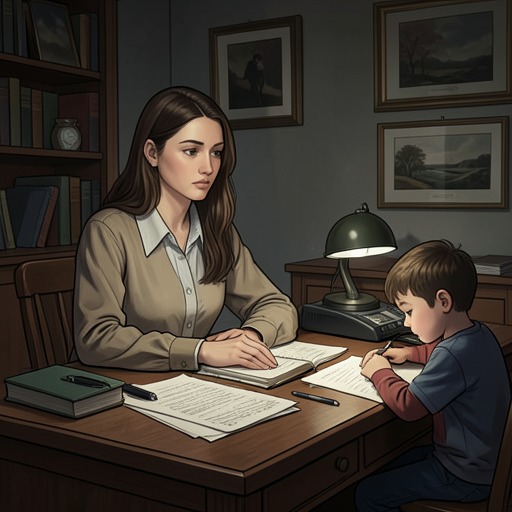
When Jiyoung began elementary school, Eunyoung was put in charge of getting her there. Each morning she checked the timetable, packed her sister’s books, notebooks, and class-announcement log, and prepared a fairy-princess pencil case with one eraser and four pencils. If Jiyoung needed extra supplies, Eunyoung asked their mother for money and bought them at the stationery store by the school gate. This was more than occasional help: Jiyoung’s first routine of school attendance depended on her sister’s attention to small, repeated tasks.
Eunyoung’s care did not always mean that she understood what Jiyoung needed emotionally. When Jiyoung complained about a boy desk-mate who bothered her, Eunyoung dismissed him as immature and advised Jiyoung to ignore him. Their mother likewise treated his conduct as play. The response left Jiyoung without meaningful help, even though her sister was one of the people she turned to. The contrast captures a limitation in their childhood closeness: Eunyoung was practically responsible for Jiyoung, but did not always recognize the seriousness of the experiences Jiyoung reported.
Sisterhood and Unequal Household Expectations
The sisters’ closeness also appears in the ordinary passage into adolescence. Both had their first periods in eighth grade, and Jiyoung expected hers because their physical development had been similar. She used a sky-blue sanitary pad from Eunyoung’s drawer and told her sister. Eunyoung passed the news on to their mother, sparing Jiyoung the uncertainty of how to raise it with the rest of the family. The episode is matter-of-fact, but it shows Eunyoung acting as an intermediary between her younger sister and the household.
A later family meal makes the difference between the girls’ and their brother’s childhood responsibilities explicit. When their younger brother filled his bowl while there was not enough rice for everyone, Eunyoung objected that their mother should serve herself before him. Their mother stroked the boy’s head and defended him as the youngest. Eunyoung answered that she and Jiyoung had been caring for school bags, supplies, and homework from the age of ten, while also mopping floors, hanging laundry, and making food for themselves when they were his age. She named what the family’s explanation obscured: his special treatment was not only because he was the youngest, but because he was the son. Her protest makes visible the unpaid work that had made the girls seem capable while allowing their brother to remain a child.
Education and a Change of Ambition
Eunyoung initially wanted to become a television producer. She had chosen journalism as her major and was already studying previous essay-test materials for the universities she was considering when her mother raised the possibility of teacher training college outside Seoul. The suggestion came amid financial uncertainty: older workers were being laid off, young people were struggling to find jobs, their father’s previously secure employment no longer seemed certain, and the family had two other children to support. Teacher training offered comparatively low tuition and the prospect of stable work. Yet Eunyoung had strong options among Seoul universities, while the cut-off scores for teacher training colleges there had risen beyond her reach.
She rejected the proposal at first. She already had a goal, and did not want to leave home for a university far away. Her mother argued that teaching was an especially secure occupation for women. That practical case did not immediately persuade Eunyoung, and the difference between their positions was more than a disagreement about a degree: her mother was thinking about family security, while Eunyoung was defending a future she had begun to imagine for herself.
Eunyoung later reconsidered. She looked into elementary education, consulted the school careers adviser several times, visited a teacher training college outside Seoul, and brought home an application. When their mother opposed the plan, she did so for a different reason than before. Having herself given up her dreams for family obligations, she understood the regret that can follow a sacrifice made without a real choice. She feared that she was pushing her daughter into the same pattern.
Eunyoung insisted that this was not what was happening. She explained that the television-producer ambition had appealed to her without her knowing much about the work. Since childhood, she had enjoyed reading to her younger siblings, helping them with homework, and doing crafts and drawing with them. Those activities, she said, made teaching seem a better fit. She also saw concrete advantages in the job’s stability and school schedule, and felt drawn to teaching young children. Her decision thus joined personal inclination to practical considerations; it was not simply the fulfillment of her mother’s earlier recommendation.
Leaving Home and the Cost of Choice
Eunyoung applied to the teacher training college she had visited and was accepted, including a place in its dormitory. On move-in day, their mother prepared essential dormitory items and offered advice, while Eunyoung, at twenty, was absorbed in the excitement of leaving. After returning home, their mother bent over Eunyoung’s empty desk and cried. She wondered whether she had made her daughter leave too soon or prevented her from attending the school she had truly wanted. Jiyoung could not tell whether her mother was grieving for Eunyoung or for her own younger self, and tried to console her.
The departure leaves the decision deliberately unsettled. Eunyoung has described a reasoned change of direction, while her mother sees the possibility that family pressures have shaped it more than Eunyoung admits. Neither account cancels the other: Eunyoung’s care for children and enthusiasm for teaching are supported by her own recollection, while her mother’s distress is grounded in the regret of a woman who knows what it means to relinquish a dream.
Narrative Role
Eunyoung’s story links intimate family routines to the broader expectations governing women’s work and care. As a child, she takes on school and household duties; as a young woman, she is urged toward a stable occupation considered suitable for women; and when she chooses that route, her mother fears that a familiar sacrifice is repeating itself. Eunyoung also gives Jiyoung an early example of resistance: she objects when their brother is excused from duties the sisters performed. Her importance lies in this mixture of care, imperfect support, and clear-eyed protest—not in a single, uncomplicated role as either family caretaker or rebel.