Maternal Love as a Moral Mandate
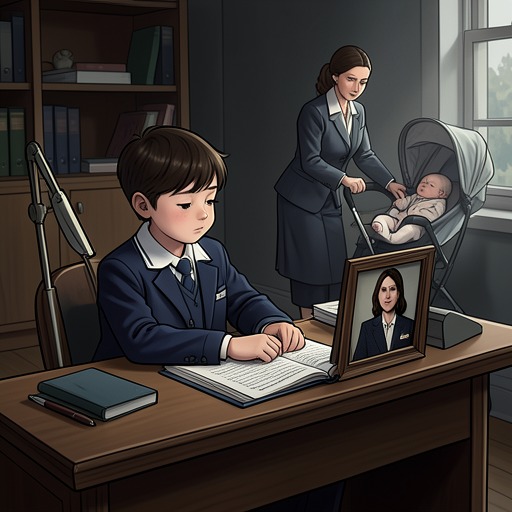
Kim Ji-young, Born 1982Maternal Love as a Moral Mandate is the social expectation that a mother’s devotion should appear as limitless endurance and self-sacrifice. In Kim Jiyoung’s story, the ideal does not simply celebrate affection for a child: it shapes what mothers are expected to bear, how their labor is judged, and whether they feel entitled to admit that parenting is hard. The novel sets the language of noble maternal love against the practical demands of care, showing how praise can disguise unequal responsibility and turn exhaustion into guilt.
An ideal imposed on everyday care
The expectation emerges in ordinary conversations as well as public depictions of motherhood. When Kim Jiyoung worries about combining a career with childcare, Jung Daehyun offers to change diapers, feed the baby, and boil the baby’s clothes. He listens as she describes her anxiety and guilt about relying on someone else for care, then emphasizes the meaning of becoming a parent and says that she need not keep working if the family cannot arrange childcare. His offer is affectionate, but its language casts his contribution as help, while Kim Jiyoung is already measuring whether she can meet the demands of both paid work and parenting.
After the birth of Jung Jiwon, those demands become concrete. The baby cries until picked up, and Kim Jiyoung fits household tasks, meals, and naps around holding her. She breastfeeds every two hours, cannot sleep for more than two hours at a time, washes the baby’s clothes and bedding, and cleans the house more thoroughly than before. She cries more than she ever has and is in pain throughout her body. These details make visible the work that idealized accounts of motherhood can leave out: care is repetitive, physically demanding, and difficult to set aside, even when a mother loves her child.
Praise, silence, and inherited experience
Kim Jiyoung’s mother praises her as a frail young woman who has given birth, breastfed, and raised a baby without her mother’s help, describing this as the power of maternal love. Kim Jiyoung answers by asking whether raising several children had been difficult and whether her mother had ever regretted having so many. The questions shift the exchange away from an image of effortless devotion and toward the mother’s own experience.
Her mother recalls that Kim Jiyoung’s older sister cried constantly, that she repeatedly took the child to the hospital, and that she cared for three children while their father never changed a diaper and their grandmother expected three meals at home every day. She remembers being exhausted and in pain. Yet Kim Jiyoung had not heard this history from her mother, relatives, or friends who had children. In the stories and images around her, babies were cute and mothers beautiful and noble. Against that polished picture, her own fatigue seemed like a shortcoming. Being told that she was admirable did not comfort her; it made her feel guilty for being exhausted.
The practical circumstances of support sharpen this contrast. Kim Jiyoung’s mother cannot help her recover after pregnancy because the porridge shop is short-staffed and she is working longer hours. The shop supports Kim Jiyoung’s younger brother’s continued education, and her mother brings leftovers when she can. Her care is real, but it has to be fitted around her own labor and family obligations. Maternal devotion does not remove those constraints; the ideal can instead make the work and its limits harder to acknowledge.
Birth choices and the demand to endure
The novel also connects the mandate to public arguments about childbirth. After documentaries and publications helped popularize natural birth, its appeal centered on minimal medical intervention and a supposedly natural process in which mother and baby made their own decisions. Kim Jiyoung chooses a hospital birth with professional assistance because she believes it is safer. For her, a birth plan depends on parents’ values and circumstances; it should not serve as a measure of a mother’s worth.
Some media accounts, however, emphasize speculative possible harms from medical treatment and medication for newborns, stirring fear and guilt. The resulting double standard is pointed: people may seek pain relief for a headache or a minor procedure, while women giving birth are expected to endure pain, exhaustion, and fear willingly. The novel’s sarcastic comparison to religious doctrine exposes the moral pressure hidden inside this expectation. If suffering is treated as evidence of love, choosing medical support can be made to seem like a failure of devotion, even when a mother has chosen it for safety.
The wider cost of the ideal
The book’s closing medical perspective broadens the issue beyond Kim Jiyoung’s experience. Her psychiatrist initially interprets her symptoms as postnatal depression that has progressed into childcare depression, but, as he hears her life history, he begins to question how hastily he formed that diagnosis. He recognizes a world he had not understood and reflects that his awareness came through following his wife’s successive compromises in her medical career, from seeking an academic position to working on contract and ultimately giving up her career.
His account of their son’s difficulties at school further shows how childcare expectations fall unevenly. When the boy’s teacher recommends that his mother stay home, she suspends her work and takes on the daily tasks of preparing him, getting him to school, arranging lessons, and sleeping in his room. She later tells her husband that he cannot confidently judge the child when he spends so little time with him and remains occupied with his phone. Her rebuke makes attentive care and the authority to interpret a child’s needs inseparable: the parent doing the work has knowledge the absent parent lacks.
Together, these episodes distinguish love from the demand that love must look like limitless self-denial. Kim Jiyoung cares for her child, and her mother has cared for hers, but neither affection nor praise distributes the work fairly or supplies the support families need. By placing intimate acts of care beside public ideals and a clinician’s belated recognition, the novel shows how the language of maternal love can both honor mothers and silence the truth of what motherhood costs.