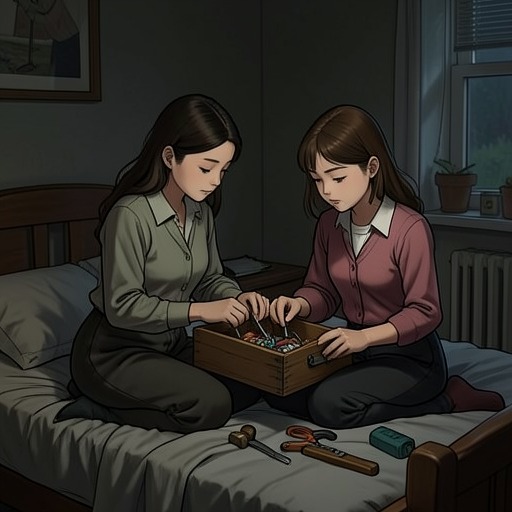
Son Preference in South Korea
Kim Ji-young, Born 1982Son Preference in South Korea is a recurring social pressure in Kim Jiyoung’s family and adult life, not merely an expectation about which children a family should have. It is expressed in the promise that another pregnancy will produce a boy, in the unequal value attached to sons and daughters, and in the costs women are expected to absorb when marriage and childcare reshape their lives. Its force lies partly in how ordinary it is made to seem: family affection and practical decisions coexist with assumptions that daughters should yield and that mothers should carry the greater sacrifice.
Family Expectations Across Generations
Koh Boonsoon’s belief in the need for sons grows out of a hard life and a family structure that has not delivered what she expected. Her husband did not support the household through work, and of the four sons she raised, Kim Jiyoung’s father was the only one who fulfilled his responsibilities toward her in old age. Yet Koh interprets the care she receives as a benefit of having had four sons. In fact, Oh Misook, her daughter-in-law, prepares her warm meals and bedding. Koh credits her son for that labor and urges Oh Misook to have at least two sons, presenting the preference as advice given for the younger woman’s sake.
The births of Kim Eunyoung and Kim Jiyoung make the expectation visible in the women’s responses. Each time Oh Misook holds a newborn daughter, she weeps and apologizes to Koh Boonsoon. Koh answers warmly that the next child will be a boy: after Eunyoung, she predicts a boy in the second pregnancy; after Jiyoung, she makes the same prediction about a third. Her tenderness does not remove the pressure. The girls’ arrival is treated as a disappointment that must be answered by another pregnancy, while the hoped-for son remains the measure by which the family’s future is imagined.
Pregnancy and the Cost of Son Preference
When Oh Misook becomes pregnant again less than a year after Jiyoung’s birth, she dreams of a large tiger entering the home and believes the child will be a boy. The doctor’s examination instead indicates that the fetus is female. Against the background of the South Korean Family Planning Policy, the book describes sex identification and abortion of female fetuses as common practice. In the early 1990s, when the imbalance in the male-to-female birth ratio was at its height, the ratio for third children and beyond exceeded two to one.
Oh Misook goes to a clinic alone and has an abortion. The narrative makes clear that responsibility for this outcome does not belong to her alone, even though she bears the physical and emotional burden without family support. The doctor offers comfort, and the account presents that compassionate response as helping her endure the experience. Years pass before she becomes pregnant again; this time, the child is a boy, Kim Jiyoung’s brother, born five years after Jiyoung. The sequence gives the preference a concrete consequence: the anticipated son is not simply a family hope but a standard that can determine which pregnancies continue and who is left to carry the distress.
Sons, Daughters, and Everyday Treatment
The same hierarchy appears in an ordinary meal. When Kim Jiyoung is in eighth grade, she tells Kim Eunyoung that her first period has begun. Their father is late, there is not enough rice for everyone, and their mother and three children share ramen alongside the remaining rice. Their younger brother fills his bowl first. Eunyoung objects that their mother should be served before him, fills their mother’s bowl, and takes some of her brother’s noodles. Their mother then gives her own noodles to her son.
The exchange turns on the explanation that he is the youngest. Eunyoung rejects that as the real reason for his favored treatment: he is the son. She leaves the table in anger, while Kim Jiyoung hesitates over her food and their mother neither comforts Eunyoung nor openly rebukes her. The scene places gender preference inside household routine: food is scarce, a daughter challenges the distribution, and the mother’s action restores the son’s advantage. The expectation is reinforced not only through explicit statements about future births but through repeated choices over whose needs come first.
Motherhood, Work, and Unequal Sacrifice
As an adult, Kim Jiyoung encounters the same preference while pregnant with Jung Jiwon. After an insulting remark on the subway makes her leave the train and take a cab, an obstetrician confirms that she is having a girl and advises the couple to buy pink clothes. Kim Jiyoung and Jung Daehyun have no preference for a child’s sex, but they anticipate that family elders expect a boy. Kim Jiyoung’s mother again predicts that the next child will be male; Daehyun’s mother says she does not mind. Kim Jiyoung does mind. She also hears women of her own generation describe relief at having a boy, greater standing with in-laws, or permission to indulge in expensive food once they learned they were expecting a son. She wants to claim that she too can hold her head high, but keeps the response to herself to avoid sounding bitter.
The pressure around having a child is bound up with a separate but related inequality: the expectation that Kim Jiyoung will give up more of her life to care for one. Before pregnancy, she worries that she may not be able to maintain her career while raising a child. Daycare and babysitters seem insufficient for a couple who work late and on weekends, and their parents cannot provide the needed help. When Jung Daehyun offers to help with diapers, feedings, and laundry, she asks what he will give up. She names her youth, health, job, colleagues, social networks, career plans, and future as things placed at risk. His anticipated sacrifices—fewer evenings with friends, less freedom to attend work dinners or work late, and more housework—strike her as much smaller.
Near the due date, the couple writes out three plans: an immediate return to work, returning after a year of maternity leave, or not returning. They consider childcare responsibilities, costs, and practical advantages and disadvantages. Sending the child to Daehyun’s parents in Busan is not feasible because they are elderly and his mother has had back surgery; a live-in nanny would be costly and would become part of the household’s daily life. They conclude that one parent must stay home. Daehyun’s work is more stable and better paid, but the account also identifies the gender convention behind the decision: husbands more commonly work while wives raise children and run the home. Kim Jiyoung becomes the person expected to leave employment. The decision is made together, but the burden is not shared equally.
After Jung Jiwon starts daycare shortly after turning one, the apparent gain in Kim Jiyoung’s free time is largely consumed by housework. Jiwon attends from 9:30 in the morning and returns before one; the remaining time is spent on laundry, dishes, tidying, and preparing food. Statistics cited in the narrative put a stay-at-home mother with a child under two at four hours and ten minutes of personal time each day, compared with four hours and twenty-five minutes for a mother whose child attends daycare. The fifteen-minute difference exposes how little respite childcare arrangements necessarily create when domestic work remains the mother’s responsibility.
Domestic Labor and the Persistence of the Norm
The expectations placed on mothers are reinforced by the way domestic work is described and valued. When Kim Jiyoung seeks help for wrist pain, a doctor dismisses her complaints by comparing modern housework with the harder physical labor women performed in the past and pointing to appliances such as washing machines and vacuum cleaners. Her own unspoken objection is that appliances do not load themselves, complete every step of the laundry, or clean and maintain themselves. The technology reduces some exertion but does not remove the work.
The narrative also notes the opposing language used for housework: it may be demeaned as idleness or praised as work that sustains life, while its monetary value goes uncalculated. That omission helps make women’s labor appear available without cost. Kim Jiyoung’s mother, meanwhile, cannot help her daughter recover after pregnancy because she is working longer hours at her porridge shop, whose business has weakened as other restaurants move into the building. She brings leftovers when she can, but her labor is also needed to support Kim Jiyoung’s younger brother, who is extending his education. Across generations, women’s work is treated as a resource for family survival, while the expectation of sons persists alongside the unequal assignment of care. The book thus connects son preference to a wider pattern: daughters and mothers are asked to accommodate family needs, even when the work and sacrifices that sustain the household remain largely unrecognized.