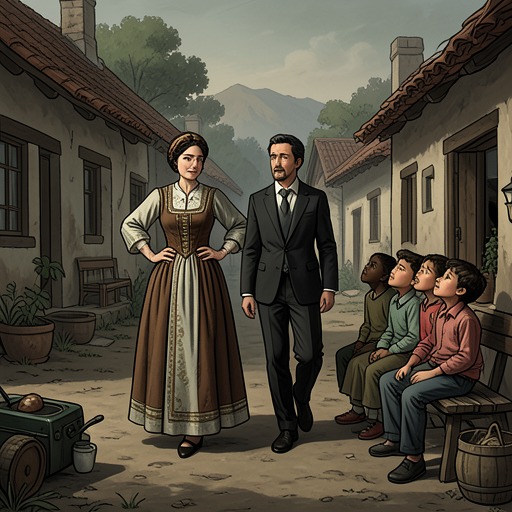
South Korean Family Planning Policy
Kim Ji-young, Born 1982South Korean Family Planning Policy, introduced to keep population growth under control, forms the historical backdrop to a family’s experience of son preference and sex-selective abortion. The policy’s name suggested neutral population management, but the narrative describes a setting in which the fetus’s sex could determine whether a pregnancy continued. Its consequences reach beyond one reproductive decision: the burden falls on Oh Misook, while later episodes in Kim Jiyoung’s life show gendered expectations continuing through education, employment, marriage, and childcare.
Policy and Historical Context
The government implemented birth-control measures under the label family planning. In the account, abortion for medical problems had been legal for ten years, while checking fetal sex and aborting female fetuses had become common. The juxtaposition makes visible how a practice framed around population management could operate alongside son preference: being a daughter was treated as though it were a medical problem.
Sex-selective abortion continued through the 1980s. In the early 1990s, at the height of the imbalance in the male-to-female birth ratio, the ratio for third children and later births exceeded two to one. These figures place individual family decisions within a wider pattern. They also mark the unequal stakes attached to birth order and sex, rather than presenting Oh Misook’s experience as an isolated misfortune.
Oh Misook’s Experience and Its Aftermath
Oh Misook went to a clinic alone and underwent an abortion because the fetus was female. The account describes the responsibility and physical and emotional pain as falling on her, without family members present to comfort her. A doctor held her hand and expressed sympathy for her loss. The doctor’s recognition of that loss helped Oh Misook endure the experience; the narrative specifically credits the encounter with helping her avoid a psychological collapse.
Years passed before Oh Misook became pregnant again. The child was a boy, who survived and became the brother five years younger than Kim Jiyoung. This later birth does not undo the earlier loss. Instead, the contrast brings the gendered pattern into focus: the missing younger sister and the eventual son occupy different places in a family shaped by the preference for boys.
Gendered Expectations Beyond Reproductive Policy
The book places this history beside ordinary institutional routines that privilege boys, without claiming that the family-planning program alone caused them. At school, boys were placed first on class rosters and routinely led processions, gave presentations, and had their homework checked before girls. Kim Jiyoung and her classmates could challenge an unfair lunch-line arrangement, yet still took the boys’ precedence in other settings as natural. The contrast shows how gender hierarchy can persist as routine even where it is not openly defended.
Later, Yun Hyejin explains that unofficial recruitment recommendations through university departments sometimes went to male students only. She recounts the case of a highly accomplished woman passed over for interviews in favor of four men; when the graduate challenged the decision, she received justifications invoking employers’ preferences, men’s military service, and men as future household heads. This is not a direct consequence of family-planning policy, but it extends the article’s central context: son preference belongs to a larger social order that assigns men and women unequal value and expectations.
Marriage, Childbearing, and Unequal Costs
The same assumptions surface when Kim Jiyoung and Jung Daehyun discuss whether to have a child. Kim Jiyoung worries about bodily changes, the demands of childcare, and whether she could keep her career. Because both spouses work late and on weekends, daycare or a babysitter would not, in her view, solve the problem; their parents could not take on the care either. Jung Daehyun offers to change diapers, feed the baby, and wash baby clothes, but Kim Jiyoung asks what he would give up in return. She names her youth, health, job, colleagues, social networks, career plans, and future as things placed at risk. His anticipated losses, including fewer evenings with friends and the responsibility of financial support, seem much smaller to her than the potential disruption to her life.
As the due date approaches, they compare three plans on a large sheet of paper: returning to work directly, returning after a year of maternity leave, or not returning. Continuing to work would mean sending the child to Jung Daehyun’s parents in Busan or hiring a live-in nanny. His parents are elderly, and his mother has recently had back surgery; a nanny would bring substantial cost and another person into the household’s daily life. They conclude that one parent must stay home. Jung Daehyun’s job is more stable and better paid, and the convention that husbands work while wives care for children points the decision toward Kim Jiyoung. The process is presented as discussion and calculation, but its available choices and their unequal consequences are already shaped by gender and work.
Care Work and the Policy’s Wider Significance
The decision to stay home links the historical reproductive context to the less visible labor of raising a child. When Jung Jiwon starts daycare shortly after turning twelve months old, Kim Jiyoung has about three hours to herself between drop-off and pickup. Most of that time goes to laundry, dishes, tidying, and preparing food and snacks. Statistics cited in the account put the daily time available to a stay-at-home mother with a child under two at four hours and ten minutes, compared with four hours and twenty-five minutes for a mother whose child attends daycare. The small difference underscores that daycare changes where housework happens more than it removes the work.
Kim Jiyoung also encounters the dismissal of domestic labor as easy because machines have replaced older forms of physical work. The narrative counters that reasoning by distinguishing the machine’s operation from the tasks of loading, unloading, hanging, and cleaning up. Domestic work may be described either as idleness or as indispensable labor, but its monetary value is rarely calculated. That invisibility helps explain why childcare and household responsibility can be treated as a mother’s natural obligation rather than as work with costs to divide.
South Korean Family Planning Policy is therefore significant not only as a government population-control program, but as part of the historical setting in which reproductive decisions were made under son preference. The narrative follows that setting into later family and workplace arrangements without equating them: the imbalance at birth, boys’ priority in school, discrimination in hiring, and women’s disproportionate responsibility for care are distinct practices. Together they show how gender hierarchy can move between public policy, routine procedures, and intimate choices, while the consequences repeatedly settle on women.