
The Cost of Becoming a Mother
Kim Ji-young, Born 1982This flow follows Kim Jiyoung’s transition into motherhood, tracing how reproductive expectations, childbirth, unpaid care, and lost work accumulate into a constrained and emotionally fraught new life.
increasing Bearing strength in each event
 decreasing
Bearing strength in each eventdecreasingMotherhood as Assumed Destiny

Motherhood as Assumed Destiny
Family Pressure
After Kim Jiyoung and Jung Daehyun marry, relatives begin asking when they will have a child. During a family gathering, they speculate about Kim Jiyoung’s fertility and offer explanations for why she has not become pregnant, despite her saying that they are not yet planning a child.
The exchange makes clear that her reproductive choices are treated as family business. Jung Daehyun stays quiet to avoid conflict, leaving Kim Jiyoung to absorb the scrutiny and defend herself through politeness.
Unequal Calculation
On the drive home, Jung Daehyun apologizes and suggests having a child partly to stop his parents’ questions. Kim Jiyoung instead considers pregnancy, childcare, and the effect of parenthood on a career she wants to keep.
When she asks what Jung Daehyun would give up, his examples concern socializing and work routines, while she names her health, career, and future. The contrast makes the unequal stakes visible before they make their decision.
Pregnancy Under Scrutiny

Pregnancy Under Scrutiny
The Expected Son
Family members anticipate that Kim Jiyoung will give birth to a boy. When the doctor reveals that the baby is a girl, the older generation responds with comments implying that a son might come next or that the result is acceptable only because they supposedly do not mind.
Kim Jiyoung minds. The remarks revive a familiar hierarchy in which a daughter’s arrival requires consolation or explanation, and she must hold back her objections to avoid sounding resentful.
Public Judgment
Pregnancy also makes her body and labor newly visible. A coworker treats a schedule adjustment as a perk, while strangers on crowded transit offer uneven consideration and scrutinize her choices.
These moments do not amount to one continuous confrontation, but together they reveal how a pregnant woman can be expected to endure discomfort quietly while proving that she is not taking unfair advantage.
The Career Decision
The Career Decision
Few Practical Options
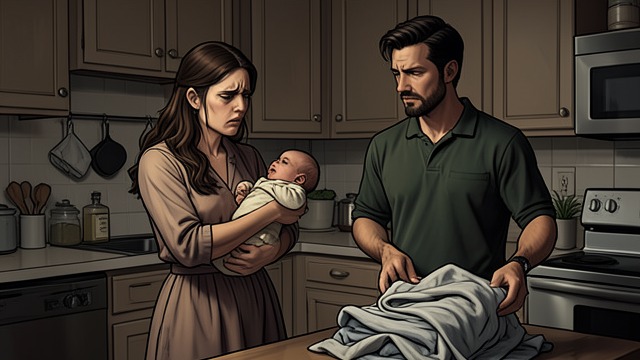
As the due date approaches, Kim Jiyoung and Jung Daehyun compare returning to work immediately, taking leave, or leaving employment. Their available arrangements offer no workable balance: sending the child to relatives in Busan is impractical, and a live-in caregiver raises questions of cost, privacy, and trust.
They conclude that one parent must stay home. Jung Daehyun’s job is more stable and better paid, while the prevailing family arrangement makes Kim Jiyoung’s withdrawal from work seem like the obvious answer.
The Meaning of Help
Jung Daehyun promises to help with the baby and chores, but his language intensifies Kim Jiyoung’s frustration. She points out that the home and child are shared responsibilities, not her private work to which he occasionally contributes.
She apologizes after the argument, but the underlying imbalance remains. The decision is described as mutual, yet it is Kim Jiyoung who is asked to surrender the career she enjoys.
Birth and Physical Cost
Birth and Physical Cost
Labor and Delivery
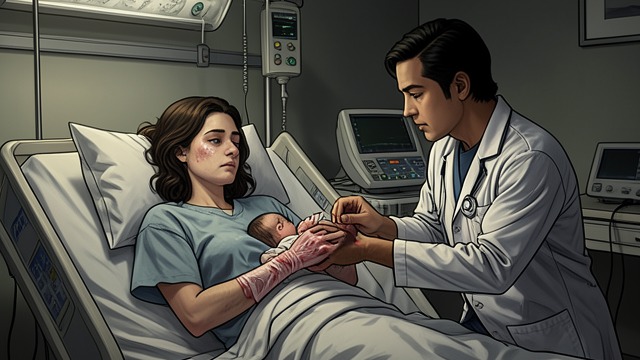
After a long labor and an induction, Kim Jiyoung gives birth to Jung Jiwon. The child’s arrival brings immediate tenderness, but the birth is physically demanding and the early weeks offer little time for recovery.
Jung Jiwon cries frequently, feeds every two hours, and must be carried through much of the day. Kim Jiyoung cleans, washes, feeds herself to support breastfeeding, and sleeps in fragments while her body remains in pain.
Domestic Work Dismissed
When Kim Jiyoung seeks treatment for inflamed wrists, a doctor minimizes her condition by comparing modern housework unfavorably with the physical labor of the past. His remark overlooks the work that machines do not perform: sorting, loading, hanging, cleaning, and maintaining a household.
Kim Jiyoung recognizes that domestic labor is alternately dismissed as idleness or praised as noble service, but rarely treated as work with measurable value. Her exhaustion is real even when others describe it as ordinary maternal duty.
A Life Narrowed by Care
A Life Narrowed by Care
Limited Time Away
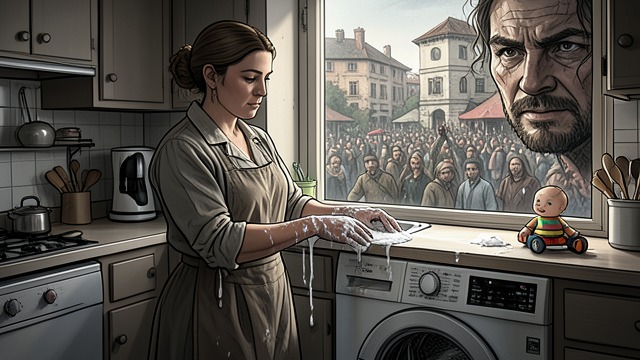
When Jung Jiwon begins daycare, Kim Jiyoung gains a few hours without the child beside her. Most of that time is consumed by laundry, dishes, tidying, and preparing food, so daycare changes the setting of her labor more than it provides rest.
Rising housing and education costs give her additional reason to seek income. Yet the jobs she can realistically consider must fit around childcare, and many options offer little security or path for advancement.
A Frustrated Return
An ice-cream shop offers a part-time position with suitable hours, but Kim Jiyoung does not want the work and sees no future in it. At the same time, returning to reporting would require classes and childcare she cannot readily arrange.
Her search stalls between work she does not want and aspirations she cannot accommodate. The narrowed choices deepen the sense that becoming a mother has restricted not only her employment but also her ability to imagine a future on her own terms.
2012–2013, after marriage
During Kim Jiyoung’s pregnancy, 2014
Late pregnancy, shortly before the birth in 2014
Early 2015, Jung Jiwon’s birth
2015, after Jung Jiwon starts daycare
