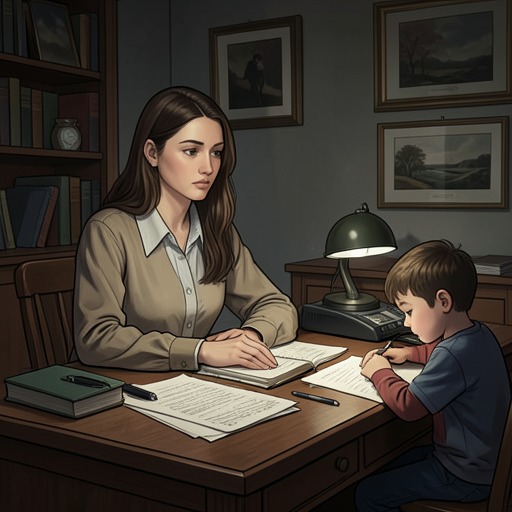
Jiyoung’s Psychiatric Diagnostic Reassessment
Kim Ji-young, Born 1982Jiyoung’s Psychiatric Diagnostic Reassessment marks a shift from treating Kim Jiyoung’s distress as a familiar postpartum condition to questioning how much of her suffering a diagnosis alone can explain. As treatment continues, the psychiatrist listens to her recollections, revisits his own assumptions about domestic work and motherhood, and recognizes that he may have mistaken a complex life for a straightforward clinical case.
Clinical course and changing diagnosis
In 2016, the psychiatrist describes Kim Jiyoung’s history as reconstructed from her account and her husband Jung Daehyun’s. She attends 45-minute appointments twice a week. Her symptoms have become less frequent, but they have not disappeared; to address depression and insomnia, he prescribes antidepressants and sleeping pills. Treatment is underway, but improvement in frequency does not settle the question of what her condition means.
Before meeting her, he had suspected dissociative disorder after hearing Jung Daehyun describe her symptoms, a condition he had previously encountered only in case studies. After his initial session with Kim Jiyoung, however, he concluded that she had a typical case of postnatal depression that had progressed into childcare depression. As the sessions continue, his confidence in that diagnosis fades. He does not decide that his first assessment was simply false. Rather, he recognizes that it may have been hasty, and that the scenes Kim Jiyoung chooses to recount do not fit comfortably inside the explanation he began with.
Her manner in the sessions complicates any easy account of what he is hearing. He does not describe her as guarded or antagonistic, and she does not repeatedly complain about the injustice of her present circumstances or dwell on childhood trauma. She needs encouragement to begin, but once she does, she retrieves long-buried memories herself and describes them calmly and logically. The reassessment grows from this contrast: a patient who does not present her suffering as a complaint nevertheless recounts a sustained history that changes how her doctor understands it.
The life behind the symptoms
The earlier decision to seek help begins with Jung Daehyun’s concern. He visits the psychiatrist alone to discuss his wife’s symptoms and treatment options, then tells her he has booked a therapy session because she has not been sleeping well and seems stressed. Kim Jiyoung appears not to recognize the condition he is worried about, but thanks him and says she has been feeling blue and enervated; she suspects maternity blues. The exchange sets out two perspectives without making them identical: her husband sees a need for care, while she names a possible explanation for how she feels.
Her memories of paid work show that distress cannot be separated from the conditions in which she has had to work. At the marketing agency, she likes her colleagues and adjusts relatively well to the job itself, but interactions with reporters and client-company staff remain awkward and wearing. Older male clients repeatedly subject her to jokes she cannot comfortably answer: laughing encourages them, while not laughing prompts them to ask what is wrong. At a business dinner, client managers steer her into the seat beside a division head despite her repeated insistence that she would rather sit with her colleagues. He makes comments about her appearance and sex life, presses her to drink, and she secretly empties her beer into the other cups and bowls on the table. These episodes make the pressure to manage other people’s reactions part of the work she is recalling, not a symptom that can be understood in isolation.
Domestic labor provides another point of friction between the psychiatrist’s assumptions and Kim Jiyoung’s account. When she says that she cannot rest her wrists because she must care for the baby, do the laundry, and clean, he responds by comparing modern appliances with the harder physical methods women used in the past. Her unspoken rebuttal is practical: washing machines do not load, unload, or hang the laundry, and vacuum cleaners do not wipe floors or clean their own rags. The narrative extends the contrast to other work that technology has made less physically demanding, arguing that domestic labor is still unusually liable to be dismissed or idealized rather than valued in monetary terms. That observation supplies a social context for what the clinical encounter risks overlooking: appliances may change the tools, but they do not remove the labor or decide who must perform it.
Caregiving, time, and the doctor’s blind spots
The daycare routine makes that labor measurable. After Jung Jiwon starts daycare a little past twelve months, she is dropped off at 9:30 in the morning, has a snack and playtime, eats lunch, and returns before 1 p.m. The arrangement gives Kim Jiyoung about three hours without her child, but most of that interval goes to laundry, dishes, tidying, and preparing food and snacks. She has hardly a moment to sit with coffee. The broader statistics cited in the account estimate that a stay-at-home mother with a child under two has four hours and ten minutes a day to herself, compared with four hours and twenty-five minutes for a mother whose child attends daycare: a difference of only fifteen minutes. Daycare changes whether a mother does household work with her baby beside her, not whether the work is waiting.
The psychiatrist’s reassessment also draws on his own family, which makes his change in perspective personal without turning it into an answer for Kim Jiyoung’s case. He reflects that, as an average man in his forties, he might have gone through life without understanding women’s experience, especially that of mothers. His wife had moved from pursuing a tenure-track professorship in ophthalmology to contract work and, eventually, giving up her career. With the couple’s parents living far away, she relied on a succession of nannies while continuing to work. When their son’s behavior at school raised a question of ADHD, she challenged the psychiatrist’s confidence: he could not know the boy’s condition from only a few minutes together each day, especially while looking at his phone. He accepts that her criticism is true. She then suspends her work to manage the child’s routines and care; after arranging a possible return with a senior colleague, she calls to cancel because their son has not improved.
A related blind spot appears in the psychiatrist’s response to a clinic employee, Lee Suyeon. After six years of marriage and years of trying to conceive, she becomes pregnant but is warned that the pregnancy is unstable; following several scares, she gives up her job temporarily. The psychiatrist initially wonders why she could not take only a couple of months off. Although he recognizes her as an excellent employee, he focuses on the patients who leave rather than transfer to another counselor, calling her departure a loss to the clinic. He concludes that he should replace her with an unmarried employee. The thought reveals how readily a professional workplace can treat pregnancy and childcare as a problem caused by women employees, even as the psychiatrist is beginning to see the unequal conditions behind such decisions.
Significance and unresolved outcome
The reassessment does not announce a definitive replacement diagnosis or claim that treatment has ended. Instead, the psychiatrist records a more limited but consequential realization: he is not necessarily saying his earlier judgment was wrong, but he has become aware of a world he had not known. Kim Jiyoung’s calm, detailed recollections, the daily work that appliances do not abolish, and the career compromises of women close to him all unsettle the apparent simplicity of his first diagnosis.
That change in awareness is part of the event’s significance. Clinical care can address depression and insomnia, and the psychiatrist continues to prescribe medication and see Kim Jiyoung regularly. Yet his own account shows how treatment can narrow a social history into an individual condition if the clinician does not notice the labor, gendered expectations, and caregiving arrangements surrounding the patient. The reassessment does not erase the diagnosis; it makes the psychiatrist less certain that the diagnosis, by itself, is an adequate account of her life.