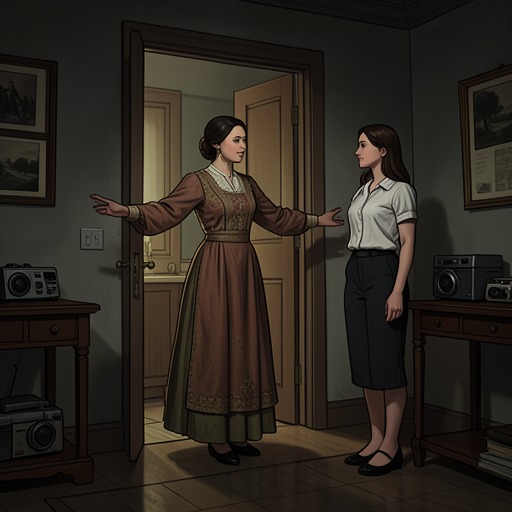
Kim Jiyoung–Jung Daehyun marriage
Kim Ji-young, Born 1982Kim Jiyoung and Jung Daehyun’s marriage is marked by real care and attempts at compromise, yet its most consequential choices repeatedly place the cost of family life on Jiyoung. As they navigate her distress, his family’s expectations, parenthood, and financial pressure, the difference between supporting a partner and sharing responsibility becomes central to their relationship.
Marriage and Everyday Circumstances
In autumn 2015, Jiyoung is thirty-three, or thirty-four by Korean age. She and Daehyun have been married for three years and live with their young daughter, Jung Jiwon, in a small rented apartment on the outskirts of Seoul. Daehyun, thirty-six, works for a mid-size IT company; Jiyoung left a small marketing agency shortly before her due date. His work often keeps him out until around midnight, and he goes to the office on at least some weekends. Her parents run a restaurant, while Daehyun’s parents live in Busan, leaving Jiyoung as Jiwon’s sole caretaker during the couple’s ordinary working days.
Their marriage contains tenderness, not simply conflict. One evening, after Jiwon has gone to sleep, they drink beer together for the first time in a while. Jiyoung, speaking as though she were her friend Cha Seungyeon, tells Daehyun that he should regularly reassure his wife that she is doing well, working hard, and appreciated. Daehyun responds affectionately, pinching Jiyoung’s cheek and telling her that he loves and appreciates her. The gesture does not settle the strain: she swats his hand away, irritated by the way he treats her as the lovestruck young woman Seungyeon once was. The scene sets care and misattunement beside each other—he offers affection, while she signals that the present demands more than a fond recollection of their past.
Family Expectations and Conflict
A visit to Daehyun’s family exposes a similar gap between his wish to preserve family harmony and Jiyoung’s need to be treated as an equal member of the family. When his father rebukes her for raising a complaint in front of elders, Daehyun tries to explain, but cannot find a way to begin. Jiyoung speaks for herself: holidays are occasions for her family to gather as well, and their daughter should be allowed to visit Jiyoung’s family when Daehyun’s daughter comes to see him. Daehyun eventually covers her mouth and takes her out of the room. He then tells his parents and sister that she is unwell and promises to explain later. His response protects her from the immediate argument by attributing her words to illness, but it also leaves her point about whose family gets priority unanswered.
Another visit to Busan turns on relatives’ comments about fertility. When Daehyun’s aunts suggest that his mother should give Jiyoung herbal medicine, Jiyoung keeps her objections to herself and says that it is all right. On the drive home, however, she tells Daehyun through her hurt and anger that he remained silent while his family treated her as though something were physically wrong with her. He says he did so to avoid inflaming the situation and calls her response an overreaction. The drive back to Seoul passes without a stop; only after they reach the apartment’s underground parking lot does he break the silence. He recognizes that he should defend her when his family is unfair, since he is more at ease with them than she is, and apologizes. The exchange shows both the injury caused by his initial silence and his capacity to reconsider it.
Parenthood and the Unequal Cost of Care
The couple’s decision about having a child begins from an assumption that parenthood is the natural next step after marriage, but Jiyoung experiences it as a much less casual choice. She worries about how pregnancy might change her body and whether she can keep her career while raising a child. Because both spouses work late and on weekends, she doubts that daycare or a babysitter alone will solve the problem; neither set of parents is readily available to take over. She also feels guilty for contemplating outside care before the child is even born. Daehyun listens as she explains these anxieties and promises to handle diapers, feedings, and washing the baby’s clothes. He urges her to consider what parenthood might give them, and says that if childcare cannot be arranged, she need not keep working because he will support the family. Jiyoung asks what he, in turn, will give up.
As her due date approaches, they make the question concrete on a large sheet of paper, comparing a return to work soon after birth, a return after a year of maternity leave, and not returning at all. They list childcare responsibilities, costs, and advantages and disadvantages. If both work, the options are sending the child to Daehyun’s parents in Busan or hiring a live-in nanny. His parents are willing, but elderly, and his mother has recently had back surgery. The couple is reluctant to bring a nanny into their household routine, and the expense and uncertainty of long-term care weigh on the decision. They conclude that one parent must stay home. Daehyun’s job is more stable and pays more, but the expectation that husbands work while wives raise children makes Jiyoung the presumed person to leave her job.
Daehyun continues to describe his proposed contributions as assistance: he will help with chores, raising the baby, and Jiyoung’s search for new work. Jiyoung objects that the home and child belong to both of them, and that if she works, her pay also supports their household. Her frustration is not with the idea of cooperation but with the suggestion that shared obligations are principally her work and his optional contribution. She apologizes after snapping at him, and he accepts the apology without escalating the argument. Even so, the exchange reveals how easily a supportive intention can preserve an unequal division when the underlying responsibility is not treated as mutual.
Jiwon is born at four in the morning. Jiyoung cries with joy, but the days that follow are physically punishing: the baby cries until picked up, breastfeeding recurs every two hours, and Jiyoung does housework, eats, uses the toilet, and naps while holding her. Her wrists become inflamed. When a doctor dismisses her complaint by contrasting modern appliances with the heavier labor women performed in the past, Jiyoung recognizes that a washing machine does not load itself, and a vacuum does not complete every task around cleaning. The episode makes the hidden work in their household visible: even when domestic labor uses machines, someone must still perform and organize it. Jiyoung’s mother cannot help her recover because she is working long hours at the family porridge shop, though she brings leftovers when she can. Material limits therefore narrow the couple’s choices along with gender expectations.
Work, Money, and the Marriage’s Wider Context
The decision that Jiyoung should leave work is made within a labor market where her prospects were already constrained. Before applying for jobs, she is more hopeful than her study-group friend Yun Hyejin, who has stronger qualifications but doubts she will find secure employment. Hyejin points to the absence of women among the alumni appearing at job fairs. In the year Jiyoung graduated, women made up only 29.6 percent of new employees at one hundred companies, a figure presented as a substantial improvement; a separate survey found that 44 percent of recruitment managers at fifty large corporations preferred a male candidate when qualifications were equivalent. This background does not determine the couple’s decision by itself, but it helps explain why Jiyoung’s paid work and future re-entry cannot be treated as interchangeable with Daehyun’s more stable income.
The household’s financial pressure grows after the lease on their flat expires. The landlord raises the deposit by 60 million won, forcing them to borrow again. They cannot afford to buy a home for three people on Daehyun’s income alone, and they anticipate further costs when Jiwon begins kindergarten and after-school programs. Jiyoung feels pressure to earn, even as childcare narrows the jobs available to her. She knows mothers who return through freelance work, tutoring, or part-time service jobs. Reports describe how many women who leave employment remain unable to find work for more than five years; those who do return often enter smaller workplaces or lower-paid roles than before childbirth. The choice to leave a marketing job thus carries a risk that a later return will not restore the same professional position.
When Jiwon starts daycare just after turning twelve months old, she adjusts well. Her morning routine runs from drop-off at 9:30 to return before 1 p.m., leaving Jiyoung approximately three hours without the baby. Most of that time goes to laundry, dishes, tidying, and preparing food; she can barely sit down for coffee. Statistics cited in the narrative put the daily free time of a stay-at-home mother with a child under two at four hours and ten minutes, compared with four hours and twenty-five minutes for a mother who uses daycare. The small difference underlines that daycare changes whether a mother does housework alongside her child, not whether the work disappears. Daycare gives Jiyoung some relief and makes her consider starting something new, but it does not by itself undo the career interruption or redistribute domestic labor.
Significance of Their Negotiations
Jiyoung and Daehyun’s marriage is presented through negotiations whose consequences are not evenly shared. Daehyun offers affection, listens when Jiyoung explains her fear, and eventually apologizes after failing to defend her. Yet his long working hours, the stability and higher income of his job, family expectations, and the common assumption that a wife will stay home all give their compromises a direction: Jiyoung’s work and time are the more readily surrendered resources.
Their disagreements make the distinction between a couple agreeing on a decision and sharing its costs especially clear. They discuss childcare scenarios together, but Jiyoung leaves her job, performs the daily care, and bears the immediate bodily consequences of childbirth. The financial need for her to earn remains even while the unpaid work that limits her available time continues. In this way, the relationship is neither reduced to a lack of love nor resolved by good intentions. Its central tension lies in how care is expressed, who is expected to organize it, and whether work described as assistance can become genuinely shared responsibility.