Kim Jiyoung’s Chuseok conflict with her in-laws
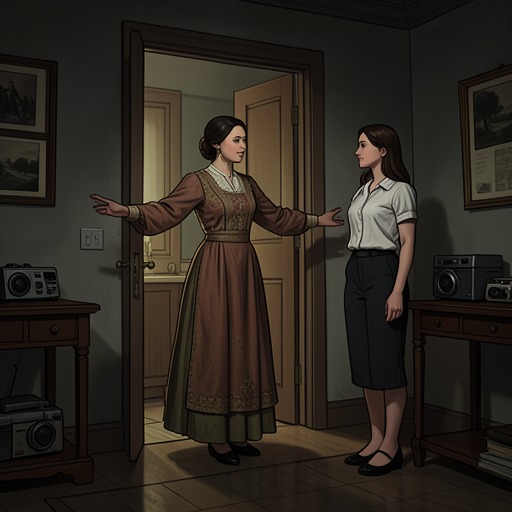
Kim Ji-young, Born 1982Kim Jiyoung’s Chuseok conflict with her in-laws turns an argument about holiday food into a public challenge to the unequal expectations governing family visits and care. When Daehyun’s mother asks whether the holiday work has been too much for Jiyoung, Jiyoung answers in her own mother’s voice, voicing a complaint that the family’s customs have left unspoken. Her intervention unsettles the gathering, but it also gives direct form to the imbalance: her husband’s family treats its holiday traditions as shared family time while her own family’s claims remain secondary.
The dispute over holiday work
Jiyoung’s mother-in-law has prepared food at home, including dishes that Jiyoung thinks could instead be bought at the market or a shop. Jiyoung objects that the household does not even hold ancestral rites and that making so much food is hard on her. Her mother-in-law responds that cooking for one’s family does not feel like work and presents making and eating food together as the point of the holidays. She then asks Jiyoung whether the work has been too much for her.
That question opens a space for Jiyoung to answer, but her response comes through a changed identity. She speaks as though she were her own mother, addressing Mrs. Jung and describing Jiyoung as exhausted by the holidays. The shift makes the family’s polite exchange difficult to contain: a complaint that could have been dismissed as a daughter-in-law’s unwillingness to help is voiced instead as a mother’s concern for her daughter. The scene’s tension lies in the collision between the language of family togetherness and the labor required to produce it.
A challenge to the family’s priorities
Daehyun tries to redirect attention by pointing out that Jung Jiwon needs a diaper change. Jiyoung then turns to him, calling out his part in the arrangement: he spends the holidays in Busan and visits her family only briefly for a meal. She asks him to come earlier the following year. Her rebuke makes the conflict more than a disagreement between a daughter-in-law and her husband’s parents; it identifies Daehyun’s own participation in the pattern that privileges his family’s gathering.
Daehyun’s father responds angrily. He argues that his children and the rest of his family meet only a few times each year and treats the complaint as an unreasonable objection to spending time together. His response frames the existing arrangement as an ordinary family custom rather than an unequal distribution of holiday time. Jiyoung answers him directly. She acknowledges that holidays are occasions for families to gather, but insists that they belong to her family as well as his. Because her family members are busy and cannot easily meet at other times, she says their daughter should be allowed to visit Jiyoung’s family when Daehyun’s sister comes to visit his.
The argument exposes a practical asymmetry beneath the abstract appeal to family. Daehyun’s relatives are together for the holiday, while Jiyoung’s family is not given equivalent time with her and their daughter. Her demand is not that his family stop gathering; it is that the same principle of family connection apply to both sides. In challenging his father, she makes visible the assumption that her role is to accommodate her husband’s family, even when doing so limits her own family’s access to her.
The rupture and immediate aftermath
Daehyun tries to explain that Jiyoung is not well, but cannot find a way to begin. Jiyoung continues speaking, and he eventually stops her and takes her out of the room. He tells his parents and his sister that she has not been well lately and promises to explain later. The family leaves in haste, without time to button their coats. Daehyun is overwhelmed by what has happened, while Jiyoung sings to their daughter as if nothing has changed. His parents do not come out to say goodbye; his sister carries her brother’s bags to the car.
The departure does not resolve the argument. Instead, it leaves Daehyun to manage two problems at once: the family’s anger and the symptoms he says Jiyoung has been experiencing. He is described as baffled, sad, and scared rather than angry with her. Soon afterward, he visits a psychiatrist alone to discuss her symptoms and possible treatment. He tells Jiyoung that he has arranged a therapy session because she has not been sleeping well and seems stressed. She thanks him and says that she has felt low and enervated, suspecting maternity blues. The consultation supplies a clinical aftermath to the confrontation without explaining away the substance of what she said about the family’s unequal expectations.
The wider stakes of care and family time
The dispute gains further context from the couple’s discussions about having a child and arranging care. Jiyoung worries that she may not be able to continue her career while raising a child, especially because both she and Daehyun work late and on weekends and their parents cannot reliably help. When she asks what Daehyun would give up, she names her youth, health, job, colleagues, social networks, career plans, and future as things placed at risk by motherhood. His anticipated sacrifices, by contrast, include fewer evenings with friends, discomfort about work dinners, and the burden of helping after work. The contrast clarifies why an apparently limited disagreement over holiday time carries broader weight: family duties already fall unevenly, and expectations that Jiyoung will adjust are not confined to the holiday table.
When the couple later evaluates childcare arrangements, they consider returning to work immediately, taking a year of maternity leave, or not returning to work. Sending their child to Daehyun’s parents in Busan proves impractical because they are elderly and his mother has had back surgery; hiring a live-in nanny raises concerns about cost and bringing a stranger into their daily life. They conclude that one parent must stay home, and Jiyoung becomes that parent because Daehyun’s work is more stable and better paid, as well as because it is more common for husbands to work and wives to care for children. Later, when Jung Jiwon starts daycare, Jiyoung’s limited time without the child is largely consumed by laundry, dishes, tidying, and preparing food. These circumstances show how the conflict’s argument about who gets family time is connected to a wider division of paid work and unpaid care.
Significance
The confrontation is a moment of both disclosure and disruption. Jiyoung’s changed voice makes her distress unmistakable to the people around her, while the content of her speech remains a lucid demand for reciprocity: the holidays cannot count as family time only when they serve Daehyun’s family. The scene does not show the in-laws accepting that demand; Daehyun removes her from the gathering, and the family leaves without a farewell from his parents. Its immediate consequence is a hurried departure and a later psychiatric consultation, but its social argument remains intact. The episode places Jiyoung’s symptoms within a household where care, work, and access to relatives are unevenly assigned, rather than treating the family dispute as a simple failure of manners.