Motherhood Penalty and Career Interruption
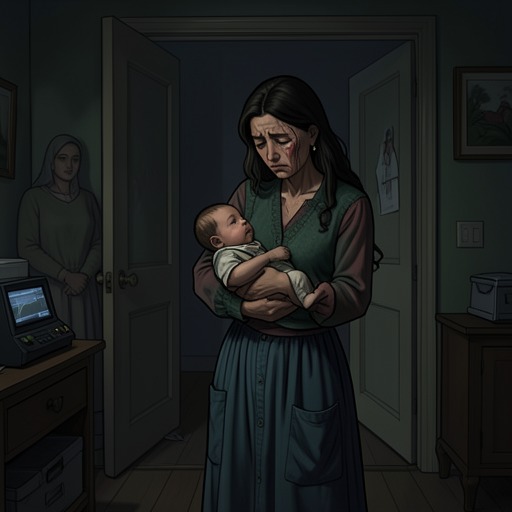
Kim Ji-young, Born 1982Motherhood Penalty and Career Interruption names the unequal professional costs attached to becoming a mother: in Kim Jiyoung’s story, childbirth does not simply add care to an otherwise unchanged life but redirects her working hours, earnings, and future options. The novel traces that change from workplace practices that already disadvantage women through the couple’s decision about childcare, Jiyoung’s resignation, the unpaid work that fills her days, and the obstacles she encounters when she considers returning to employment. Its account links intimate choices to economic and institutional arrangements without treating Jiyoung’s departure from work as a lack of ability or ambition.
Workplace Conditions Before Motherhood
The pressures that later shape Jiyoung’s choices begin before she becomes a parent. In her senior year, she and Yun Hyejin discuss how job fairs and meetings with alumni offer few visible female role models. Hyejin explains that business-management departments sometimes receive informal requests to recommend candidates, yet only men may be put forward. Because the process is kept out of view, applicants may not know whether a department selected men on its own or a company requested them. The uncertainty itself makes discrimination difficult to challenge.
Hyejin recounts the case of an exceptionally qualified female graduate who learned that four men had been recommended for interviews at a company she hoped to join. When the graduate challenged her adviser and sought a legitimate explanation, the reasons included the company’s apparent preference for men, compensation for men’s military service, and the assumption that men would become household heads. The department head dismissed the complaint rather than examining the selection process. The episode shows how assumptions about future family roles can shape access to employment even before a woman has children.
The surrounding figures make the unequal starting point measurable. In 2005, women accounted for 29.6 percent of new employees at one hundred companies, a share reported as a major improvement. In a separate survey of recruiting managers at fifty large corporations, 44 percent said they would rather hire a man than an equally qualified woman; none said they would prefer a woman. These figures do not explain Jiyoung’s later decision by themselves, but they establish a labor market in which women’s professional prospects are already constrained.
The Unequal Cost of Having a Child
When Jung Daehyun suggests that the couple have a child, the decision sounds to him like a natural next step after marriage. Jiyoung, by contrast, considers what pregnancy and childcare could mean for her body, her work, and the life she has built. She has little direct experience of pregnancy or newborn care, and she doubts that daycare or a babysitter could cover the couple’s late hours and weekend work. Their parents cannot reliably provide childcare. She also feels guilty at the thought of arranging care for a child who has not yet been born, as though anticipating the limits of her time were itself a failure of parenthood.
Daehyun listens and promises to change diapers, feed the baby, and wash the baby’s clothes. He also tells her to consider the meaning and emotional rewards of being a parent, and says she need not keep working if they cannot find childcare. Jiyoung explains that she is anxious about losing her career and feels guilty about relying on another caregiver. When she asks what he would give up, she names the youth, health, job, colleagues, social connections, career plans, and future she believes are at stake for her. Daehyun anticipates seeing friends less, coming home earlier, feeling guilty about business dinners or late work, and taking on household chores, but also describes his continued financial support as a major responsibility. Jiyoung sees a difference in scale between the losses each expects.
As her due date approaches, the couple makes the decision more concrete on a large sheet of paper. They compare returning to work immediately, returning after a year of maternity leave, and not returning at all, considering childcare arrangements, costs, and advantages and disadvantages. Sending the child to Daehyun’s parents in Busan is not practical: they are elderly, and his mother has recently had back surgery. A live-in nanny would cost considerably and become part of the household’s everyday life, while leaving unresolved how long the arrangement could continue. The couple concludes that one of them must stay home. Daehyun’s job is more stable and brings in more money; the expectation that husbands work while wives raise children also weighs on the outcome. Jiyoung becomes the stay-at-home parent, though knowing this was likely does not make it less depressing.
The language of assistance becomes part of their disagreement. Daehyun describes himself as helping with housework, childcare, and Jiyoung’s possible job search. Jiyoung challenges the idea that their shared home and child are primarily her responsibilities and that his contribution is a favor. Her objection makes visible a distinction between nominal willingness to assist and an equal assumption of responsibility. They apologize and move on from the exchange, but the unequal distribution embedded in their decision remains.
Resignation and the Value of Work
Jiyoung leaves the marketing agency without crying during the conversation with the company head, her farewell with team leader Kim Eunsil, the gradual removal of her belongings, or the farewell party. The loss reaches her the next morning, when her familiar working-day plans—breakfast on the way to the station, lunch near the office, perhaps a film after work—make no sense because there is no workplace to go to. The ordinary routine has disappeared before she has worked out what will replace it, and then she cries.
The agency had not been an ideal workplace: the pay was low, its work could feel absurd, and clients and reporters subjected Jiyoung to awkward, gendered interactions. At business events she had to manage older male clients’ crude jokes and attention without an easy way to respond. Yet she liked her colleagues and found satisfaction in completing assignments, progressing in her work, and supporting herself with her own earnings. The company had given her a place and a measure of independence. She recognizes that leaving is not proof that she is incompetent or lazy, just as arranging care for a child would not mean she did not love that child. Career interruption and professional capacity are not the same thing.
Kim Eunsil’s experience provides an earlier view of the same problem inside the workplace. She had joined the company when it had only three employees and tried to be accepted among male colleagues by staying late at company dinners, volunteering for overtime and business trips, and returning to work a month after giving birth. As she watched the women around her leave while male colleagues advanced into leadership or founded companies, she came to regret that her own example may have helped normalize expectations that women should absorb extra work and resume their jobs quickly.
After becoming a manager, Eunsil removed unnecessary dinners, retreats, and workshops and guaranteed maternity and paternity leave. She took particular pride in welcoming a team member returning from a year of maternity leave, the first such return in the company’s history. But the welcome did not resolve the conditions that made continued employment difficult. The employee could not keep up with frequent late nights and weekends, spent most of her paycheck on a babysitter, struggled to find last-minute childcare, and argued with her husband daily. After bringing her baby to work one weekend, she resigned. Eunsil could offer no adequate response when the employee apologized for leaving. Formal leave rights mattered, but they could not by themselves make the job compatible with the care arrangements available to the employee.
Unpaid Care and Restricted Time
After becoming a full-time caregiver, Jiyoung finds that domestic labor remains labor even when machines reduce some of its physical effort. A doctor responds to her aching wrists and her account of washing, cleaning, and childcare by comparing her life to earlier generations of women who did those tasks without modern appliances. Jiyoung recognizes that a washing machine does not load itself, sort and hang the laundry, or complete the work surrounding a wash; a vacuum cleaner does not take care of every step of cleaning either. The technology changes the tasks but does not make the household work disappear.
The novel contrasts two common descriptions of housework: dismissing it as idleness at home and praising it as work that sustains life. Neither description calculates its economic value. The omission matters because household labor and paid employment rely on one another, while the work required to maintain a family is not counted as a wage or assigned a price. Jiyoung’s mother, meanwhile, is too occupied with her porridge shop to help her recover from pregnancy. The shop has fewer workers as business becomes more competitive, and her mother works longer hours partly to support Jiyoung’s younger brother as he extends his education. Her limited capacity to help is shaped by her own work and family obligations, not indifference.
When Jung Jiwon begins daycare shortly after turning twelve months old, she adapts well. The schedule gives Jiyoung roughly three hours between drop-off at 9:30 a.m. and pickup before 1 p.m. Most of that time goes to laundry, dishes, tidying, and preparing food and snacks; she hardly gets a moment to sit with coffee. The novel compares this experience with time-use statistics: a stay-at-home mother of a child under two has an average of four hours and ten minutes a day to herself, while a mother whose child attends daycare has four hours and twenty-five minutes, a difference of only fifteen minutes. Daycare changes whether housework happens alongside the child, but does little to create substantial leisure. Even so, the prospect of a later pickup gives Jiyoung a small opening to consider beginning something new.
The Narrow Route Back to Work
Economic pressure makes that opening consequential. The couple had saved and paid off the loan on their flat’s deposit before the landlord raised it by 60 million won when the two-year lease ended, requiring another loan. They cannot afford a home for three on Daehyun’s income alone, and later costs for kindergarten and after-school programs loom ahead. Jiyoung feels the pressure to earn money as housing, living, and education costs rise.
The kinds of jobs available to mothers returning after a break often represent a downward shift rather than a simple resumption of the former career. The novel notes that more than half of women who leave jobs cannot find new work for over five years. Those who do return commonly take more menial jobs than before childbirth. The share working at firms with four or fewer employees doubles; fewer return to manufacturing and office jobs, while more enter hotels, restaurants, and sales, often at lower pay. The statistics give scale to the risk Jiyoung faces: time away from work can narrow both the range and quality of later employment.
Jiyoung does not abandon the wish to work. A decade after first considering her career, she again thinks about becoming a reporter, a goal she had held while at the marketing agency. She imagines freelance reporting or contributing as more attainable than passing recruitment tests for a staff position. But her new first priority is a job that lets her care for Jiwon as much as possible without hiring a babysitter. Evening journalism classes conflict with daycare hours and Daehyun’s work schedule; a sitter for a short evening period is difficult to find, and tuition plus childcare would be burdensome. Daytime programs, meanwhile, mostly offer hobbies or credentials for teaching children. The available choices make her professional interests feel restricted by motherhood, and her initial excitement gives way to helplessness.
A weekday ice-cream-shop job briefly seems more workable. A sign advertises shifts from 10 a.m. to 4 p.m. at 5,600 won an hour and welcomes housewives. The current worker, herself a mother of two, has held the job for four years while her children were in daycare, but is leaving because her first child is starting first grade. By the time Jiyoung returns to ask about the position, it has already been filled. She resolves to take another part-time job if she finds one with the hours and pay she needs, whatever the work may be. The episode closes this portion of her search without a new job: the need to earn, the wish to remain attentive to her daughter, and the limited openings available to her persist together.
Structural Significance
The novel places Jiyoung’s experience alongside national employment figures. Around the time she leaves work in 2014, one in five married women in Korea has quit because of marriage, pregnancy, childbirth and childcare, or the education of young children. Women’s workforce participation falls from 63.8 percent among those aged twenty to twenty-nine to 58 percent among those aged thirty to thirty-nine, then rises again to 66.7 percent among women over forty. These figures frame withdrawal from employment not as an isolated private preference but as a recurring pattern concentrated around marriage and childrearing.
Motherhood Penalty and Career Interruption is therefore represented through linked losses and constraints rather than one decisive prohibition. Workplace norms reward availability for late nights and weekends; family planning assigns the stay-at-home role to Jiyoung; unpaid domestic work consumes much of her day; housing and education costs increase the need for income; and re-entry options are often less secure, less aligned with previous careers, or poorly matched to childcare hours. The account also preserves the value Jiyoung found in paid work and the difference between choosing to care for her child and ceasing to care about her career. Her interrupted employment is both a personal change and an outcome shaped by how workplaces, households, and the labor market distribute the costs of care.