Oh Misook
Kim Ji-young, Born 1982Oh Misook, Kim Jiyoung’s mother, is a capable worker and parent whose life is shaped by competing demands: the family’s preference for sons, her own interrupted education, and the labor of earning and caring. Her story links private family choices to wider expectations placed on women, while her practical skill and support for her daughters show that those expectations do not wholly define her.
Family and Background
Oh Misook married into Koh Boonsoon’s family, where having sons was treated as a source of security and a measure of family success. Koh Boonsoon had raised four boys through poverty and hardship, and she believed that sons would provide for their parents in old age. Yet the warmth and household care she credited to her son were actually supplied by Oh Misook, who cooked for her and prepared her bedding. The discrepancy makes visible how women’s domestic work could disappear even within a family that depended on it.
Koh Boonsoon was relatively caring toward her daughter-in-law by the standards of her generation, but still urged her to have sons, ideally more than one. When Kim Eunyoung was born, Oh Misook apologized to Koh Boonsoon, while Koh reassured her that a later child could be a boy. The scene establishes the pressure Oh Misook faced without making her the source of it: a daughter’s birth was met as a disappointment for which the mother felt responsible.
That pressure became more consequential during a later pregnancy. In the context of government family-planning policies and widespread sex-selective abortion, Oh Misook went to a clinic alone and ended a pregnancy after learning the fetus was female. She had no family beside her to support her through the experience. A doctor’s expression of sympathy helped her endure it. Years passed before she became pregnant again; the child was a boy, born five years after Kim Jiyoung. The sequence places an individual family’s son preference within a broader social pattern, while keeping the physical and emotional burden centered on Oh Misook.
Education and Work
Oh Misook’s own education had also been limited by the unequal distribution of opportunity in her family. She admired her hardworking, successful elder brothers and valued supporting them, but the family’s resources went toward educating a younger brother. Only later did Oh Misook and her sister attend a company-affiliated school, working by day and studying at night to earn middle-school diplomas. Oh Misook then prepared for her high-school certificate independently and received it in the same year her younger brother became a high-school teacher. Her educational achievement came through persistence, but it followed years in which her ambitions had been secondary to the schooling of male relatives.
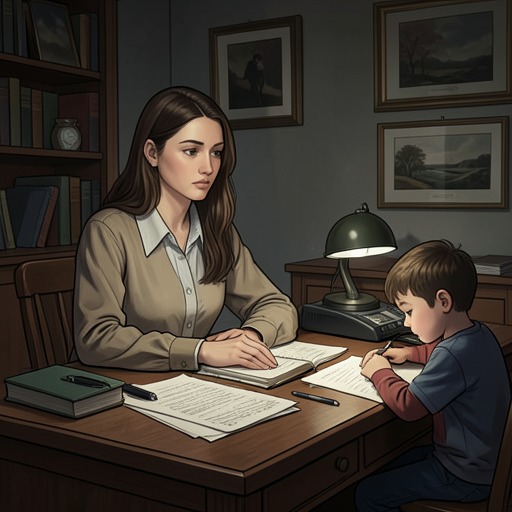
She eventually made paid work into a source of independence and ingenuity. At thirty-five, after leaving a job making weather strips, she took a hairdressing course, despite initially thinking herself too old to learn a new skill. She did not pursue a license; once she knew how to cut and perm hair, she began making inexpensive house calls to children and older people in the neighborhood. Her daughter Kim Eunyoung cared for the younger Kim Jiyoung while Oh Misook studied, and the youngest child stayed with his grandmother.
The small business grew through attention to what customers needed. Oh Misook added simple makeovers for older clients and quick trims for family members, and she deliberately chose a slightly more expensive hair product than the neighborhood salon used. She explained its features to customers by reading the label aloud, turning the product itself into a persuasive sales pitch. Her talent and business sense emerge in these everyday decisions: she combines services, notices what could reassure a customer, and makes a modest house-call operation work.
Ambitions and Motherhood
Oh Misook’s own unrealized ambitions surface when Kim Jiyoung is in elementary school. Reading a comment from Jiyoung’s teacher, she says she had wanted to become a teacher too. Jiyoung laughs because she has assumed that mothers can only be mothers. Oh Misook counters that she had earned the best grades among the five siblings, even outperforming her eldest brother. Her daughter’s surprise exposes how completely maternal identity has eclipsed the young woman Oh Misook once was.
She also supports Kim Eunyoung’s ambitions, even when the family’s financial circumstances make a secure career especially important. When Eunyoung questions whether she is being pushed toward teacher training because tuition is affordable, employment is relatively secure, and she can begin earning soon, Oh Misook acknowledges that those practical considerations matter. She also recognizes the genuine appeal of teaching and apologizes for having raised the issue in a way that might have discouraged her daughter. Her response does not erase the family pressures behind Eunyoung’s choice, but it shows Oh Misook trying to make room for her daughter’s own judgment.
Care Across Generations
When Kim Jiyoung considers having a child, she worries that childcare and work will not fit together and feels guilty about the possibility of relying on someone else to care for the baby. Her concerns are grounded in the couple’s late hours, weekend work, and lack of dependable family help. By the time Jiyoung has a baby, Oh Misook cannot provide the practical support her daughter might need: she is working longer hours at a porridge shop whose business has weakened as other restaurants move into the building. She brings Jiyoung leftovers when she can, but the shop also helps support her younger son, who is continuing his education.
Oh Misook expresses pride in Jiyoung for breastfeeding and raising her baby without her mother’s help. The praise conveys genuine affection, but it also sits beside the circumstances that made such solitary care necessary. Jiyoung’s experience is not simply a personal test of maternal devotion: her mother’s long working hours, the financial claims of another child’s education, and the couple’s childcare difficulties all shape what help is available. Care passes between generations, but it is constrained by work, money, and the expectation that women will absorb its shortfall.
Character and Significance
Oh Misook’s life is marked by contradictions that the narrative leaves intact. She has been subject to son preference and has endured its costs, yet her family’s hopes for a boy coexist with the remarkable labor she performs for that family. Her education was postponed while male relatives advanced, but she returns to study and later turns a practical skill into a neighborhood business. She remembers the teacher she might have become, then recognizes and encourages her daughters’ ambitions.
Through Oh Misook, domestic labor and paid work are not separate worlds: she supports relatives, raises children, earns money, and continues to be expected to care for others. Her efforts are sometimes miscredited, as in Koh Boonsoon’s account of who provides her meals and bedding, and sometimes praised in language that risks making unsupported maternal sacrifice seem natural. The distinction between affection and obligation remains important. Oh Misook’s tenderness toward her daughters is real, but so are the social and economic limits that narrow her choices and restrict the help she can give.