Love and the perception of inner beauty
Kiss of the Spider WomanLove and the perception of inner beauty is a recurring idea in the films Molina recounts to Valentin: love changes what characters can see, allowing them to recognize a person beyond bodily appearance, social rank, or the role imposed on them. The idea is not presented as a simple denial of physical reality. Instead, the stories test whether affection can endure when enchantment fades and whether care can still affirm a beloved person when illness, fear, and loss become impossible to disguise.
The Disfigured Pilot and the Maid
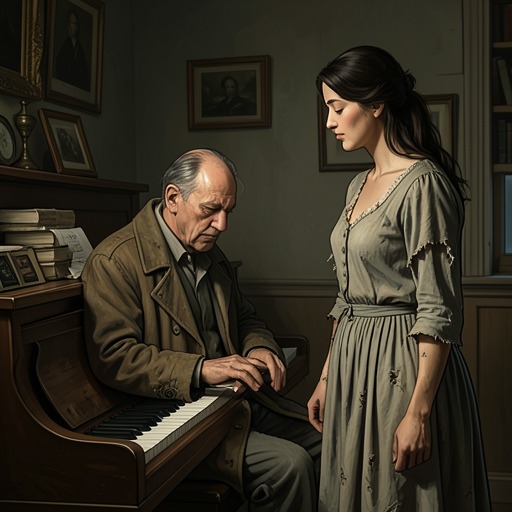
In one tale, a pilot returns from battle with a severe scar running from his forehead across an eyebrow and eyelid, down his nose, and into the opposite cheek. He is bitter about his injury and unable to return to the front; when he rents a room in the house, he speaks sharply to the maid and demands to be left alone. She remembers his formerly handsome face and longs to be near it, but the scar and his hostility make beauty seem at first to belong only to the past.
The pilot proposes marriage to the maid as an arrangement between two lonely people, offering financial security in exchange for her care. They marry in a nearly empty church, with the spinster as witness. At their wedding supper, neither can look at the other. Then the ordinary room seems to change: the candlelight grows strange, music becomes audible, and the maid’s face appears transformed into that of a beautiful woman. The pilot’s features remain difficult to make out until, through tears, she sees him as handsome. Their hands meet, they kiss, and the tale presents their newly discovered beauty as part of an intimacy they had not been able to recognize before.
The enchantment is tested when the pilot invites his parents to visit. They see his scar and the maid’s ordinary appearance, and their disappointment leaves the couple wondering whether their transformation was a cruel deception. The maid looks in a mirror; the pilot destroys his self-portrait, and both retreat from one another and from the house. The reversal matters because it restores bodily difference rather than making it disappear permanently. The blind man later explains that love has allowed them to see each other’s souls, as if they were blind to the body. The spinster supports this understanding with her own history: her fiancé died in the trenches in France, yet she believes he would still find her beautiful because he died loving her.
The story’s final reconciliation makes recognition an act rather than a lasting visual spell. The spinster combs the maid’s hair when the girl’s hands tremble too much, and the pilot approaches her without demanding that she first become beautiful in a mirror. He takes her hand, removes her ring, and writes their names on the window glass; then he caresses her hair and skin, and they kiss. The narrative thus locates beauty in reciprocal love, while preserving the characters’ awareness of their actual faces. The blind man’s blindness also gives the idea a concrete form: his way of knowing others is not based on sight, and he helps the couple understand that appearance is not the only ground for recognition.
Desire, Agency, and Recognition
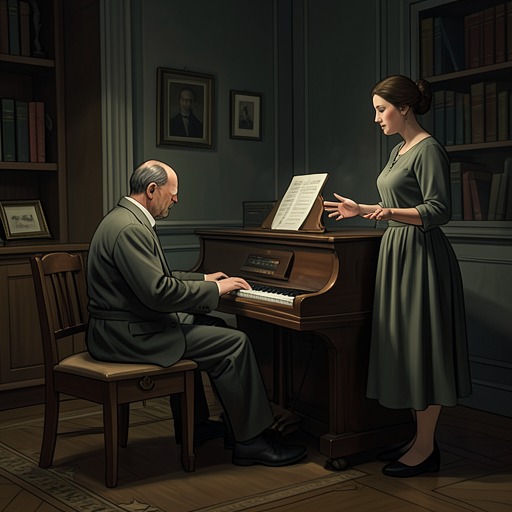
A second film story complicates the connection between love and beauty by placing affection amid unequal power. A singer, exhausted by her work in the theater, has accepted the protection of a wealthy magnate who takes her around the world but eventually confines her to a life of idleness and jealousy. A reporter helps her by destroying an article, and their attraction becomes unmistakable. Yet when he urges her to leave with him at once, she resists being treated as someone a man can manipulate. She insists on making her own decision and offers him money for the favor he has done; he rejects it and leaves.
Their separation turns feeling into song. The reporter composes lyrics about the singer’s solitude and his continuing love for her. When he later appears at her home, she is with the magnate, who has brought an emerald necklace as an apology. The reporter leaves the lyrics behind. The singer cannot bring herself to deny her love, but she refuses to identify the reporter to the magnate, who is investigating the newspaper and may seek revenge. He slaps her and leaves. The song becomes a private testimony to a feeling she cannot safely state aloud, while the scene shows that love does not automatically dissolve the structures of possession and fear surrounding her.
The singer eventually leaves the magnate and returns to work. Later, when the reporter is gravely ill and destitute, she supports him through prostitution. The magnate finds her and, after learning what she has sacrificed, gives her back her jewels and accepts that she loves the reporter. She uses the money to search for him and finds him in a hospital, delirious and near death after alcohol, hunger, and exposure. He imagines a future together and sings new lyrics for her to repeat. His death interrupts that imagined escape, but the songs continue beyond him: fishermen sing them, and the singer carries his memory as she walks along the shore. Here, inner beauty is disclosed through fidelity and sacrifice rather than through a miraculous alteration of the body; love recognizes the beloved even when it cannot rescue him.
Storytelling and Emotional Meaning
The two film plots approach the same idea through different reversals. The pilot and maid mistake visible appearance for the whole truth, then learn to see one another differently; the singer and reporter are separated not by a spell but by money, control, illness, and fear. One story makes the body seem transformed before restoring its ordinary appearance. The other makes love audible in lyrics that persist when the singer’s beloved is gone. In both, recognition is tested by a return to painful circumstances rather than secured by a happy illusion alone.
The tales also matter in the prison conversation through which Molina tells them. After recounting the story of the pilot and maid, he admits that he and his mother loved it, then decides not to share any more of the films he likes most with Valentin, who has mocked what he considers Molina’s softness. The scene makes the stories’ emotional vulnerability part of their meaning: Molina protects these romances from ridicule, even as their telling has offered a way to communicate feeling indirectly. Love’s power to see inwardly therefore belongs both to the films’ characters and to the act of narration, which reveals what the teller values while leaving him exposed to judgment.