Luis Alberto Molina
Kiss of the Spider WomanLuis Alberto Molina is a prisoner whose movement from a cell with other convicted offenders into Valentin Arregui Paz’s cell places personal attachment inside a system of political surveillance and coercion. Molina seeks Valentin’s friendship and affection, and prison officials make his possible release conditional on information. After leaving prison, he is followed by intelligence agents and dies during an attempted arrest, an ending presented through the same official reporting that had tracked his movements.
Identity and Prison Record
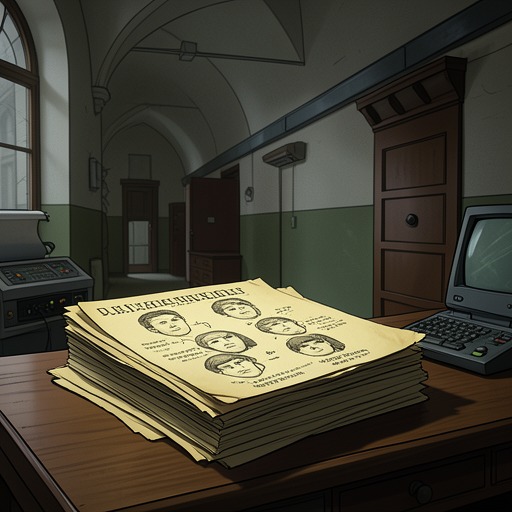
A penitentiary report identifies Molina as prisoner 3018. It records that he was sentenced on July 20, 1974, to eight years’ imprisonment for corruption of minors. As of July 28, 1974, he was lodged in Pavilion B, cell 34, with three other prisoners described in the record as sexual offenders. The report gives his conduct as good, a brief administrative judgment that contrasts with its characterization of Valentin as rebellious and politically troublesome.
On April 4, 1975, Molina was transferred to Pavilion D, cell 7, where he shared quarters with Valentin, a political prisoner awaiting judgment. The record marks the two men’s distinct legal and institutional positions even as the transfer put them together: Molina was serving a sentence, while Valentin was held under executive authority. Their shared cell becomes the setting for a relationship that the prison authorities regard as a possible means of obtaining information.
Attachment to Valentin
Molina explains his kindness to Valentin as an effort to win his friendship and, more openly, his affection. His account connects that desire to his regard for Valentin’s selflessness and the risk Valentin has taken for a political ideal. Molina describes respect and fondness as bound together, and acknowledges that he wants his feelings to be returned. The appeal is personal rather than strategic in its stated terms: he presents affection as something he hopes to give and receive.
Molina also relates this longing to the love he receives from his mother. He says that she accepts him as he is and identifies her affection as the one good thing in his life and the support that keeps him going. This comparison helps explain why Valentin’s response matters so much to him. Molina’s attachment is not merely an attempt to make prison life easier; in his own account, it touches a deep need for acceptance and reciprocated care.
When he tells Valentin that Valentin may do as he wishes with him, Molina makes clear that the offer is voluntary, while also voicing fear that Valentin may find him repellent. The moment makes the vulnerability in his request explicit. It also places Valentin in a position of response: Molina has risked naming his desire, but the exchange does not erase the unequal circumstances of imprisonment or the fact that the authorities are seeking to exploit their closeness.
The Prison’s Bargain
The Warden tells Molina that an option has been arranged because of Parisi’s interest in him and asks whether he is making progress with Valentin. Molina says that he thinks he is getting somewhere. The Warden then asks whether weakening Valentin physically has helped. This exchange links Molina’s developing personal connection to the prison’s deliberate effort to weaken a political detainee and elicit information. Molina’s own feelings and the institution’s purpose occupy the same conversation, but are not the same thing.
Later, the Warden discloses that Molina’s parole papers have already been prepared, with only the Warden’s signature outstanding, and states that release depends on Molina providing information. When asked whether he has anything to report, Molina says no. The conditional offer makes his position precarious: the authorities present freedom as available, yet attach it to cooperation. The evidence records both the pressure and Molina’s denial that he has supplied anything, without establishing what the officials believe he knows.
When Valentin learns that Molina may be released, he responds with happiness and immediately turns to Molina’s situation after the transfer, asking what will become of him in the cell. The exchange gives the prospect of freedom a double meaning. It is welcome news for Molina, but it also threatens to separate the two men at the moment when their attachment has become important to them.
Release and Surveillance
An intelligence report states that Molina was paroled on the ninth and released at 8:30 in the morning. He arrived home by taxi at about 9:05 and spent the day there, repeatedly looking out from his third-floor apartment on Calle Juramento 5020. The report identifies the surveillance as a joint operation by CISL and TISL, including a wiretap unit. Its routine recording of his arrival, movements, and calls turns the return home into another monitored stage of his confinement.
That morning Molina telephones Lalo. According to the report, the two speak for several minutes, use a succession of different names for one another, and laugh; they also promise to meet over the weekend to see a movie. The officers note that Lalo presses Molina to describe sexual experiences in prison and that Molina replies there had been no such diversions. The report’s language reflects the surveillance apparatus’s interest in private behavior, while the conversation itself also shows Molina maintaining a social connection beyond the prison.
The following week’s record follows him between work and home. On one Thursday, he withdraws nearly all of his savings, leaving only the minimum deposit needed to keep his bank account open. At a notary’s office he leaves a sealed envelope for his mother containing the withdrawn money, according to the report’s account of a sworn declaration. The document does not explain his decision, so its significance remains uncertain; concretely, however, the savings are transferred out of his account and placed in an envelope intended for her.
Arrest and Death
On Friday, Molina leaves work at 12:30 and goes to a nearby pizzeria on Las Heras. He uses a public telephone, dialing three times and hanging up immediately each time before making a brief call, then eats only a little and returns to work. After leaving at 6:40, he takes a bus and then the subway to José Maria Moreno station, walks to the intersection of Riglos and Formosa, and waits there for approximately thirty minutes. The report says this was the period allowed by the Central Bureau for a party or parties to meet him before agents took him away for questioning.
Two CISL agents approach to arrest Molina, who demands to see their credentials. At that point, according to the report, shots are fired from a passing automobile. Molina and agent Joaquin Perrone are wounded and fall; Molina dies before the patrol unit arrives to provide first aid. Perrone survives with thigh wounds and serious contusions. The report says the patrol arrived too late to pursue the vehicle. It records an abrupt death in the middle of a surveillance operation, but cannot establish who was in the car or what happened to them afterward.
The report’s explanation remains explicitly conjectural. Members of the patrol unit believe that extremists killed Molina to prevent a possible confession, while the report also suggests that Molina may have feared an incident and may have expected either to escape with the extremists or to be killed by them if caught in a compromising position. These are competing possibilities offered by the surveillance document, not confirmed motives or a settled account of Molina’s intentions. Its final image is therefore also an evidentiary limit: the state has recorded his route, calls, savings, and waiting period in detail, yet the circumstances and purpose of the fatal shooting remain unresolved.