National Socialism
Kiss of the Spider WomanNational Socialism in the novel is represented not as an abstract platform alone but as a system that seeks to organize bodies, art, political feeling, and historical memory. Through Werner’s explanations and the staged public spectacles Leni encounters, the ideology offers a vision of national regeneration founded on physical fitness, reproductive expectations for women, heroic discipline, and loyalty to a charismatic Leader. Its persuasive force is dramatized alongside its coercive and conspiratorial elements: Leni is moved by its aesthetics and rhetoric, while a purported documentary turns racial hatred into an apparent explanation of famine and political violence.
A national ideal of beauty and gender
At Leni’s introduction to the Berlin press, the expected image of a Parisian diva gives way to a carefully composed alternative. She appears in a plain white tunic, with a clean face and hair braided around her head; the description emphasizes health, strength, and an athletic figure rather than elaborate cosmetics or fashionable ornament. This presentation makes her appearance do ideological work. The body is treated as evidence of a supposedly healthier national culture, while the simple costume suggests that beauty should express discipline and fitness rather than individual display.
The Berlin studios’ representative connects this ideal to a sharply restrictive account of women’s purpose. In the doctrine he repeats, women are assigned beauty and childbearing, and a mother of many sons is ranked above a woman jurist. Women’s exclusion from politics is framed not as a denial of power but as protection of their dignity, while the future growth of the state is imagined as dependent on their reproductive contribution. The argument thus presents a gender hierarchy as natural and beneficial: women are denied political participation even as their bodies are made central to the projected future of the nation.
The scale of that projected future is explicit. The speech contrasts a Reich said to contain more than 80 million people with an imagined population of 250 million patriots in 2040, destined to govern the world from the Fatherland and its colonies. The grand demographic forecast converts private reproduction into a state project. Leni’s carefully styled appearance at the press event is therefore more than a change in fashion; within the scene, it makes her a public emblem of the healthy, disciplined woman the ideology claims to require.
Art, spectacle, and heroic discipline
Werner extends the same ideal from the body to public art. He takes Leni to a vast youth gathering in a stadium, driving her in his white coupe rather than an official limousine so that she can experience herself as one person among thousands. There, the synchronized gymnasts form straight lines that dissolve and reform into curves. Their coordinated movement turns physical education into political spectacle: individual bodies become legible as parts of a mass, and the changing formations are presented as a visual argument for discipline and national unity.
The stadium also supplies Werner’s answer to Leni’s question about why German public art seems more enduring to her than the decorative styles she associates with the rest of Europe. He rejects communist and Catholic traditions through hostile ideological labels and argues that art should give form to heroism. His formulation replaces love with honor and recasts Christ as an athlete expelling merchants from the Temple. The scene binds athletic strength, religious imagery, and political authority into a single aesthetic, while the youth chorus’s martial language further turns performance into an instrument of political mobilization.
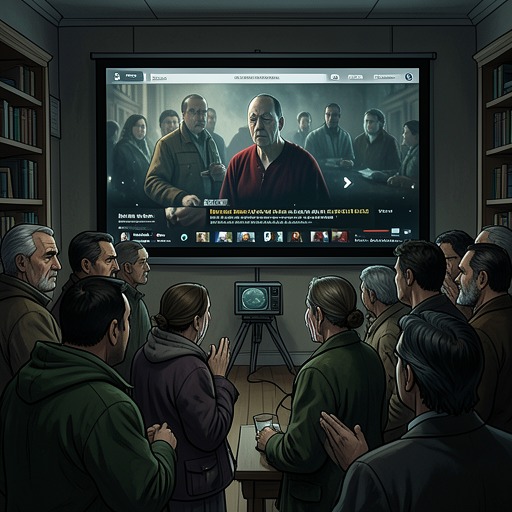
Leni’s response is deliberately complicated by what she already knows of Werner: she has been troubled by his role in ordering a person’s execution. At dinner she asks how someone she regards as superior could have authorized a death, then breaks her glass against the fireplace. Werner answers not with a discussion of individual responsibility but by taking her to a screening room at the Ministry of Political Affairs. The sequence shows ideology working through spectacle as well as argument: a private moral question is redirected into a political film designed to settle what kind of person deserves condemnation.
Racialized propaganda and the documentary
The film Werner presents depicts famine in several regions and repeatedly inserts the same figures before scenes of deprivation. Its narration assigns responsibility to Jews, portraying them as a coordinated network that hoards necessities and profits from catastrophe. The sequence builds an explanatory story out of images of hunger, shortages, and suffering, but its purported evidentiary method is inseparable from its antisemitic premise. Rather than establishing responsibility through investigation, it asks the viewer to read recurring faces as proof of a racial conspiracy.
Leni watches with alarm, but her attention is also fixed on recognizing one of the faces. Werner initially assumes that she has identified the criminal he himself condemned to death. Instead, she means the other figure: Jacob Levy, described by Werner as the most pursued anti-Nazi agent still at large. She cannot immediately place where she has seen him, and the pair run the film backward, stopping at his image. This moment makes the propaganda film part of the plot’s espionage machinery, while also showing how its imagery directs Leni’s memory toward an enemy already defined for her by Werner’s account.
Werner believes the screening will justify the execution that has troubled Leni. Her gesture of taking his hand and holding it close to her heart relieves his fear that the matter has estranged them; she appears to accept his explanation that the death saved innocent people. Yet the scene’s political persuasion is inseparable from the film’s false certainty and racialized framing. The narrative shows how an intimate moral conflict can be displaced by a spectacle that claims to make political violence not merely permissible but necessary.
The Leader and the manufacture of belief
During a picnic in the Bavarian Alps, Leni asks Werner about the Leader. His account begins with a theory of government, presenting authoritarian rule as a more effective answer to the problems of liberal democracies and as protection against abusive international elites. When she asks for a more personal explanation, he offers a story of clandestine journeys, secret meetings, and speeches delivered despite danger. He recalls accompanying the Leader in small aircraft through storms and describes roads repeatedly traveled between the Alps and Berlin as routes into the hearts of the people.
The details of the account construct an image of austerity and exceptional resolve. The Leader is said to have avoided being photographed, traveled extensively, and eaten only bread, a hard-boiled egg, and fruit during journeys. Werner contrasts this modest routine with the transformation he claims occurred at public meetings, where the apparently simple man became a commanding speaker. The picnic setting echoes the frugal meals in Werner’s story, lending the account a material correspondence without independently verifying its claims.
Werner ultimately explains the Leader’s appeal through authenticity and faith: he says that the Leader believes his own words, that the people recognize this quality, and that even close associates cannot fully explain his personality. Leni embraces Werner and tells him that he has conveyed the essence of National Socialism. The exchange presents belief not as the conclusion of political analysis but as a response to a leader whose power is described as partly miraculous. The movement’s authority is thus grounded in personal devotion as well as in its public ceremonies and doctrines.
Leni’s conversion and the ideology’s reach
After weeks of work in the Berlin studios, Leni remains preoccupied with Jacob Levy’s face. Although Werner has arranged a reunion before returning to Paris, she asks to go back sooner and search for the anti-Nazi agent. Werner accepts her entry into an espionage cadre despite his fear for her. Her new political commitment develops from the screening-room encounter: the film’s imagery has given her a target, and the moral conflict over Werner’s earlier execution has been folded into the movement’s account of enemies and necessary action.
On returning to France, Leni views her country through the same racialized categories she has absorbed. The narration describes her as disgusted by what she perceives as racial contamination, marking the reach of the ideology beyond German territory and into her understanding of home. This change is significant because the story has just established her as a French singer whose public image was associated with Parisian fashion. National Socialism offers her a new identity through which to judge that earlier world, while its political vision narrows her perception of the people and country she has returned to.
Across these episodes, the ideology’s components reinforce one another. Fitness supplies its image of bodily order; gender hierarchy assigns women a reproductive role; mass performance makes conformity appear beautiful; the Leader’s biography turns political authority into an object of faith; and antisemitic propaganda supplies a fabricated enemy against whom violence can be justified. Leni’s growing assent gives that system a personal trajectory, but the novel also exposes how its apparent coherence depends on spectacle, selective storytelling, and the conversion of prejudice into supposed evidence.