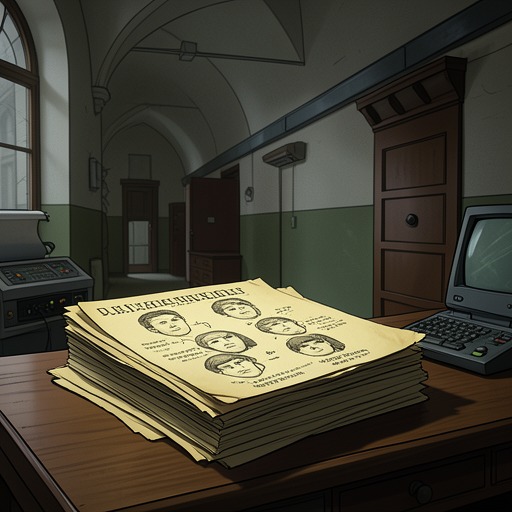
Penitentiary of the City of Buenos Aires
Kiss of the Spider WomanThe Penitentiary of the City of Buenos Aires is presented through both official custody records and the routines of cell life. Its administration sorts prisoners by status and housing assignment, tracks their movements and conduct, and imposes confinement measures; those procedures shape the conditions under which Molina and Valentin Arregui Paz share a cell.
Identity and Administrative Records
The prison is identified by its full institutional name in a record that documents Molina’s sentence, housing, transfer, and conduct. A separate entry tracks Valentin Arregui Paz’s arrest, detention, cell placements, participation in protest, and disciplinary confinement. Together, the records depict an institution that makes prisoners legible through dates, classifications, locations, and assessments rather than through personal histories.
Molina’s entry records an eight-year sentence for corruption of minors, imposed on July 20, 1974, by Judge Justo José Dalpierre of the Criminal Court of the City of Buenos Aires. The record says he was lodged in Pavilion B, cell 34, on July 28, alongside Benito Jaramillo, Mario Carlos Bianchi, and David Margulies, who were also identified as sexual offenders. It describes his conduct as good, an administrative judgment that contrasts with the prison’s later transfer of him into a cell with a political prisoner.
Housing and Transfers
Cell and pavilion assignments organize the prisoners’ daily proximity. On April 4, 1975, Molina was transferred from Pavilion B, cell 34, to Pavilion D, cell 7, which housed Valentin Arregui Paz. The same date marks Valentin’s transfer into that cell from a different pavilion. The records thus establish the shared confinement of two men categorized very differently by the institution: Molina as a sentenced sexual offender, Valentin as a political prisoner.
Valentin’s file traces a longer period of custody. He was arrested on October 16, 1972, along Route 5 outside Barrancas, after National Guard troops surrounded activists involved in promoting disturbances with strikers at two automotive assembly plants on the highway. Held under the Federal Government’s executive power and awaiting judgment, he was recorded in Pavilion A, cell 10, with political prisoner Bernardo Giacinti as of November 4, 1974. His subsequent transfer to Pavilion D, cell 7, places him in the same room as Molina, whose own record notes the move without explaining its rationale.
Protest and Discipline
The prison’s records connect Valentin’s political status with collective protest and disciplinary control. He took part in a hunger strike protesting the death of political prisoner Juan Vicente Aparicio while Aparicio was undergoing police interrogation. The entry also associates Valentin with protests over poor hygienic conditions in the pavilion and other incidents, describing him as rebellious and as a reputed instigator. This is the institution’s perspective: dissent appears as a conduct problem and a matter for administrative recording.
The response included solitary confinement. Valentin was moved there for ten days beginning March 25, 1975, before his April 4 transfer to Pavilion D, cell 7. The sequence documents a concrete disciplinary measure between the hunger strike and his new cell assignment, showing how the prison regulated protest not only through classification but through changes in where a prisoner could be held.
Daily Routine and Narrative Significance
The prison also appears at the scale of ordinary provision. In a cell conversation, a prisoner asks why dinner is taking so long and suggests it may already have been brought to the neighboring cell. The exchange gives no formal account of meal procedures, but it makes food distribution and the uncertainty of waiting part of the inmates’ daily experience. In this setting, even dinner is encountered through the cell boundary and the timing of institutional routines.
The prison’s administrative documents and cell scenes offer complementary views of confinement. The records fix dates, charges, conduct, and movement; the dialogue conveys how life is experienced within those arrangements. By bringing Molina and Valentin together in Pavilion D, cell 7, the institution supplies the material conditions for their relationship while its classifications and disciplinary practices remain an active pressure on their lives.