Report on Luis Alberto Molina
Kiss of the Spider WomanThe Report on Luis Alberto Molina is a state surveillance dossier that follows Molina after his parole from prison and ends with his death during an attempted arrest. It presents ordinary movements as intelligence, but its close attention to detail does not resolve the central uncertainty: whether Molina was arranging contact with political associates, trying to evade the authorities, or anticipating that he himself was in danger.
Identity and Scope
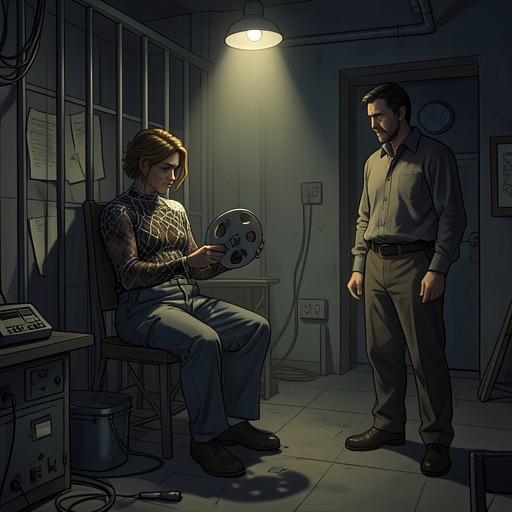
The dossier identifies its subject as prisoner 3.018 and notes that he was paroled on the 9th. It says that the surveillance was conducted by CISL in conjunction with the TISL wiretap unit. The report’s bureaucratic opening places Molina within an administrative system of observation before recounting his conduct outside prison: routes, work hours, calls, purchases, and encounters all become material for assessment.
The report is not a continuous account of Molina’s private life. It is a record assembled by observers, and its entries alternate between actions they claim to have witnessed and interpretations they draw from them. That distinction matters throughout. A call, a period of waiting, or a withdrawal of money is reported as a fact; the purpose attributed to it remains an institutional judgment, sometimes explicitly uncertain.
From Suspicion to Surveillance
Suspicion precedes the dossier’s detailed itinerary. In a separate conversation, someone voices the thought that Molina is concealing something and asks whether he has gone over to the authorities’ opponents, perhaps out of fear of reprisals from Arregui’s revolutionary organization. The report’s later attention to possible hidden meanings in Molina’s conversations gives that suspicion a documentary counterpart, but does not confirm it.
The investigators consider whether the feminine names Molina uses when addressing Lalo might form a code. Their own account undercuts the theory: they describe the exchanges as bantering and disordered, and say the possibility will continue to be watched rather than declaring it proven. The dossier thus preserves not a discovered message but a hypothesis generated by surveillance. Its institutional language makes uncertainty actionable without making it disappear.
Movements and Recorded Anomalies
One Tuesday entry tracks Molina from home to a boutique, where he arrives shortly before 9 a.m. after running the last two blocks. At 12:30 he goes to a coffee shop on Calle Juncal, between Ayacucho and Rio Bamba, and uses a public telephone. He dials three times, hangs up immediately, then speaks for about three minutes. The report emphasizes that he waited to use this phone despite having access to a telephone at work. Investigators check the telephones at his home, the Restaurant Mallorquin, and the Banco de Galicia, and conclude that the call was not to any of those places. The recorded behavior is specific; the identity of the person contacted is not established.
On another occasion, Molina waits at a location visible from none of four surveillance vantage points. No one speaks to him, although cars pass, and none stops. He returns home directly. The report interprets the site as one chosen by someone skilled at avoiding police observation and suggests that Molina had arranged a meeting with people who noticed the surveillance. Yet the same entry records no meeting and no contact. The dossier’s confidence lies more in its theory of the location than in anything its agents actually observe there.
A Thursday entry adds a financial detail: Molina withdraws nearly all his savings, leaving only the minimum deposit needed to keep the account open. The money, the report says, had been deposited at intervals before his imprisonment. At a notary’s office he leaves a sealed envelope in his mother’s name containing the savings, according to an executive’s sworn declaration. The entry also notes that his activities are otherwise limited: he goes to work at his usual time, eats there, drinks coffee repeatedly during the day, and arrives home at 8:10 p.m. The transfer to his mother is documented, but the report does not establish why he made it.
The Attempted Arrest and Death
On Friday, Molina again uses a public telephone after dialing and hanging up three times, then speaks briefly. He eats alone at a nearby pizzeria on Las Heras, taking only a little food and leaving most of it. After work, he travels by bus from Callao to Congreso, continues by subway to José Maria Moreno station, and walks to the intersection of Riglos and Formosa. He waits there for about thirty minutes. The report says this was the interval allowed for a contact to meet him before agents were to pick him up for questioning.
Two CISL agents approach to arrest him. Molina demands to see their credentials. Several shots are fired from a passing automobile, wounding Molina and agent Joaquin Perrone; the car escapes before the patrol unit arrives. Molina dies before the patrol can administer first aid. Perrone suffers thigh wounds and serious injuries from his fall. These are the report’s final observed events, abruptly replacing the itinerary of calls and journeys with an outcome that the surveillance operation neither prevents nor explains.
Conclusions and Documentary Form
The report attributes the shooting to extremists and suggests they wanted to eliminate Molina before he could confess. It also says his recent behavior, including the withdrawal of his savings, suggests that Molina himself feared that something might happen. These explanations are presented as impressions and possibilities, not established knowledge. The dossier even proposes alternatives for what Molina may have intended if confronted: he might have expected to escape with the extremists, or he might have been prepared for them to kill him. It cannot determine whether he knew that he was under continuous surveillance.
That unresolved ending defines the document’s significance. Its surveillance system gathers precise details—the public calls, checked telephone lines, waiting periods, travel routes, and sealed envelope—but converts them into meanings it cannot verify. The report therefore records both an attempt at control and the limits of what its observers can know. It says the compilation was typed in quadruplicate for authorized personnel, with the original to remain permanently on file. The final act of preserving the account gives official permanence to its facts and its conjectures alike.