Sexual Orientation, Gender Identity, and Gender Norms
Kiss of the Spider WomanSexual Orientation, Gender Identity, and Gender Norms in the novel emerge through Molina’s attempt to describe who he is and what kinds of intimacy he longs for. His account does not fit neatly into a distinction between sexuality and gender: he describes desire for men alongside a sense that he cannot speak of himself as a man. The novel places that self-description beside social expectations that men should desire women, peer judgments, and prison classifications, showing how identity is expressed in personal terms but also constrained by other people’s categories.
Molina’s Self-Description
In explaining his feelings for a man he admires, Molina says he cannot describe himself in the same way as a man because he does not feel like one. The statement links attraction to gendered self-understanding without reducing either to the other. His words are an account of his own experience, not a general definition of gay identity, and the novel leaves room for the distance between the labels available in conversation and the complexity of what he feels.
Molina also describes himself and his friends as feminine and distinguishes them from gay men who fall in love with one another. In his account, he and his friends have sex with men while hoping for friendship or a more serious bond with a man who, he assumes, will want a woman. His division is revealing precisely because it carries both desire and a limit: he imagines men as the people whose recognition he wants, while treating heterosexual desire as the norm that makes reciprocal intimacy difficult. The distinction belongs to Molina’s personal vocabulary; it should not be taken as a universal account of gay men or as an objective taxonomy supplied by the novel.
Gender Expectations and Belonging
That expectation—that a man wants a woman—helps explain why Molina describes serious friendship with a man as something he and his friends await but cannot easily attain. His longing is not merely for sexual attention. He presents it as a wish for a weightier friendship and a more serious connection, while anticipating that conventional male desire will obstruct it. The tension gives his self-description its emotional and social stakes: the desired relationship is imagined through the very norm that seems to deny its possibility.
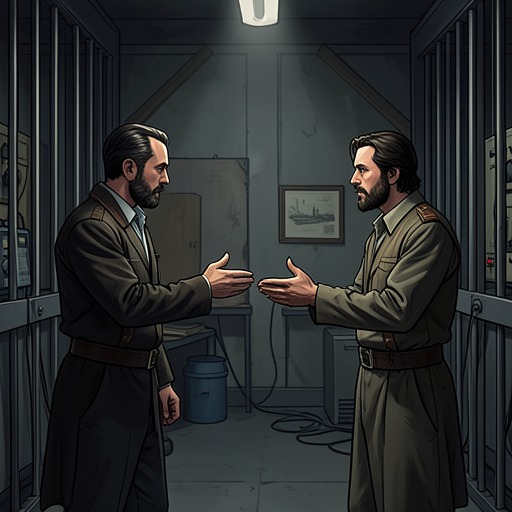
A brief exchange with Valentin extends the novel’s attention from intimate self-definition to gendered solidarity. Molina reproaches a group of men for defending one another, and Valentin asks whom he means. The exchange turns on who is included in that collective and who is positioned outside it. It does not establish a general theory of men’s behavior, but it shows that gender categories are active in the cell’s conversations: they shape how solidarity is perceived, challenged, and negotiated between the two prisoners.
Molina’s remark that a political group would never trust someone like him also connects identity to political belonging. Valentin suggests that Molina might seek a political group after release; Molina rejects the suggestion and insists that its members would not trust him. He then refuses to be told anything about Valentin’s comrades. The exchange presents exclusion as Molina’s expectation, rather than establishing what the group would actually do. It nevertheless shows how anticipated stigma can narrow the future a person imagines for himself, even when another person offers a possible route into collective life.
The Prison’s Categories
The institutional account of Molina makes a different kind of identity claim. It records his sentence for corruption of minors, his placement in a cell with other prisoners classified as sexual offenders, and his later transfer to a cell with Valentin. The report describes his conduct as good. These administrative details do not explain Molina’s sense of gender or his relationships, but they show how the prison organizes him through legal and custodial categories rather than through his own account of himself.
The Warden’s warning before Molina’s expected release repeats the legal category in admonitory form: he tells Molina to avoid further trouble involving children. The warning is presented as an instruction about conduct, not as an account of Molina’s identity or the circumstances of his conviction. Set beside Molina’s own description of himself, it exposes the difference between self-understanding and institutional judgment. The prison can classify, sentence, transfer, and warn him; none of those actions supplies a full description of who he is.
Identity and Its Momentary Instability
The conversation with Valentin also contains a small but striking gesture of identification. As Molina describes strange feelings, he raises a hand to his face as if searching for a mole. Valentin points out that the mole belongs to him, not to Molina. Molina recognizes the difference, yet says he has touched his forehead to feel for a feature he does not possess. The physical detail makes the boundary between the two men tangible: the mole is Valentin’s, while Molina’s gesture registers an impulse to locate it on himself.
Molina then recalls a moment in which he seemed to be neither in the cell nor anywhere outside it, and another in which he felt as though he were no longer himself but Valentin. The experience is brief, as he emphasizes, and the text does not present it as a permanent change of identity. Its importance lies in the way it unsettles a fixed separation between self and other. Read alongside Molina’s earlier difficulty describing himself as a man, the moment makes identity appear not only as a label but as something felt and momentarily reconfigured through closeness.
Narrative Significance
The subject develops through contrasting forms of speech: Molina’s self-description, the conversational judgments exchanged with Valentin, and the impersonal language of prison records and orders. Each provides a different frame for understanding him. The personal account makes room for desire and uncertainty; the institution reduces a life to a sentence, placement, and warning. The contrast does not erase the consequences of the legal record, but it prevents that record from standing in for Molina’s entire identity.
The novel also resists treating gender expectations as background assumptions. Molina’s anticipated rejection by political comrades and his belief that men want women both show norms shaping what forms of intimacy and affiliation seem available to him. His brief sense of becoming Valentin offers no simple resolution: it neither settles his identity into a new category nor removes the obstacles he has described. Instead, it marks a moment in which the self he has struggled to articulate becomes porous in relation to another person.