The blind composer’s blindness
Kiss of the Spider WomanThe blind composer’s blindness is more than a biographical detail in the forest love story told around his sonata. It determines how he encounters the people and house around him, frames his account of love, and gives him a distinctive role in bringing a troubled couple back together. The story links literal loss of sight with a different kind of perception, while making music and narration the means by which the blind man’s understanding reaches others.
Identity and Introduction
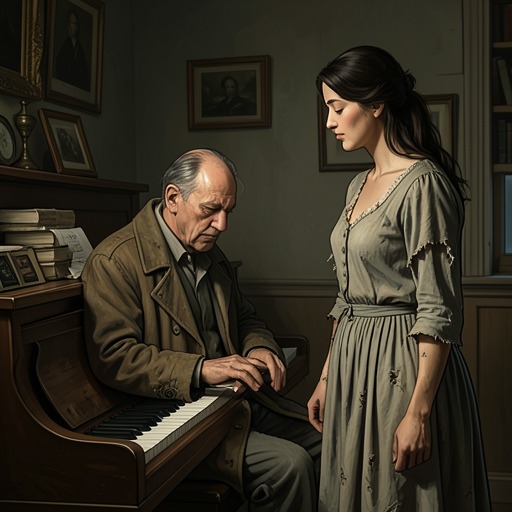
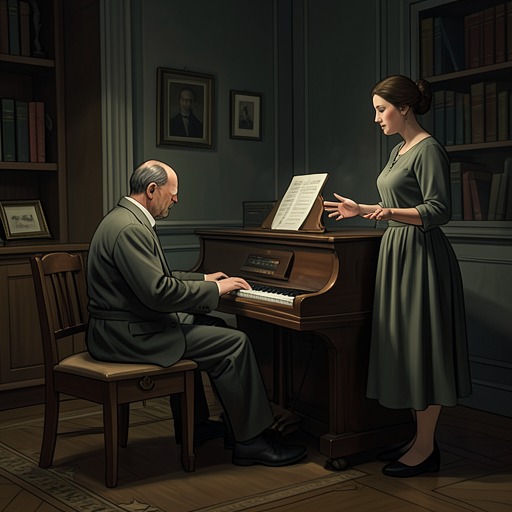
The blind composer appears among guests gathered in a forest chalet for the debut of a sonata he has composed. The surroundings are described through shifting possibilities—a stone house beneath slate roofs, a candlelit or lamplit room, furnishings variously imagined as pine, mahogany, or sandalwood—before attention settles on the blind pianist and his friends. His eyes are described as having almost no pupils left; appearances, the narration suggests, are not what he sees. The guests have assembled to hear the new work, but he first explains the events that inspired it: a love story that took place in that same forest. His blindness is therefore present from the beginning both as a physical condition and as part of the story’s method of approaching what can and cannot be known by sight.
The account gives no cause for his loss of eyesight. In another part of the tale, he speaks of how he gradually came to terms with losing his sight. That emphasis is on an inward process of resignation, not on a medical explanation or a moment of cure. His composing and storytelling establish what he does with that experience: he makes a work of music out of a remembered human relationship, then supplies listeners with its history before the sonata is performed.
Blindness in the Forest Story
The forest episode gives his blindness immediate consequences. Moving with a gnarled cane and a seeing-eye dog, he follows a palisade near an old chalet. He senses something strange about the house, though he cannot perceive it visually; the narration renders this impression as a heartbeat in the stones, beams, and walls, which ceases as footsteps approach. The scene makes his attention different from that of a sighted observer: it is organized around sound, touch, and an apprehension that the house is somehow alive.
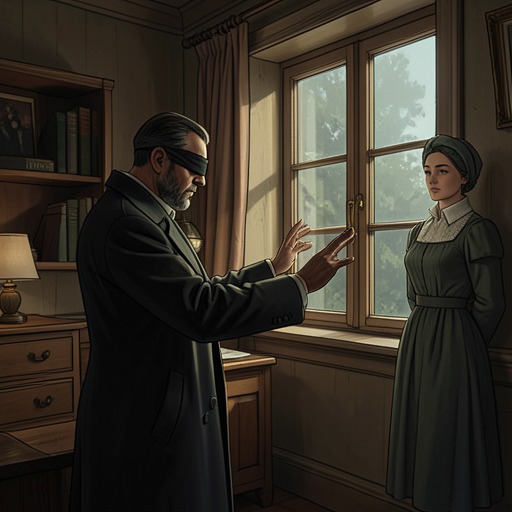
When he encounters the young woman, he does not know that she is a servant. He greets her with the courtesy he would offer someone he assumes may belong to the house, removing his hat as he speaks with her. The mistake is directly connected to his inability to see her circumstances, but the episode does not reduce their encounter to that limitation. The account also gives weight to her voice and manner, which shape the impression she makes on him. Blindness changes the information available to him; it does not prevent him from responding to another person.
The story later recalls that the blind man himself tells how he gradually accepted his failing sight. It also recounts a proposal made by the sick young pilot to the girl: each is lonely and has little hope of happiness, and he offers a practical arrangement based on companionship and care rather than a promise of romance. The blind composer is associated with this pivotal moment as a listener and confidant, although the surviving recollection does not make clear what he said to the pilot. His own blindness thus sits alongside another person’s illness and the maid’s loneliness, without making their circumstances identical.
Mediator Between the Couple
The blind man returns when the young pilot and the woman have withdrawn from one another. At an autumn twilight, he visits them while they are avoiding the sight of each other; the spinster listens from behind a door. The visitors are described as three blind beings at the saddest hour of the day, a figurative grouping that extends the story’s concern beyond literal eyesight. The couple’s estrangement has made them unable to face one another, while the blind man has lived with the literal loss of sight and the spinster witnesses their distress from concealment.
He argues that the couple’s love has allowed them to see one another’s souls rather than judge one another by their bodies. His blindness gives this appeal particular force, but he is not simply presented as a symbol: he has his own history of coming to terms with lost sight, and he uses his position to interpret the couple’s difficulty to them. He asks them to look at one another again after he leaves, without doubt or trembling. The house’s earlier heartbeat returns in his explanation as an image of the love that has animated it and enabled this way of seeing.
After the blind man departs in the last reddening light, the young man goes upstairs to prepare for supper, and the girl sets the table. She is afraid to face the mirror and cannot steady her hands to comb her hair. The spinster enters her quarters and begins combing it for her, turning the blind man’s counsel into a small, practical act of care. The scene does not make the woman’s insecurity disappear by assertion; it shows other people helping her approach the evening she had feared.
Music, Perception, and Narrative Role
The sonata gives the blind composer’s perception a form that can be shared. He tells the love story before the performance so the guests can understand the experiences that inspired the music. The remembered events and the composition are joined: his account supplies a human history for the work, while the music carries that history beyond the limits of any one person’s sight. His blindness is therefore connected not only to what he cannot see but to how he listens, remembers, composes, and guides an audience toward the emotional meaning of the story.
The tale’s treatment of blindness holds two ideas together. Sightlessness is a concrete condition, shown through the cane, guide dog, gradual adjustment, and mistaken assumption about the maid’s status. At the same time, the story uses blindness to question the authority of appearances: the couple’s renewed perception depends on looking beyond bodies, while the blind man’s own experience lends moral weight to that appeal. The distinction matters. His condition does not magically solve the couple’s problems; he offers an interpretation, leaves them to act, and the following preparation for supper marks their first movement back toward one another.
Blindness also belongs to the novel’s wider pattern of music and narrated cinema. In a separate film story, a blind pianist plays in a bar while a reporter drinks and begins composing lyrics to a song associated with a masked ball. That pianist is not identified as the blind composer of the forest tale, but the recurrence places blindness beside musical performance in more than one embedded narrative. In the forest episode, the blind composer’s defining contribution is to turn loss of sight into a perspective through which a love story can be heard, understood, and, at a critical moment, returned to its protagonists.