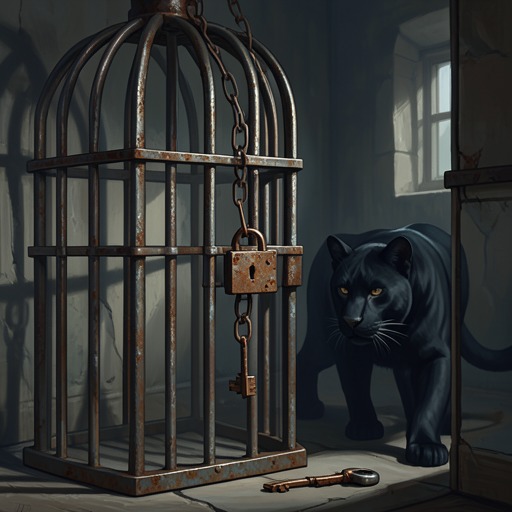
The panther cage
Kiss of the Spider WomanThe panther cage is the enclosure at the center of Irena’s growing fascination with the Panther and the final action of the film story Molina recounts. First presented as a barrier separating animal from visitor, it becomes a threshold Irena deliberately opens; the keeper’s lock and bolt make that change possible, while the Panther’s escape ends in death for both the animal and Irena.
The enclosure and Irena’s first visit
The cage is described as huge, with a barred door secured by a lock and bolt. Irena visits the zoo after missing an appointment with the Psychiatrist, drawn to look at the Panther. In her thick, plush black coat, whose surface glistens almost iridescently, she watches the Panther pace back and forth without taking his eyes off her. His iridescent black fur echoes the sheen of her coat, bringing visitor and captive into visual alignment while the bars keep them apart.
During the keeper’s feeding routine, he opens the cage, tosses in meat, and shuts the door, but forgets a large, rust-covered key in the lock. Irena approaches stealthily and removes it. After pausing with the key in her hand, she takes it back to the keeper, who thanks her. In this first encounter, she notices the vulnerability of the enclosure but does not use it to free the Panther.
The key and the repeated visits
Irena returns to the zoo on subsequent afternoons to see the Panther. On the afternoon when the Psychiatrist is already dead, she again watches the absent-minded keeper feed the animals: he unlocks the cage, slides back the bolt, throws in two enormous chunks of meat, and secures the door, once more leaving the key in the lock. This time, Irena takes it and keeps it. The recurrence makes the feeding routine—meat, an opened door, a forgotten key, a refastened bolt—the practical sequence through which the cage can be breached.
At night, Irena comes back holding the keys. The Panther is asleep, but wakes at her odor. She looks at him through the bars, puts the key into the lock, and opens the door; she then slides back the bolt. The cage’s hardware, previously used to maintain confinement, becomes the mechanism of release.
Escape and consequence
The Panther leaps out in the instant the door opens, knocking Irena down with the force of his jump. He runs through the park and across the road, where a police car hits and kills him. The Architect finds Irena lying on the cobblestones near the place where they first met; her face has been disfigured by the Panther’s claw, and she is dead. The opened cage therefore marks not a safe passage out but the start of a fatal collision between animal, human, and the arriving police.
Narrative significance
The cage’s function changes through the sequence without changing its material form: its bars and fastening first hold the Panther apart from Irena, then become the objects she studies and finally manipulates. The key’s repetition links her earlier restraint—when she returns it—to the later decision to take it and open the enclosure. The Panther is not simply released from a passive container: he wakes, watches, and makes the forceful leap that determines the immediate outcome. Yet escape does not secure his freedom; the police car kills him, while the encounter leaves Irena dead beside the cage. The enclosure thus concentrates the story’s turn from fascination and containment to release and irreversible loss.