Valentin Arregui Paz
Kiss of the Spider WomanValentin Arregui Paz is a political prisoner whose defiance of prison authority coexists with fear, doubt, and a growing openness to intimacy. His recorded history charts arrest, solitary confinement, and protest; his conversations with Luis Alberto Molina reveal a more inward struggle, as he confronts the limits of his political convictions and considers what freedom might mean between two people sharing a cell.
Identity and Imprisonment
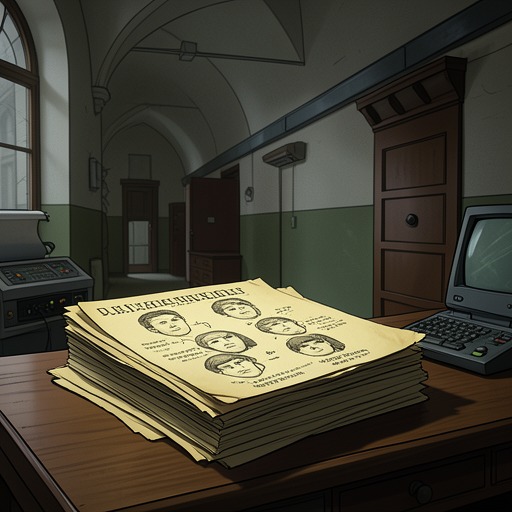
The prison register identifies Valentin as detainee 16115. It records his arrest on October 16, 1972, along Route 5 outside Barrancas, where National Guard troops surrounded a group of activists. The authorities described the group as involved in disturbances alongside strikers at two automotive assembly plants situated along the highway. Valentin was held under the Federal Government’s executive power while awaiting judgment. The record establishes the political circumstances of his imprisonment, but it does not provide a judgment or a sentence for him.
By November 4, 1974, Valentin was lodged in Pavilion A, cell 10, with another political prisoner. His confinement repeatedly brought institutional discipline into conflict with protest. After participating in a hunger strike over the death of political prisoner Juan Vicente Aparicio during police interrogation, Valentin was placed in solitary confinement for ten days beginning March 25, 1975. The prison record also associates him with protests over Pavilion hygiene and the violation of personal correspondence. It labels his conduct rebellious and attributes an instigating role to him, presenting resistance through the hostile language of the institution that confined him.
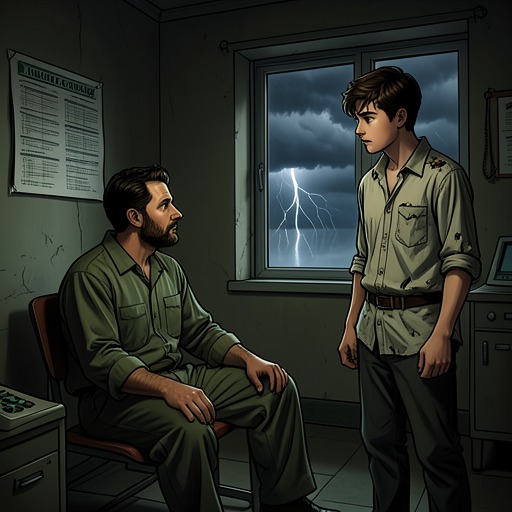
On April 4, 1975, Valentin was transferred to Pavilion D, cell 7, where he shared a cell with Luis Alberto Molina. The transfer joined two prisoners whose cases and positions differed, and it set the immediate conditions for their conversations. The record’s terse facts—cell numbers, dates, conduct assessments—register confinement as an administrative sequence; the dialogue that follows gives that shared space an emotional and ethical dimension.
Political Commitment and Private Crisis
Valentin describes having been tortured but says he did not confess information that could expose his comrades. He explains that he did not know their real names and had given only their combat names, which, in his view, left the police unable to make progress. The account presents both the violence directed at him and the limits of what he could disclose; it does not turn his resistance into a simple story of composure. He says that an inward torment has continued after the physical ordeal, and he wonders whether his political course may have been a terrible mistake.
That doubt is bound up with a newly acute fear of death. After being ill, Valentin fears that his life may end in the prison cell and resists the prospect that the remaining measure of his existence should be confinement. He recalls his commitment to generosity and to fighting the exploitation of others, saying that he had opposed it from the time he began to understand the world. The crisis therefore does not erase his political principles; it places them beside a demand for justice that he had previously associated with religion’s power to distract people from struggles for equality.
In this moment he finds himself asking for divine justice and for the possibility that God exists, despite his longstanding denunciation of religion. The reversal is significant because it emerges not as a settled conversion but as a response to vulnerability: he seeks a justice beyond the prison’s authority while also fearing that death could make his struggle and his life abruptly finite. His appeal exposes the distance between the certainty of political conviction and the uncertainty of a person facing illness and mortality.
Relationship with Luis Alberto Molina
Valentin tries to describe the relationship with Molina as something the two men can shape for themselves. They are alone together, he argues, and no one outside the cell can dictate how they behave toward one another. His image is of an island where they may have to remain together for years: oppression exists beyond the cell, but he says that neither man oppresses the other inside it. This distinction does not make the prison itself free. Instead, it marks out a limited interpersonal possibility within an unfree institution.
The difficulty Valentin identifies is that Molina wants to be kind without demanding anything in return. Valentin wonders whether exhaustion, conditioning, or his own sense of what is permissible makes such kindness hard to accept. His response shows how political language about oppression meets the less familiar challenge of receiving care without treating it as a transaction. The cell’s enforced isolation gives that question unusual weight: the men cannot leave their circumstances, but Valentin imagines that they retain some choice in how they treat each other.
Later, Valentin describes an altered sense of identity in relation to Molina. He says it is as though he were no longer himself, but somehow Molina. The statement registers a movement from defining their relationship as a conscious freedom of conduct toward experiencing the self as entangled with another person. It does not resolve the pressures of imprisonment; rather, it suggests that their shared life has changed the terms in which Valentin understands separateness.
Narrative Significance
Valentin’s portrait depends on a contrast between official classification and intimate speech. The prison register reduces him to a detainee, a cell assignment, a record of protest, and a judgment of conduct. In conversation, he appears as a committed activist who has resisted giving useful information, but also as someone who doubts his choices, fears death, and questions the religious certainties he once rejected. Neither account cancels the other: the political prisoner is also a vulnerable person whose private questions cannot be contained by the administrative label.
His reflections on freedom likewise remain deliberately bounded. Valentin cannot claim liberty from the prison, and his island analogy acknowledges the oppressors outside the cell. What he can imagine is a relationship in which neither person exercises power over the other and kindness need not carry an obligation. His later sense of becoming like Molina extends that idea from chosen conduct into altered identity. Across these moments, the cell is at once an instrument of confinement and the setting in which Valentin tests whether mutual understanding can survive within it.