Éric Reinhardt
L'Amour et les ForêtsÉric Reinhardt is the novel’s first-person narrator and, within the novel he discusses, a writer who appears under his own name. His decisive role is to turn an encounter with Bénédicte Ombredanne from a reader’s letter into an extended act of listening: her account of a divided self first illuminates his fiction, then opens onto the violence and illness that shape her life. Yet he is not an all-knowing witness. His narrative moves among his own recollections, Bénédicte’s letters and manuscripts, and later testimony from others, so his attention to her is inseparable from the limits and responsibilities of telling her story.
Identity and the Novel Within the Novel
Reinhardt describes a novel structured around four protagonists whose storylines never meet, although they gradually emerge as different versions of one person. Each shares the same childhood, parents, tastes, aspirations, temperament, intelligence, and cultural references; after the age of eighteen, their lives diverge according to experience and social milieu. One becomes a London hedge-fund proprietor, another a long-term unemployed recluse living with his mother in the suburbs, a third a geologist working in Germany for a major lime producer, and the fourth a writer who spends time at the terrace of Le Nemours at the entrance to the Palais-Royal gardens. This last figure bears Reinhardt’s own name and is presented as dissatisfied with his writing.
The novel’s organizing question is what Reinhardt might have become had his life taken a different course. He casts the other figures as possible versions of himself shaped by the pursuit of money and power, revenge and self-destructive violence, or withdrawal into a virtual existence. Their shared substance remains perceptible beneath their contrasting social identities, while circumstance alters how that substance is expressed. The design makes identity neither a single fixed profile nor a collection of unrelated roles: the four lives are divergent possibilities that the reader is invited to hold together.
Bénédicte reads this structure as a demonstration that apparently incompatible fragments can be assembled into a more nearly whole person. She tells Reinhardt that the novel helped her feel better and strengthened her belief that someone who experiences the self as divided can still achieve a kind of unity. The writer-character, she argues, is especially important because he seems to contain the other versions while retaining the capacity for happiness and insight that they lack. Her reading turns his formal experiment into a personal possibility: accepting one’s contradictions rather than trying to silence them.
The Letter and the Meetings
Reinhardt’s relationship with Bénédicte begins when her first letter captures his attention through its unusual mixture of fervor and humor. As the letter proceeds, its initially cautious manner gives way to anger, irony, and an unruly energy. He senses beneath its audacity a timidity that the writer has had to overcome in order to send it, and he reads the letter as an urgent escape from a life that is painful or intolerable to her. This is an intuition rather than a conclusion he can prove from isolated examples, a qualification that anticipates the uncertainty with which he will interpret her life.
In his reply, Reinhardt tells her that the letter moved him and that she had made an unintentional self-portrait. He invites her to contact him when she next visits Paris so that they can have a drink. He says the invitation arose from ordinary courtesy rather than from speculation about her appearance, while also acknowledging that he had imagined the possibility that her outward presence might match the intensity he perceived in her writing. His account preserves both impulses: the wish to meet the person who wrote so vividly, and his awareness that physical attraction had crossed his mind.
They meet twice on the terrace of Le Nemours café near the Palais-Royal. The first meeting, in March 2008, is awkward for both of them; Reinhardt does most of the talking while Bénédicte asks questions about how he writes his novels. He later recognizes that his own disclosure of anxiety may have helped her risk a more personal confidence. In the weeks afterward, she asks how his novel is progressing and whether he has overcome his writing block. He has little desire to discuss his work and no appetite for a steady correspondence, so he evades her questions and their contact dwindles.
The second meeting takes place on a Sunday in September, several months later. Reinhardt admits that he had almost refused another appointment and had answered her requests with vague messages about an unpredictable schedule. Bénédicte persists, following up each day and writing again on the morning of her departure from Paris. He feels unable to refuse her insistence clearly, and the two meet. This time she speaks for four hours about her life. He sustains her account with questions and gentle encouragement, understanding that she has kept much of it to herself for years. Afterward, shaken by what he has heard, he resumes contact by text message and email both to offer comfort and to ask her to clarify episodes that the conversation had only touched on.
Listening, Testimony, and Narrative Limits
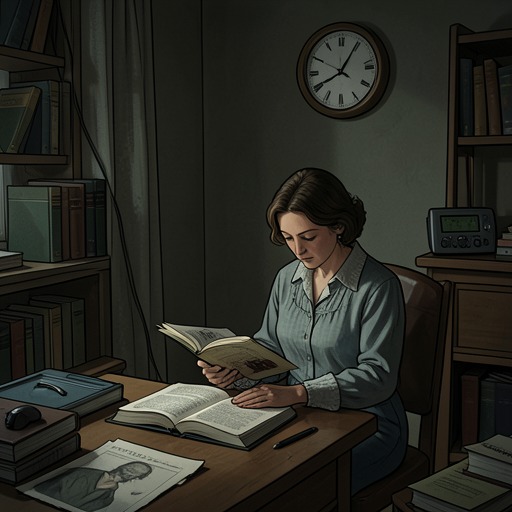
During the September conversation, Bénédicte recounts terrible events in a clinical, detached manner, as though describing a distant case. Reinhardt, by contrast, struggles to keep from showing his distress and feels an impulse to embrace her or take her hand. He notices the physical signs of exhaustion in her face and the black polish on her nails, gathered around the bowl of her wineglass, as well as the old-fashioned jewelry she wears. These details register not as proof that he understands her, but as the visible setting in which he receives an account whose severity exceeds the elegant café around them. He tells her that she must take steps to change her situation and offers help; she agrees in principle, yet says she can see no practical way out and sometimes feels close to giving up.
Reinhardt’s account also records the awkwardness of his position. He does not simply witness Bénédicte’s life as it happens: he reconstructs it from her telling, her writing, and other people’s memories. He later visits Clinique Sainte-Blandine to inspect its layout because details in the pages Bénédicte sent him in autumn 2008, written during her stay from July 6 to 21, 2006, were not clear to him. The decision to make that visit explicit exposes the work behind his narration. He is trying to give readers a precise sense of the place, but the account remains a retrospective reconstruction assembled after the experiences he describes.
At their conversation, Bénédicte explains that she wanted to remain at the clinic long enough to make a radical decision about her future. The psychiatrist allowed her four additional days but ultimately told her she would have to return home. Reinhardt listens as she describes the short stay as insufficient time to build a new life, and the recollection places his encouragement beside a material limit: the refuge she had found could not continue indefinitely. The evening light on the Paris terrace seems to him to promise happiness and decisive encounters, and he feels that she will emerge from her ordeal. That hope belongs to his perception in the moment, not to an assurance the subsequent story can guarantee.
Bénédicte’s Later Story as It Reaches Him
The later account of Bénédicte’s illness reaches Reinhardt through Marie-Claire Ombredanne’s recollections, rather than through his own presence at the events. Marie-Claire describes how Jean-François Ombredanne repeatedly dismissed Bénédicte’s physical complaints and insisted on strenuous walking, treating her pain as psychological or exaggerated. In the Cotentin, Bénédicte was forced to continue a week-long hike despite severe back and leg pain, fatigue, and tears; a doctor prescribed painkillers after the second day. The account also recalls an earlier collapse during a forced walk, when Bénédicte was found to be close to a pulmonary embolism because of clots in both legs. Her symptoms and her husband’s interpretation of them thus enter Reinhardt’s narrative through a sister who remembers how often they were minimized.
After the trip, a phlebologist examined a painful lump below Bénédicte’s ribs and urged her to seek urgent hospital care. Tests established that she had widespread cancer, with metastases in a lung, liver, bones, and adrenal glands. Marie-Claire recalls having noticed her sister’s altered complexion and a small morning cough months earlier, although the December tests had shown nothing abnormal. The narrative distinguishes those retrospective suspicions from the later diagnosis: what Marie-Claire believes she saw is not presented as medical confirmation at the time.
Marie-Claire’s testimony also brings Reinhardt close to the final consequences of Jean-François’s refusal to take Bénédicte’s distress seriously. On a Friday visit, she finds her sister gravely weakened by chemotherapy, unable to keep food down, and asking to be taken to hospital. Jean-François has refused, insisting that her condition is due to treatment rather than the disease. Marie-Claire takes Bénédicte’s request seriously and recognizes that urgent medical care is needed; Bénédicte is hospitalized for three days to regain some strength before later being admitted to the public hospital in Metz. These scenes are not presented as Reinhardt’s eyewitness memories. Their force depends on his receiving and transmitting Marie-Claire’s account, just as his earlier knowledge of Bénédicte depended on her letters and the four-hour conversation.
Narrative Role
Reinhardt’s character is shaped by a contrast between his attentiveness and his hesitation. He can recognize the urgency beneath Bénédicte’s letter and later make room for her extended confession, but he initially avoids her questions about his work and admits that he handled the prospect of a second meeting evasively. After hearing what she has endured, he chooses to sustain the correspondence and seek a fuller account. That change does not make him a rescuer or an authority over her experience; it makes him the recipient through whom a dispersed story becomes legible.
His self-insertion as a dissatisfied writer also links the novel’s formal preoccupation with divided identity to the act of narration itself. Bénédicte’s interpretation of his fiction gives her a language for imagining wholeness, while her letters and testimony complicate any easy claim that a story can repair the life it describes. Reinhardt’s narrative role is therefore double: he is an object of Bénédicte’s reading and a reader of her life, attentive to the possibility of self-reinvention yet confronted by the stubborn realities that constrain it.