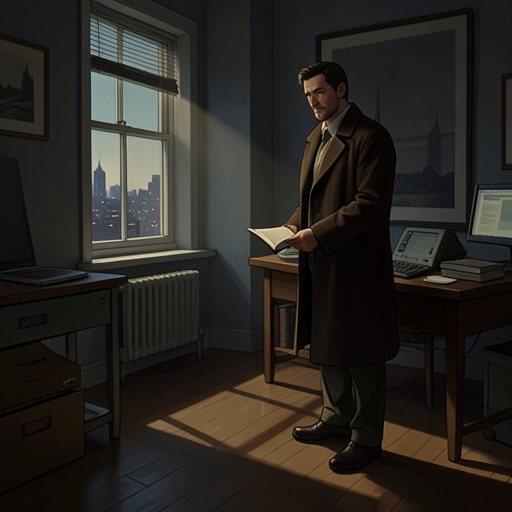
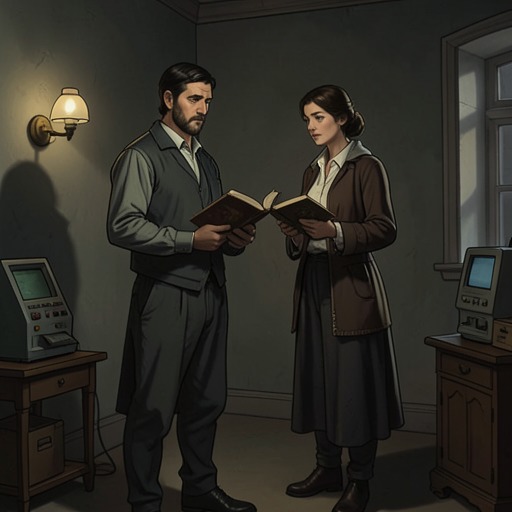
Éric discovers Bénédicte's death and travels to Reims to meet Marie-Claire
L'Amour et les ForêtsÉric Reinhardt discovers Bénédicte Ombredanne’s death only after every direct means of contacting her has failed, and travels to Reims to meet the sister whose existence he did not know. The journey turns a sudden, impersonal search result into a personal reckoning: through Marie-Claire Ombredanne, he learns that Bénédicte had a twin and hears how her final illness was recognized, contested, and eventually treated. The event joins the loss of a friend to the belated recovery of the life she had kept from him.
The silence and the search
In March 2009, Bénédicte had telephoned Éric to ask that they suspend their contact and that he send no messages. Her husband had discovered her second phone, hidden behind the collected works of Mallarmé, after its quiet notification sounded while he was nearby. He read tender messages exchanged with another man, and the discovery led to a violent confrontation. Bénédicte told her husband the messages were from Éric, presenting them as affectionate but not romantic, in order to divert suspicion from the person she had recently met. She then warned Éric that they should stop communicating for a time. The episode explains why, when she vanished from his life again, he approached the possibility of contact with caution rather than simply sending a message.
In 2011, an email to Bénédicte’s address came back undelivered. Éric remembered that she had once forbidden him to use her phone number, so he did not send a text asking for a new address. Instead, he called her numbers from his office phone. Both had been disconnected. The practical dead ends sharpened into a more terrible possibility when he searched her name online: as he typed, the search engine suggested a query identifying her death. He opened a link to an online copy of a death notice. It listed her death on January 23, 2011, and gave Condé-sur-Marne as the location of the religious ceremony. The notice also connected the death to Reims, giving Éric a lead to follow.
Finding Marie-Claire
Éric called Beauté Turquoise, a beauty salon in Reims, and arranged a facial for the following day. He first asked whether the service was available to men, then sought to establish who would perform it. The woman on the phone said that she was the only person working there. She did not react noticeably when he gave his name, though he had wondered whether Bénédicte might have spoken to her sister about his books. The salon appointment offered him a way to meet the family member suggested by the notice without first making an uncertain approach by telephone.
The next morning, he collected his train ticket at Gare de l’Est and travelled to Reims, tired after a troubled night. He walked to the salon on the rue des Élus, guided by his phone, arriving at the appointed time with a small bag containing spare clothes and a toothbrush. The ordinary details of the trip—ticket, train, appointment, address—mark the effort required to turn an online trace into an encounter. At the salon, the woman who had booked him began the treatment and encouraged him to relax. Éric then asked directly whether she was Bénédicte’s sister. Marie-Claire stopped what she was doing and regarded him with immediate suspicion. His question changed the appointment from a routine service into the first face-to-face exchange between Bénédicte’s confidant and her family.
The hidden twin
Marie-Claire’s answer revealed a relationship Bénédicte had never told Éric about: she was her twin sister. The disclosure startled him, and Marie-Claire was surprised that he had not known. She described how others had always seen the sisters as opposites. She portrayed herself as physically imposing, energetic, intensely active, and driven by a longstanding fear of having too little; Bénédicte, by contrast, was more inward, less physical, and more anxious, though she had been more expansive when young. The contrast did not erase their bond. Marie-Claire spoke of Bénédicte as her twin, and her account gave Éric access to a family intimacy beyond the correspondence and confidences he had shared with her sister.
The disclosure also altered the meaning of Bénédicte’s silences. Éric had known the isolated woman who described her husband’s close monitoring of her movements and the interrogations that followed her afternoon away. He had not known that she had a twin sister living within the family circle, or that the person who could later explain her final months was already part of her closest history. The meeting therefore supplies not just a missing identity but a new vantage point on what Éric could and could not know of Bénédicte’s life.
Marie-Claire’s account of the illness
Marie-Claire recounted that in December, when Bénédicte visited Condé-sur-Marne, she looked unwell and had a slight cough on waking. Bénédicte said that recent medical tests had shown nothing abnormal and attributed her fatigue to a demanding period. Marie-Claire, however, remembered being alarmed by her sister’s appearance and symptoms. The difference between what Bénédicte reported and what her twin suspected becomes consequential in retrospect, but Marie-Claire’s account does not make the diagnosis immediate or certain at the time.
In February, Jean-François insisted that Bénédicte join a long walk in the Cotentin, treating her complaints of pain and exhaustion as evidence of anxiety or poor physical condition rather than illness. He had previously pushed her to exercise when she felt unwell, despite an earlier episode in which she collapsed during a forced walk and required emergency assistance. During this trip Bénédicte continued walking for a week despite severe back and leg pain, and even Lola came to blame her for spoiling the holiday. After a sudden stop on the return journey, Bénédicte’s pain worsened. At a scheduled appointment, a specialist examined a lump she had noticed near her abdomen and told her to seek urgent hospital care. Tests then found cancer that had spread to several organs; the doctors could offer no curative treatment. Marie-Claire believed signs of the disease had already been present in December, though the earlier tests had not detected them. Bénédicte died ten months later, on January 23, 2011.
Marie-Claire also described the final period as one in which Bénédicte’s access to care and control over her own treatment were constrained. Jean-François prepared and supervised her medication, keeping the prescriptions and deciding the doses. When treatment left Bénédicte profoundly weak and unable to keep food down, she wanted to go to hospital, but he dismissed her condition as the effects of chemotherapy and refused. During a visit, Marie-Claire found her sister gravely unwell and learned that her request for hospital care had been rejected. She helped secure an admission, where Bénédicte stayed three days to regain strength; later, she was to be transferred to the public hospital in Bénédicte’s home city of Metz. These episodes clarify the stakes behind Marie-Claire’s role: her presence helped Bénédicte obtain medical attention when her own account of her suffering was being discounted.
Significance of the encounter
The event moves from failed communication to recovered testimony. First, disconnected accounts and an online notice establish the fact of death; then a deliberate journey brings Éric to a person able to supply the family and medical histories he lacked. The revelation of the twin relationship makes the encounter intimate, while Marie-Claire’s account exposes the distance between Bénédicte’s reported symptoms, her husband’s interpretations, and the medical findings that finally confirmed the seriousness of her condition.
The meeting cannot restore the relationship that ended in silence, nor can it give Éric direct access to Bénédicte’s last thoughts. Its consequence is instead a more complete, though still mediated, understanding. Marie-Claire’s memories place Bénédicte’s death within a sequence of symptoms overlooked, pain minimized, and care delayed, while the journey to Reims transforms a search-engine result into a human exchange. The sister whom Bénédicte had never mentioned becomes the witness through whom her final history can be told.