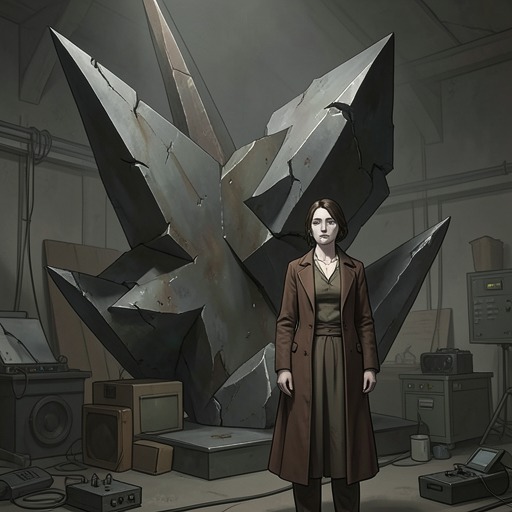
Abstract Sculpture on the Roundabout
L'Amour et les ForêtsThe Abstract Sculpture on the Roundabout is a recently installed public artwork that becomes, in Bénédicte Ombredanne’s perception, a portrait of her own entrapment. Its angular, harsh form first catches her attention on the road to school; later, she imagines herself absorbed into its steel, and the image returns in her bathroom mirror amid the strain of her husband’s prolonged interrogations.
Appearance and Setting
On her journey to school, Bénédicte passes a roundabout where the abstract sculpture has recently been installed. She examines it carefully, wondering what it represents, then forgets it until she passes it again that evening or the next morning. The repeated encounters make the work part of an ordinary route, a fixed presence in the rhythm of her daily life.
The sculpture’s angular, discordant appearance initially resists interpretation. After a sleepless night, Bénédicte suddenly understands it as an image of herself: a steel cramp and migraine, a repellent urban presence. The recognition is not a literal likeness but a frightening interpretation of what her life has made her feel she is becoming.
The Sculpture as a Self-Portrait
A few days later, Bénédicte experiences the identification more intensely. In her mind, she sees herself standing within the roundabout, alive but absorbed by the sculpture, inscribed in its steel and trapped in its corrosion. The public artwork has become a figure for a self enclosed and altered by circumstances she cannot readily escape.
This imagined enclosure resonates with the restrictions surrounding her. Bénédicte explains to Christian that her husband keeps track of her schedule and expects to be able to contact her; she has deliberately gone beyond his awareness for several hours and anticipates having to face the consequences. Elsewhere, the repeated accusations and questioning of Jean-François are described as an inescapable forest of words. The sculpture gives this continuing pressure a visible, external form: rigid, exposed, and without an apparent way out.
Recurrence and Consequences
When Bénédicte turns away from the terrifying image at the roundabout, she is involved in a car accident. The collision is not serious, but it frightens her; she remains still for a long time, crying with her hands gripping the steering wheel. The sequence links her recoil from the sculpture to a sudden interruption of her ordinary journey, without making the artwork itself the physical cause of the crash.
The image returns later in the bathroom mirror, after Jean-François has repeatedly compelled Bénédicte to recount her affair. She sees the same steel abstraction in her reflection, amid a mental din that she associates with the roundabout’s traffic and with words and phrases. The vision recedes; she recognizes herself again as alive, exhausted, and sad. Soon afterward, she takes twelve Xanax tablets. The sculpture’s recurrence thus marks the persistence of her distress, while the movement from the roundabout to the mirror brings its metaphor into the private space of her marriage.
Narrative Significance
The sculpture changes from an object Bénédicte intermittently observes into a framework through which she perceives herself. Its importance lies in that change of scale: an ordinary feature of the road becomes an image of psychological confinement, then reappears in a moment of acute crisis. The contrast between the fixed metal form and Bénédicte’s attempts to turn away from it gives the object a recurring narrative role, registering the pressure of her circumstances without reducing that pressure to a single incident.