Arthur
L'Amour et les ForêtsArthur, the young son of Bénédicte Ombredanne and Jean-François Ombredanne, is seen through brief family scenes that make the children’s exposure to domestic conflict unmistakable. At five, he is affectionate and imaginative, but also sensitive to the fear and strain around him. His small acts—hiding beneath a duvet, confirming his sister’s account, or clinging to a sofa rather than going to bed—register a child trying to make sense of adult behavior that repeatedly unsettles the home.
Identity and Family
Arthur grows up with his older sister, Lola, in a household where ordinary family life can abruptly give way to silence, anger, and anxious waiting. The children’s father is at times attentive to them, but his conduct toward Bénédicte and his sudden outbursts shape the atmosphere in which they live. Arthur’s behavior is presented not simply as a matter of temperament: his aunt later describes him as highly sensitive to the unhealthy family environment and suggests that its effects show in his conduct.
The children are close to their mother in moments of security. When Bénédicte returns home one evening to find the house dark and unnaturally quiet, she discovers Lola and Arthur together beneath the covers in his room. Reassured that they are there, she collapses onto the bed, still wearing her coat. The children reach for her and cover her with affection; she holds them against her and rocks them until their breathing settles into a shared calm. Arthur’s room, crowded with stuffed animals, becomes a temporary refuge from a house that has seemed deserted and frightening.
A Child in the Midst of Anger
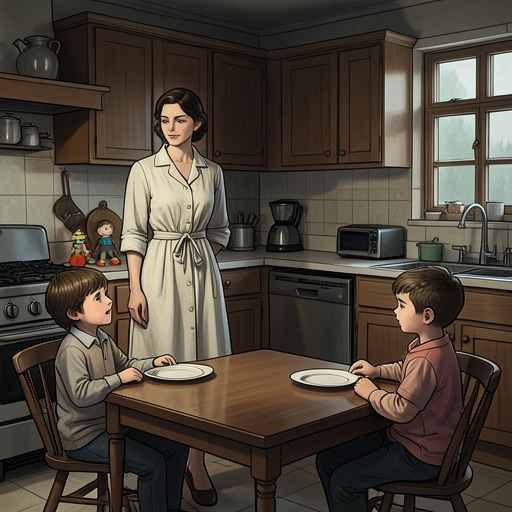
Arthur’s account of one evening helps establish how the children encounter their father’s anger. While he and Lola were eating in the kitchen, Jean-François was listening to the radio and told them to be quieter. He then ordered them out of the room. When Lola objected that they had only just begun their meal, their father shouted at her. Arthur backs up his sister’s version: they had been very quiet, and their father had shouted extremely loudly. His confirmation is simple, but it matters; the scene is not only an argument between adults, and the children are not merely elsewhere while it happens.
Afterward, the children went to watch a film in the living room while their father remained in the kitchen. He eventually left by slamming the door. Arthur makes the sound of the slam into a performance, closing his eyes and thrusting out his hands as he describes it. The comic imitation briefly gives him control over the story of what frightened him, though the scene’s humor does not erase the force of the disturbance. The next day, the children eat a pizza whose underside has burned while their father paced and muttered; they do not dare tell him. Their dinner, reduced to the topping and then the crisp outer edge, is one of the ordinary adjustments the children make around his mood.
A further bedtime scene shows Arthur’s distress turning into resistance. When Bénédicte switches off the television and tells him to go to bed because he has school the next day, he cries and clings to the sofa. Jean-François arrives and uses the dispute to criticize Bénédicte in front of the children. Arthur eventually lets his father take him to bed, but when Bénédicte comes to say goodnight, he has disappeared beneath the duvet and does not answer her. At five, he has found a way to make his silence hurt in return. The scene suggests how a child can be pulled into the parents’ conflict even when the immediate disagreement concerns his bedtime.
Witness to His Parents’ Conflict
The children are also awakened by a night-long confrontation between their parents. They come to the doorway at different times and see Jean-François in tears while Bénédicte, furious, continues the argument. Arthur asks why she is shouting at his father. She turns to comfort the child who has appeared, gives him a brief reassurance and a kiss, and closes the door again; on two occasions she takes Arthur back to bed and tucks him in. The children’s repeated visits show that the dispute has broken through the boundary of the adults’ room. They are frightened enough to seek an explanation, but Bénédicte’s brief attention cannot make the larger conflict comprehensible to them.
By morning, the family returns to routine without resolving what the children have witnessed. Bénédicte prepares breakfast, helps Arthur get ready for school, and goes to work. She and Jean-François exchange no words or even looks over breakfast; the children, exhausted by the night, say little for fear that the confrontation will begin again. The contrast between the previous night and the familiar sequence of breakfast and school suggests how instability can become embedded in domestic routine. Later, Jean-François tells Bénédicte that Arthur’s misbehavior is her fault, making the child’s difficulties another point of accusation between the parents.
Changing Bonds and the Final Illness
Bénédicte’s relationship with Arthur changes as her illness advances. During a visit while she is seriously ill at home, he stands and embraces her around the waist. She leaves her arms at her sides. Her twin sister, who witnesses this, finds the absence of a returned embrace striking and wonders whether Bénédicte has become so consumed by illness and the knowledge of approaching death that she is withdrawing from the people around her. The scene does not establish that Arthur has stopped seeking her affection; rather, it shows the painful gap between his gesture and his mother’s diminished capacity to respond.
As Bénédicte becomes weaker, Jean-François brings the children to see her every evening, treating the visits as a duty. They last too long, according to her sister, and the children become bored while Bénédicte has to appear before them increasingly debilitated. Bénédicte would have preferred to see them less often but for shorter, better visits. The routine therefore places Arthur in the presence of his mother’s decline without ensuring that the time together can offer comfort. The account’s emphasis is not on a final exchange between them, but on the strain of these repeated visits and the different ways the adults understand what the children need.
Narrative Significance
Arthur’s scenes give the family’s tensions a child’s scale: a dark house, an overcooked meal, a slammed door retold with theatrical gestures, a bedtime refusal, and a silent goodnight. These details show the consequences of conflict without making Arthur an interpreter of its causes. His sensitivity and unruliness are later connected to the atmosphere at home, while his moments of tenderness toward Bénédicte reveal a bond that persists even as her illness and emotional withdrawal alter how she can meet it. Through Arthur, the novel makes the children’s experience part of the record of the marriage: they hear, witness, adapt, and carry the effects of what the adults cannot contain.