Bénédicte Ombredanne
L'Amour et les ForêtsBénédicte Ombredanne is a teacher whose attempts to define and direct her own life unfold against the sustained control of her husband, Jean-François. Her story turns on a contradiction: she experiences a day of rebellion as proof that she can still act freely, yet the consequences expose how little room her marriage leaves her. Letters, confidences, and the pages she writes at Sainte-Blandine gradually make visible a person whom the demands of domestic life and her own fear had kept largely unexpressed.
Identity and first appearance
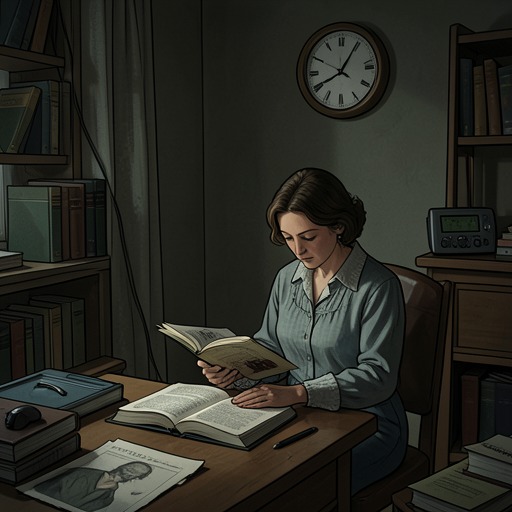
Bénédicte first enters Éric Reinhardt’s account through a letter. Its two pages combine fervor with humor and are written with a polish that moves and amuses him. He becomes curious about her not simply because she is in distress, but because the letter conveys a distinctive voice: quick, ardent, and capable of tempering intensity with wit. She initially contacts him to explain how his latest book has changed her life; before long, she is also telling him about the life from which she has been trying to awaken.
The letter gives Éric an image of a person divided among several selves that she has struggled to reconcile. Much of this complexity, she has kept enclosed in private silence. As a result, she has not been able to develop in accordance with her real desires or to show the subtler parts of her character. Her predicament is described as a paralysis before her own complexity, but her wish is not merely to escape it: she wants the courage to decide who she will be and to try new ways of bringing her mind into view.
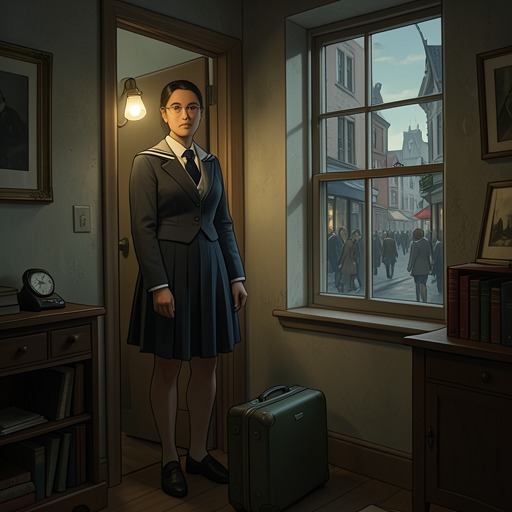
Bénédicte works as a primary-school teacher, teaching pupils in the equivalent of the final year of elementary school. She had passed the agrégation, a demanding French teaching qualification, and remembers that achievement as a time when she could pursue a goal with determination. The contrast between that earlier capacity and her later sense of confinement matters: the novel presents her not as someone without will, but as someone whose will has been pressed into a narrow and increasingly painful space.
Marriage, surveillance, and confinement
Bénédicte describes a marriage in which Jean-François expects to know where she is and when she can be reached. He has her work timetable and expects her to return home after classes; even where she can technically go out, she says he follows her movements closely. Her account distinguishes this arrangement from literal captivity, but its constant monitoring leaves her aware that any unscheduled absence will have consequences. On the day she disappears from his view for several hours, she recognizes that she will have to face those consequences, even as she hopes they will be limited.
The pressure is not confined to schedules. After her affair, Jean-François’s repeated questioning becomes a daily ordeal. He calls several times a day, wakes her at night, and resumes his inquiries in the morning, including when she is trying to shower. He presents his own distress as something she must relieve by explaining what happened, returning again and again to the fact that she had been with a man she had known only briefly despite their thirteen years together. In the novel, the repetition itself becomes a form of enclosure: his questions accumulate like a dense forest with no visible way out.
His treatment of her also swings between self-reproach and blame. At times he casts himself as the person who has made her life unbearable and pleads with her not to leave; at other times he accuses her of ruining his life and attacks her appearance and femininity. This alternation does not resolve the conflict or restore trust. Instead, it keeps Bénédicte occupied with his changing claims and leaves her navigating a relationship in which even her clothing and ordinary decisions can become grounds for judgment.
The monitoring extends to private communication. Bénédicte hides a second phone in her office library, behind Mallarmé’s collected works, but leaves its text-message alert switched on at a low volume. When the phone makes a sound while Jean-François is with her, he tracks it down among the displaced books and finds messages between Bénédicte and another man. The messages are tender but not explicit. Their discovery precipitates a rage-filled confrontation, turning the concealed phone into evidence of both her attempt at a private life and the precariousness of that attempt.
Rebellion and its cost
One evening in March 2006, Bénédicte returns from a late meeting at her school. The meeting has run on, in part because a physics teacher brought sparkling wine for his birthday. From the street she notices that her home is dark, with none of its usual lights or sounds. The contrast with the television, children’s arguments, games, and after-dinner activity that ordinarily fill the house makes the apparent absence of its occupants striking. This scene introduces a life organized around domestic routines, before her anger redirects her attention toward a more deliberate act.
Bénédicte goes online to Meetic and undertakes the tedious registration process with unusual focus. She later explains that she signed up in anger without knowing what she was looking for; after meeting Christian, she understands the encounter as the answer she had been seeking. Her profile is created with resolve, and she recalls feeling as determined as she had when preparing for and passing the agrégation. The decision to seek an encounter is therefore both impulsive and purposeful: it begins in anger, but becomes a way to test whether she can act outside the role assigned to her.
Bénédicte describes her meeting with Christian as a means of proving that she can loosen Jean-François’s hold, take initiatives for herself, and live, at least secretly, as a free woman. She insists that she has not capitulated and that she remains the person directing her life. Beauty, in her account, remains something she can seek out for herself; neither her husband, her children, her school, nor social convention should have the final say over every choice. Her insistence is not presented as an uncomplicated emancipation. It is the voice of someone asserting a right she has had to claim in defiance of the structures around her.
The encounter also carries an outcome she cannot control. In retrospect, Bénédicte calls that rebellion the most beautiful day of her life, but also the beginning of her downfall. Jean-François’s response converts the episode into a continuing crisis: he repeatedly demands an account of it, and the affair becomes the focus of his nightly questioning. What she experiences as a brief opening into another possible life is followed by the narrowing of her days around his suspicion and distress.
Hospitalization, relationships, and writing
Bénédicte’s exhaustion eventually becomes severe. She cries constantly, cannot sleep, and is advised by her doctor to rest at Sainte-Blandine. When a psychiatrist there asks about her home life, she remains evasive. She attributes her condition to profound fatigue after recurrent insomnia and insists that she has no particular family problem. Although she senses that the psychiatrist suspects Jean-François may be involved, she firmly refuses his offer to meet him. Her reticence shows how little she is ready, at this point, to make the marriage legible to someone outside it.
At Sainte-Blandine, sleep and writing begin to alter her relation to herself. After sleeping for seventy-two hours, she finds that the value of an ordinary sheet of paper and the value of her own person are becoming perceptible again. As the pages accumulate, she reads them as a kind of mirror in which she can recognize herself as distinct, singular, and estimable. Her renewed self-regard develops gradually rather than arriving as a sudden cure: at first she approaches it tentatively, then with increasing conviction as she continues to write.
She also becomes attached to the people she meets during her stay. Two weeks are enough for her to feel closer to them than to many people she knows outside the clinic. She contrasts their willingness to confront what they have hidden from themselves with the small, often unnoticed capitulations that had shaped her own life before her overdose. The comparison is not simply a judgment of outsiders: it marks her growing recognition of the distance between appearing to manage a life and being honest about what that life has become.
Bénédicte wants to remain at Sainte-Blandine long enough to make a radical decision, but the psychiatrist grants only four additional days before telling her she must return home. The limit matters because the clinic has become a temporary space in which she can rest, write, and imagine a choice; leaving it sends her back into the conditions from which she has not yet found a lasting exit. Her friendship with the other patients and the pages she produces offer real support, but they do not remove the pressures waiting beyond the clinic.
Illness, dependence, and ending
Bénédicte is diagnosed with severe, stage-four breast cancer in late 2006. Her treatment includes eight courses of chemotherapy, breast-conserving surgery, and daily radiotherapy for seven weeks. The illness adds a new vulnerability to a life already shaped by dependence and exhaustion. Later, as her condition worsens, Jean-François takes charge of her medication: he keeps the prescriptions, knows the doses, and sets out her capsules and a glass of water each morning, waiting until she has taken them all. Marie-Claire, Bénédicte’s twin sister, sees this arrangement as making Bénédicte more dependent and infantilizing her rather than allowing her to manage her own body and treatment.
Near the end of Bénédicte’s life, Marie-Claire arrives at the home and finds Jean-François answering the door. He says Bénédicte is in bed and minimizes her complaints. In the bedroom, Marie-Claire finds her sister markedly weakened. Bénédicte indicates that she wants to go to hospital and fears that she will die if she remains at home; Jean-François, by contrast, has assured her that what she feels is a side effect of chemotherapy rather than the disease. The sisters’ exchange makes the stakes of the disagreement unmistakable: Bénédicte wants medical care and the support of a team, while her husband’s reassurance keeps her at home.
Bénédicte dies on 23 January 2011. The novel’s account of her life does not make the rebellion of 2006 a simple turning point toward freedom: its promise remains real, but so do the long aftermath, the return to a coercive marriage, and the later dependence imposed by illness. Her first letter, her writing at Sainte-Blandine, and the confidences she entrusts to Éric preserve another dimension of her identity. They show a woman whose capacity for humor, reflection, desire, and self-recognition persists even when she cannot secure a lasting escape from the conditions that constrain her.