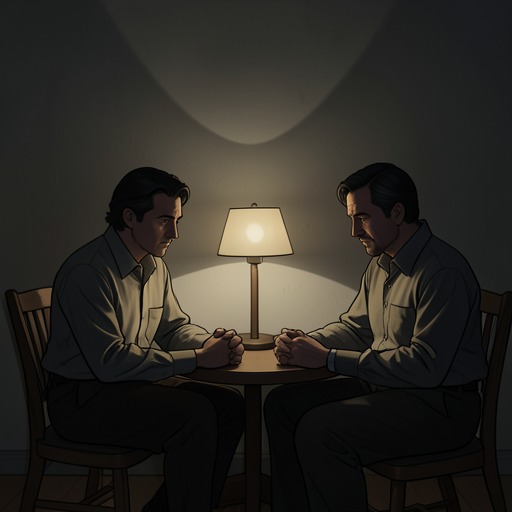
Bénédicte breaks off correspondence with Éric
L'Amour et les ForêtsBénédicte Ombredanne’s break in communication with Éric Reinhardt was an abrupt act of protection, made under pressure after her husband discovered a secret phone. In a hurried call in March 2009, she asked Éric to stop contacting her while she tried to contain the consequences at home. The interruption was not a simple falling-out: she had used Éric’s name to shield another relationship, and the deception placed him inside a conflict he had not known existed.
The call and its circumstances
In March 2009, after several weeks without news from Bénédicte, Éric received an unexpected call while waiting outside an elementary school for his son. Bénédicte sounded distressed and spoke quickly and quietly. She said that their contact had to be suspended for a time and, in particular, that Éric must not send her text messages. He pointed out that he never did so; she explained that she wanted to warn him in case he might be tempted to. Her urgency made clear that the request was not a casual decision but a precaution taken while she feared being overheard by her husband.
Bénédicte explained that she had recently met someone with whom she got along well, accounting for her silence in the preceding weeks. Her husband had found a second phone she had concealed in the bookcase in her office, behind the complete works of Mallarmé. A quiet text-message alert had sounded while he was with her; he traced it to the hidden device, moved the books, and discovered messages exchanged with the other man. The messages were tender and affectionate, but not explicit. After reading them, her husband reacted with anger and shoved her against a wall as he took the phone. Bénédicte said this was the first time he had physically attacked her.
Éric named as a diversion
Her husband suspected that the messages came from the man with whom she had had an affair in Strasbourg three years earlier. Because the texts did not contain erotic content, Bénédicte persuaded him that this was not the case. She also denied that the sender was a new lover. To end his suspicions and protect the man she had actually met, however, she told her husband that the messages came from Éric.
The choice drew on the fact that her husband regarded Éric as inaccessible and knew that Bénédicte had once met him for a literary conversation. She had concealed a later meeting from her husband, but presented Éric as an author who had become fond of her because of what she had said about his novels. Her husband resented the messages and felt diminished by Éric’s esteem for his wife, she told Éric, but she believed he would not dare confront him. She had promised her husband, on their son Arthur’s life, to end the contact. If she had not supplied Éric’s name, she feared she would face four months of relentless interrogation to identify the sender; her husband might also have called the number. She therefore asked Éric not to answer any call from an unknown number and to delete a voicemail without listening to it.
A request shaped by coercive control
The call belongs to a wider pattern in which Bénédicte’s communication and movements were subject to her husband’s scrutiny. She had previously explained to Christian that she had no mobile phone because her husband feared she would use one to create a social life beyond his control. He had her schedule and expected her home after classes; she described him as knowing where she was at all times. Her decision to spend several hours outside his reach had already led to consequences she expected to be difficult, though she hoped they would be limited.
After the affair in Strasbourg, her husband’s questioning had become an exhausting routine. He called repeatedly, sometimes woke her during the night, and pressed her to recount the same events again. Against that background, the discovery of the second phone threatened a renewed period of interrogation. Bénédicte’s request to Éric was therefore both a boundary and a calculated attempt to reduce danger: no messages, no calls returned, no voicemail retained, and no contact until she herself judged that matters had settled. The secrecy around her correspondence was consistent with other precautions she took, including using a separate email account and avoiding opening it on her home computer.
The rupture and its aftermath
Éric agreed outwardly that Bénédicte had been right to use him as a shield, but privately felt unsettled at having been made part of a lie about an affair she had never told him about. He was also troubled by the possibility that her husband might retaliate against him. At the same time, he believed Bénédicte deserved the chance to spend pleasant moments with someone who treated her tenderly, and accepted the role of diversion for her sake. His support did not erase his sense of having been placed in a compromising position without warning.
Bénédicte ended the call abruptly, saying that her husband was returning, and then disappeared for months. Éric was disappointed that she did not follow up to say whether the deception had worked, but he did not contact her again. The silence became a mutual withdrawal rather than a formally settled end: she had asked to resume contact only when she chose, while he held back after feeling used and exposed to possible risk.
Later contact
About a year later, in April 2010, Bénédicte emailed Éric to wish him a happy birthday. He did not reply, and she did not write again. Their exchanges thus remained suspended, extending the silence that followed the call outside the school.
In April 2011, Éric initiated contact by asking how she was and telling her that he had finished a new, substantial novel. He offered to send it after publication, with a discreetly coded dedication so that it would not arouse her husband’s suspicions. His message recalled the earlier image of a dart aimed at her heart, but described the new book as something more forceful. The renewed communication did not undo the break or establish that the danger around her had passed; it marked a cautious attempt to reopen a channel that had been closed under pressure.