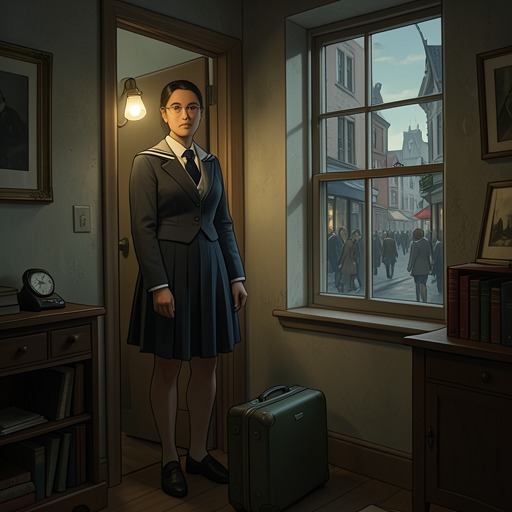
Bénédicte's depression and retreat into her parents' home after divorce
L'Amour et les ForêtsBénédicte's depression and retreat into her parents' home after divorce marked a lasting rupture in her adult life: the collapse of her marriage to Olivier became, in her twin Marie-Claire's account, a collapse of the faith in reality that had shaped her. At twenty-two, Bénédicte returned to Condé-sur-Marne and shut herself in her room. The crisis lasted six months, but its effects, Marie-Claire believed, did not end with it.
The marriage's abrupt end
Olivier left in August 1992, one week after Bénédicte had passed the agrégation. The departure followed the announcement that a cousin would take over the family farm when their father retired, a decision expected five years later. Olivier left without saying goodbye to anyone. He requested a divorce in September, and the divorce was completed in December. The couple had had no children.
For Marie-Claire, the timing intensified the force of the rupture: Bénédicte was beginning her adult life and had just achieved an important qualification when the marriage ended. She understood that the relationship had been going wrong. Olivier spent evenings out with his friends and had been seeing other women; those signs had not, however, prepared her to bear the separation. The disparity between what she could recognize about the marriage and how devastating its end felt became one of the defining contradictions of the crisis.
Withdrawal in Condé-sur-Marne
After the divorce, Bénédicte returned to Condé-sur-Marne and remained shut in her room for three months. Marie-Claire recalled the withdrawal as the outward form of a much larger inward disorientation: Bénédicte had begun adult life with the sense that something essential in her had been destroyed, though, in practical terms, her future still held the same possibilities it would have held before the marriage failed. The event was therefore not simply grief over a relationship. It was the experience of being betrayed by the reality she had trusted, and of finding that the injury seemed to reach beyond the marriage into her capacity to imagine happiness.
Marie-Claire remembered Bénédicte as a great idealist who felt that the party was over for good. Bénédicte could not see how to recover from the shock and betrayal. The language of permanent loss, as Marie-Claire recounts it, conveys the scale of Bénédicte's despair rather than an objective end to her prospects: she was young, and the divorce had not removed the possibilities ahead of her, but those possibilities no longer felt available to her in the same way.
The collapse of a secular faith
Marie-Claire interpreted the depression as the destruction of Bénédicte's basic trust in life. Bénédicte had believed that if a person lived sincerely and uprightly, remained close to her convictions, and avoided betraying or deceiving herself, reality would not disappoint her. More than that, she expected it to answer her deepest wishes. Her faith was secular and existential, and it was bound to an idea of deserving: living well seemed to promise that life would, in turn, be generous.
Olivier's departure overturned that understanding with particular force. Bénédicte had entrusted herself to the promise, carried by his energy and apparent happiness, that life was moving along a path without obstacles. The marriage's failure made that trust seem not merely mistaken but humiliatingly exposed. During the six months of depression, Marie-Claire believed, Bénédicte let this whole system of belief die within her. The crisis thus altered how she understood the relation between sincerity, merit, and what the world gives back; disappointment became evidence against the principle on which she had relied.
A lasting change
Marie-Claire said that the family never again recovered the Bénédicte they had known before the depression. She described a change across physical, moral, and psychological dimensions, extending even to Bénédicte's gestures and manner. Her spontaneity and a certain anxious daring disappeared, and her face seemed altered to those who knew her intimately. These are Marie-Claire's retrospective judgments, but they establish the episode's importance in the family account: the depression was not remembered as a temporary interval after which Bénédicte simply returned to herself.
Marie-Claire pictured her twin as isolated and lost, while the family's presence and affection could not reassure her. In that account, the depression's lasting consequence was a movement from idealistic trust toward scepticism and disenchantment. Bénédicte survived the immediate crisis, but the optimism that had once helped organize her expectations of life did not return unchanged.
Surrender and the limits of consolation
During this period, Bénédicte spoke to Marie-Claire about her long-standing attachment to the word surrender and said she now understood its appeal: she felt that happiness had not chosen her, despite her efforts to deserve it, and that she was ready to give up. Marie-Claire rejected this conclusion and urged her to stop lamenting and recover her strength; she later said she had managed to make Bénédicte retract what she had said. The exchange reveals both the depth of Bénédicte's despair and the limits of her twin's ability to answer it. Marie-Claire could oppose the surrender, but her recollection does not present that moment as a cure. Rather, it makes visible the struggle at the heart of the episode: Bénédicte's conviction that life had broken faith with her, set against her sister's effort to keep that conviction from becoming final.