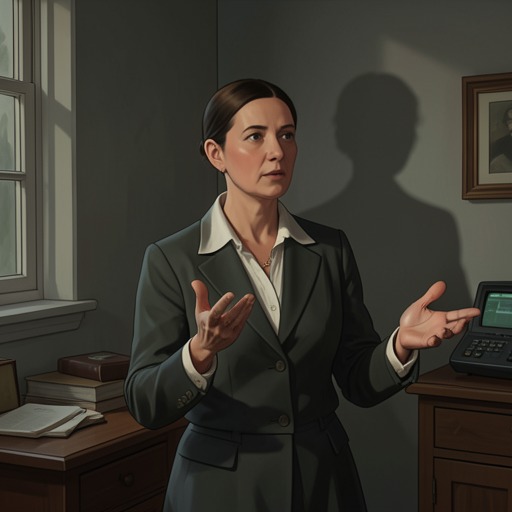
Félicien de la Vierge
L'Amour et les ForêtsFélicien de la Vierge is a twenty-year-old orphaned nobleman whose first night in Paris turns a chance encounter into an absolute, short-lived romance. Introduced as an outsider arriving from a solitary castle, he sees a woman at the opera, falls in love at first sight, and declares his feelings before learning that she has been deaf for years. His departure the next day leaves the episode suspended between the ideal of instant recognition and the limits imposed by an unbridgeable difference.
Identity and Arrival
Félicien is introduced as a wild adolescent and orphan of aristocratic standing, a melancholy lord associated with the north. He owns the château of Blanchelande in Lower Brittany and has recently escaped the night of a manor in Cornwall. The narrative places him between locations rather than firmly within one: a landowning heir from an isolated estate, he has set out for Paris, drawn by a feverish thirst for life and curiosity about the city’s “marvelous hell.” His status gives him wealth and a title, but his description emphasizes solitude and estrangement more than social power.
He has been in Paris only since that morning. At twenty, he is entering what the narration calls his first evening of youth, a world of fire, oblivion, ordinary pleasures, and gold. His appearance makes him conspicuous without making him provincial: his newish clothes have a dulled sheen but an impeccable cut, and an instinctive elegance distinguishes him. The narrator imagines that an observer might seek open space, sky, and solitude around him. That image anticipates the solitary life to which he returns, even as the city briefly draws him into a crowded public world.
The Opera Encounter
Félicien arrives at the opera in time to hear a woman’s farewell. By chance, she turns her eyes toward the audience, and their gazes meet for a moment. The narration treats this glance not as gradual attraction but as a sudden unveiling: Félicien feels that an entire world has opened within him. He shuts his eyes as if to preserve the two blue lights he has seen, then looks back at the stranger. Her lingering gaze seems to him to answer his own, and he experiences the encounter as the recognition of a familiar face, though they have never met on earth.
The episode’s romantic certainty belongs to Félicien’s perception, not to any established shared history. The narrator magnifies his response through images of lightning over a dark sea and of a face fixed in the mind like a reflection in a familiar mirror. Félicien understands the instant as the beginning of an unforgettable first love. Meanwhile, the woman appears to return to her own attention, opening a fan whose black lace touches her lips and seeming to listen only to the music of Norma. His overwhelming interpretation and her composed distance coexist in the same scene.
Confession and Revelation
After the encounter, the possibility of losing her to the chance passage of a street or a moment troubles Félicien enough to overcome his concern for propriety. He catches up with her at the corner of a dark street, turns pale, and leans against a cast-iron lamppost before addressing her. He tells her that he has seen her for the first time that evening, fears he will never see her again, and therefore must confess his love; if she passes on, he says, he will never repeat those words to anyone. The declaration makes his feeling public before he knows whether she can receive it as speech.
The woman stops, raises her veil, and studies him attentively. She does not take offense: she recognizes the depth of the feeling from his pallor and manner and tells him to recover, offering to regard him as a friend. Later, in a moment of shame and despair, she reveals the condition that changes the meaning of their encounter. She cannot hear him, cannot hear his name or his last breath, and cannot hear his heart beating against her. She explains that she has been deaf for years and that human science cannot restore her from the silence. Her disclosure is direct and painful; it is not a temporary misunderstanding that Félicien’s ardor can resolve.
Departure and Narrative Significance
The revelation breaks the pattern Félicien has imagined: the gaze seemed to establish a magical intimacy, but neither his declaration nor the intensity of his feeling can overcome the woman’s deafness. The narrative makes that contrast especially sharp by placing the language of recognition and near-divine enchantment beside her account of an enduring silence. Her experience is not simply a romantic obstacle in his story; she names it as a lived condition, including the shame and suffering it brings, and asks him to leave her.
A carriage waits nearby, and a servant lowers its step at the woman’s signal. She leaves Félicien’s arm, enters the carriage, and disappears. The following day, the count returns to his solitary castle at Blanchelande; the narration says that nothing more is ever heard of him. The abrupt retreat gives the episode no reunion or developed courtship. Félicien’s decisive movement is outward—from the isolation of his estate into Paris—and then back again, after a single night has made the promise of a wider life inseparable from loss.
The narrator closes with an ironic qualification: Félicien can at least claim to have encountered, at the first attempt, a sincere woman with the courage of her convictions. That assessment does not undo the pain of the revelation or make the encounter reciprocal in the way he first imagined. Instead, it shifts the episode’s emphasis from romantic possession to candor. Félicien’s brief appearance is shaped by a passage from enchanted certainty to an encounter with another person’s reality, followed by a return to the solitude from which he came.