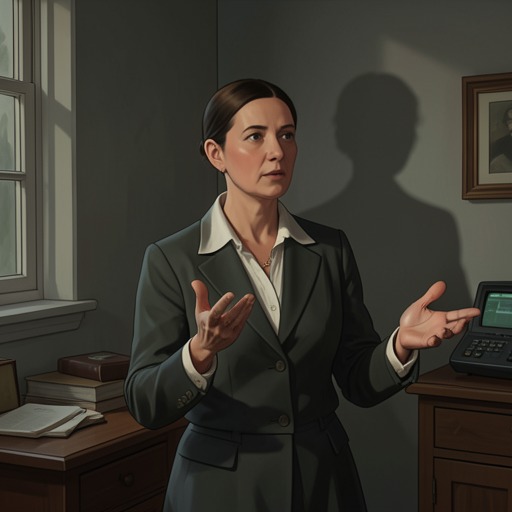
Félicien meets the deaf woman after the opera
L'Amour et les ForêtsFélicien meets the deaf woman after the opera is an embedded tale of love at first sight overturned by an encounter with the limits of reciprocity. After a performance of Norma at the Parisian Italian Theatre, Félicien de la Vierge sees a young woman in a box and takes one exchanged glance as recognition of a love that precedes ordinary memory. Their meeting continues in the street, where his declaration of love is answered by her disclosure that she cannot hear him. She briefly kisses him, then refuses the relationship and departs, leaving the young man with a love that has begun in certainty and ended in separation.
The opera and first recognition
The encounter begins amid a public farewell. The whole Parisian Italian Theatre rises to acclaim Maria-Felicia Malibran after the final accents of Bellini’s Casta diva, showering the singer with flowers, bracelets, and wreaths. The scene presents applause as a tumult of glory around an artist described as almost dying, yet enveloped in a feeling of immortality. In the orchestra seats, Félicien applauds with such fervor that he breaks his gloves. The spectacle of a farewell performance gives the meeting an atmosphere in which beauty and imminent loss are already entwined.
At first, the music absorbs Félicien so completely that the hall seems to vanish. His familiarity with the silence of woods, the rough wind among reefs, torrents over stones, and the deepening of twilight has, the narration suggests, made him receptive to the voice as something that gathers the natural world into it. Then his hands stop in mid-applause. In a box he sees a pale, strikingly beautiful woman, alone and absorbed in the performance. Her brown hair bears a gardenia; a black moiré dress veiled in lace sets off an opal in a gold setting. The narrator likens the stone’s troubled gleam to her soul, an image that foreshadows how quickly Félicien will interpret what he sees as inward revelation.
Their eyes meet for an instant when she turns toward the audience. The narration gives that glance more weight than its duration: Félicien feels that the two have not begun their lives merely at birth, and the image of a flash revealing the distant silver lines of a night sea conveys the suddenness of his conviction. When he looks again, the woman is still gazing at him, but soon seems to return her attention to the music. For Félicien, the brief exchange has already become a promise of permanent recognition; for her, no such promise has yet been spoken.
Confession and disclosure
Fear that a passing carriage might carry the woman away drives Félicien to follow her after the opera. At the corner of a dark street, he turns back, grows pale, and steadies himself against an iron lamppost before addressing her. He tells her that he has seen her for the first time that evening, fears never seeing her again, and loves her. His declaration is both an attempt to overcome chance and a surrender to it: he speaks because he imagines that silence may mean losing her forever.
The woman stops, raises her veil, and studies him in attentive silence. Félicien continues to express his love, but the scene’s emotional terms change when she leans toward him and explains that she cannot hear. She says that she has been deaf for years and cannot hear his name, his final sigh, or the beating of his heart against her. The declaration that she is deaf as the sky and the grave presents the condition in the language of absolute silence; her words make clear, however, that she can speak and that the barrier she describes is not a lack of feeling. She is distressed by the encounter and asks him to leave her alone.
This disclosure reverses the meaning of the earlier glance. Félicien has treated it as proof that they understand one another without words, but the woman names an obstacle he has not perceived and that his romantic certainty cannot dissolve. The story first filters her through his gaze—her appearance, isolation, and apparent absorption in the opera—then allows her to define the terms of the encounter herself. Her account makes his imagined union confront the concrete limits of communication.
The refusal and departure
Félicien answers the disclosure by insisting that they might overcome the future together if she is present in his life. The woman kisses him unexpectedly, joining her lips to his for a few seconds in the darkness. The gesture briefly permits intimacy, but it does not reverse her decision. She says that she will not profane her life for only half of love: though a virgin, she considers herself widowed from a dream and wants to remain unfulfilled rather than exchange her soul for his. She calls Félicien the man destined to hold her being, yet uses that very recognition to explain why she must take her body away from him. She describes it as her prison and hopes to be freed from it soon, refuses to learn or read his name, and bids him farewell.
The refusal is not a simple denial of attraction. The kiss and her acknowledgment of a powerful bond sit beside her insistence that desire alone cannot supply the kind of love she seeks. The encounter thus turns on a distinction between the intensity of feeling and the possibility of a relationship as she understands it. Félicien offers shared endurance; she rejects a life she believes would be only a partial exchange. Her decision is expressed in her own terms, even as the story surrounds it with the language of dream, imprisonment, and loss.
A carriage waits nearby at the turning of the Rue de Grammont. When a servant lowers its step, the woman releases Félicien’s arm, slips away from him like a bird, and enters. The image makes her departure swift and final: a moment later she has disappeared. The next day, Félicien returns to his solitary château of Blanchelande, and the tale says nothing more is heard of him. The opera’s public farewell has become a private one, but without the audience, applause, or possibility of an encore.
Narrative shape and significance
As an episode in Félicien de la Vierge’s story, the encounter builds from spectacle to recognition, from recognition to confession, and from confession to refusal. The performance of Norma establishes a world where a voice can command a hall and seem to confer immortality; the woman’s deafness then makes hearing the very condition Félicien cannot take for granted. The contrast does not erase her individuality into the musical scene: she attends to the opera, speaks for herself, accepts a brief kiss, and makes the final choice about whether to continue.
The story also sets Félicien’s certainty against the woman’s judgment. He reads the glance as evidence of an ancient, destined bond, while she refuses to let that feeling settle the question of what kind of love a life together would offer. Her departure leaves his idealization intact but unfulfilled. The tale’s ending does not resolve the distance between them; it closes on separation, with the woman vanishing from the narrative and Félicien returning to solitude.