Jean-François Ombredanne
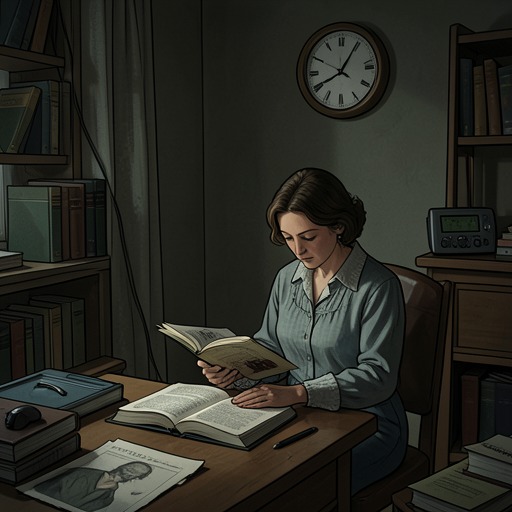
L'Amour et les ForêtsJean-François Ombredanne is Bénédicte Ombredanne’s husband, and his defining role in the story is that of a persistent controller whose methods narrow her freedom across domestic, social, and medical life. After learning of her afternoon with Christian, he subjects her to recurring interrogation and suspicion; later, he monitors her communications, distances her from her twin sister, and manages her medication during cancer treatment. His occasional remorse and declarations of dependence do not undo this pattern. Instead, the shifts between apology, accusation, and neglect show how control can continue without constant overt confrontation.
Identity and Domestic Position
Jean-François is Bénédicte’s husband and the father of their children, Arthur and Lola. Their marriage is presented through Bénédicte’s experience of its rules and routines: he has her timetable, expects to be able to reach her at home, and treats knowledge of her whereabouts as a right. She explains to Christian that she has no mobile phone because her husband would fear that it might enable an independent social life. Although she can make ordinary trips, she describes herself as being tracked continually. Her decision to spend several hours beyond his awareness is therefore not simply an outing; it is a deliberate break from the system of oversight, with consequences she expects to face when she returns.
The account makes a distinction between physical confinement and control. Bénédicte says that she is not literally captive, but the schedule and the expectation that she remain reachable make her movements legible to Jean-François. The qualification matters: her limited permission to go out does not amount to independence when he can demand an account of where she has been and use uncertainty as a reason to question her.
Surveillance and Interrogation
After Bénédicte’s six-hour meeting with Christian on March 9, Jean-François’s questioning becomes a recurring feature of their life together. He calls her repeatedly during the day, wakes her at night, approaches her as soon as she is awake, and even questions her while she is in the shower. When the children are absent, he can keep the accusations and demands going for hours. The narration presents this repetition as a closed system: each answer invites another question, and the exhaustion itself becomes a means of pressing her to disclose more.
His fixation centers on the affair and on reconstructing its details. At night he tells Bénédicte that he cannot sleep until he understands what she did, and insists that she recount the afternoon again. She protests that she has already explained it and regrets what happened, but he returns to the same demand. The episode thus becomes less a matter of seeking new information than a recurring ordeal in which his distress is made her responsibility. Even after periods in which she believes the questioning has subsided, it resumes within days; she experiences the apparent calm as temporary rather than as a change in the marriage.
The control also reaches beyond the home. During Bénédicte’s hospitalization at Sainte-Blandine, Jean-François tells her that residents, the psychiatrist, and hospital staff look at him with hostility, and accuses her of turning them against him. The narration links their reactions to the possibility that staff recognize the danger of her domestic situation, particularly because she refuses to explain her suicide attempt and insists on remaining in hospital. Jean-François’s complaints make their judgment another subject for which Bénédicte is required to answer.
Apology, Humiliation, and Withdrawal
Bénédicte describes Jean-François as alternating between remorse and blame. At some times he presents himself as her tormentor, asks how she can still love him, and pleads for forgiveness and for her not to leave. At others he says that she has ruined his life and attacks her appearance and femininity. The changes in tone do not resolve the conflict; they keep Bénédicte moving between the prospect of reconciliation and fresh humiliation.
After her discharge from Sainte-Blandine, the relationship also takes the form of sustained indifference. Jean-François rarely speaks to her except to criticize or insult her, avoids meeting her eyes, and does not respond when she tries to begin a conversation. He sometimes eats alone in the sitting room while she prepares and brings him a meal. When the family eats together, he attends to the children and remains considerate toward them, while excluding Bénédicte from conversation. The contrast leaves her present in the household but treated as negligible within it.
His accusations about the hospital deepen this isolation. He complains that staff and residents have been turned against him and threatens to stop visiting; Bénédicte answers that he need not return. The exchange briefly gives her a clear voice against his demands, but she is still hospitalized and due to leave soon. The moment marks resistance, not a lasting escape from his influence.
The Secret Phone and the Return of Violence
In March 2009, after Bénédicte has been out of contact with Éric Reinhardt for several weeks, she calls him in a hurry to explain that her husband has found a second phone. She had hidden it in her office library behind the collected works of Mallarmé, but had left its message alert on. When the phone sounds while Jean-François is with her, he searches the books and discovers it. The messages he reads are tender but not explicit. Bénédicte tells Éric that Jean-François became enraged and that this was the first time he had physically assaulted her.
Jean-François suspects that the messages concern a lover. To protect the man who had actually been writing to her and to divert her husband’s attention, Bénédicte says they were from Éric. This disclosure makes Éric a potential focus of suspicion even though he was not the correspondent. The episode shows how the discovery of a private means of communication turns ordinary affectionate messages into grounds for renewed surveillance and confrontation. Bénédicte’s call to Éric is itself hurried and fearful: she asks him not to send messages, although he says that he does not ordinarily do so.
Isolation and Control During Illness
Marie-Claire Ombredanne, Bénédicte’s twin sister, recounts that Jean-François had long opposed their plans to travel together and had worked to reduce their contact. Bénédicte had concealed his refusals behind excuses, including health concerns and household expenses. He also resisted the sisters’ regular visits and calls. Marie-Claire interprets this as an effort to remove her from Bénédicte’s life, despite their family having kept its distance from the couple’s household. Their closeness is important because it gives Bénédicte a source of affection that Jean-François cannot easily absorb into the marital relationship.
During Bénédicte’s cancer treatment, control extends to medication. Jean-François keeps the prescriptions and prepares the doses, laying out the capsules and water before work and remaining until she has taken them. Marie-Claire objects that this arrangement makes Bénédicte dependent and urges her to reclaim responsibility for her own medication and illness. This is Marie-Claire’s interpretation of his purpose, rather than a stated admission from Jean-François; the concrete arrangement nevertheless places an important part of Bénédicte’s care in his hands.
Marie-Claire also describes a cold house in late September, while Bénédicte is weakened by chemotherapy and has repeatedly asked for the heating to be turned on. Jean-François tells her to dress more warmly and wait. Bénédicte is afraid to switch on the heat without his permission and worries that he will be angry. Marie-Claire challenges him that evening, after which he turns it on. The episode condenses the larger pattern into an ordinary household decision: even when Bénédicte is seriously ill, comfort and care remain subject to her husband’s approval. Marie-Claire says that his behavior continued to worsen during Bénédicte’s final months.
Narrative Significance
Jean-François’s characterization rests less on a single confrontation than on the accumulation of restrictions: the timetable and phone access, repeated questioning, pressure to disclose, estrangement from Marie-Claire, emotional withdrawal, and dependence in treatment. These actions affect different parts of Bénédicte’s life, but together they make autonomy costly and uncertain. The narration also preserves the unevenness of the relationship: remorse can coexist with renewed blame, and apparent domestic normality can coexist with isolation and fear.
His role is therefore central to the account of Bénédicte’s diminishing room to act. Her brief departures from his control, her defense of her sisterly bond, and her refusal to accept his hospital complaints reveal resistance, but none quickly dismantles the surrounding system. The final testimony from Marie-Claire emphasizes that this pattern did not stop when Bénédicte became gravely ill; it persisted, and in her sister’s account grew more severe, through the last months of her life.