La présence vide et l'abandon affectif
L'Amour et les ForêtsLa présence vide et l'abandon affectif, or empty presence and emotional abandonment, names a central contradiction in Bénédicte Ombredanne's marriage: Jean-François can be constantly near her while failing, in Marie-Claire's account, to offer emotional companionship. The idea develops across the story, from the restrictions and questioning that narrow Bénédicte's ordinary life to the final hospital visits in which physical proximity becomes especially starkly separated from tenderness. Her twin sister's testimony gives this absence its clearest formulation, while the preceding scenes show the patterns that make it recognizable.
Surveillance and restricted autonomy
Bénédicte describes a life in which Jean-François expects to be able to reach her by landline and knows her timetable. She has no mobile phone, because he fears that one would make it easier for her to acquire a social life beyond his oversight. She insists that she is not literally confined and can go out to run an errand; at the same time, she recognizes that he tracks her movements and knows where she is. Her decision to spend several hours out of contact is therefore more than a practical deviation from routine: she understands that she will have to face consequences for being beyond his supervision.
This account establishes a distinction between freedom in name and autonomy in practice. Bénédicte can leave the house, but the conditions of her movement are organized around Jean-François's access to her, his knowledge of her schedule, and her anticipation of his response. The idea of an empty presence consequently begins before the terminal illness. A husband may occupy the position of constant companion while the relationship itself leaves little room for independent action or security.
Repetition as a form of enclosure
After Bénédicte's afternoon with Christian, Jean-François's questioning becomes a recurring feature of domestic life. He telephones several times a day, wakes her at night, and resumes his questions in the morning. When they are alone, he repeatedly accuses and interrogates her, returning to the same subject over hours. The narration compares the accumulating phrases to an inescapable forest: an image that makes the repetition feel like an environment with no visible way out, rather than a single argument that can be settled and left behind.
The questioning also turns sleep into another vulnerable interval. Jean-François says that he cannot rest until he understands what happened, and asks Bénédicte to recount the afternoon again. She protests that she has already explained it and regrets the betrayal, but the account does not bring the matter to an end. Even when she believes the worst of the ordeal has passed, his distress and suspicion return within a day or two. The repeated demand for an explanation thus keeps the past present in the marriage, while Bénédicte must manage both his reactions and the exhaustion created by their recurrence.
A later discovery of Bénédicte's concealed second phone shows how this pressure reaches into her communications as well. Jean-François finds affectionate messages after the phone's signal draws his attention to it. During the ensuing confrontation, he pushes her against a wall; she tells Éric that this is the first time he has physically attacked her. She asks Éric to stop sending messages, explaining that her husband has found the phone and that she wants to protect the person she has recently met from suspicion. The episode turns a private means of communication into another source of danger and illustrates how closely surveillance, fear, and self-censorship have become linked.
Care, illness, and dependence
During Bénédicte's illness, Jean-François takes charge of her medication. He holds the prescriptions, knows the doses, and prepares the pills on a tray with water before leaving for work. He waits until she has taken everything before going. Marie-Claire interprets this arrangement not simply as assistance but as a transfer of responsibility and control: she argues that Bénédicte should manage her own medicines and have the prescriptions returned to her. Her appeal connects practical self-management with Bénédicte's ability to retain agency over her body, illness, and decisions.
This episode complicates any simple opposition between care and neglect. Jean-François performs a repeated task associated with caregiving, but Marie-Claire sees the arrangement as making Bénédicte dependent on him. Her advice is specific: Bénédicte should insist on managing the medication herself. The conflict therefore concerns not only whether help is present, but who directs it and whether it supports or diminishes the patient's autonomy.
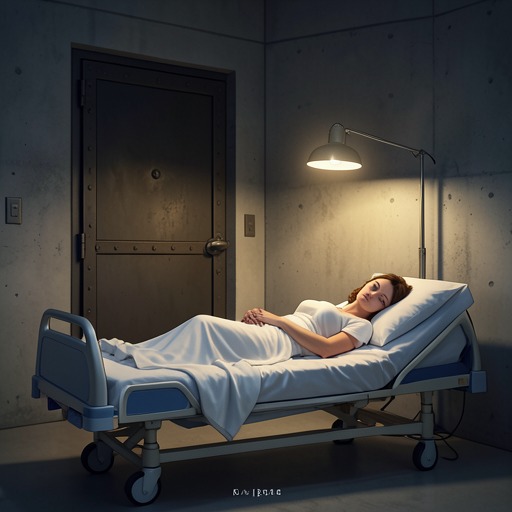
At the hospital, Jean-François is also physically present for long periods. He paces at the foot of Bénédicte's bed or sits in a chair with coffee, but Marie-Claire says she never sees him beside her. Bénédicte finds his pacing distressing and asks her sister to make him leave. She reads it as the behavior of someone impatiently waiting, rather than as a gesture of comfort. The distance between the bed and its foot becomes a concrete measure of the difference Marie-Claire perceives between staying in the room and being emotionally alongside Bénédicte.
The bedside and the performance of devotion
Marie-Claire interprets Jean-François's hospital conduct partly through its public appearance. She believes he wants staff and relatives to see an exemplary couple, united through Bénédicte's final moments. In her reading, his wish to be present until the end is bound up with being seen as the husband who remained, and perhaps with being the last person to witness Bénédicte alive. This is Marie-Claire's judgment of his conduct, not a motive independently confirmed by Bénédicte; its importance lies in the contrast she draws between outward solidarity and the emotional quality of the visits.
The family visits intensify that contrast. Jean-François brings the children every evening, even as Bénédicte becomes too weak to eat comfortably, walk, or speak. Marie-Claire believes the visits are too frequent and too long, and that Bénédicte would have preferred less frequent, better-quality time with her children. During these bedside gatherings, the children remain at a distance, while Marie-Claire recalls that her own visits with Bénédicte involve crying and embraces. Lola sometimes waits against the wall or holds her father's hand. The scene appears to Marie-Claire less like an exchange of comfort with the dying woman than a formal arrangement around the bed.
Jean-François also sends messages to the family saying that he and Bénédicte have talked through the night. Marie-Claire sets these claims against Bénédicte's extreme weakness and her diminishing ability to speak. The discrepancy makes the messages seem to her like an assertion of intimacy that the observable circumstances do not support. It sharpens the concept's distinction between being present and being in meaningful communication: a report of closeness cannot itself supply the tenderness that the witness believes is absent.
Marie-Claire's testimony and the concept's significance
Marie-Claire gives the concept its most direct meaning when she describes Bénédicte as being worse than alone: she was with an emotional void. In this account, Jean-François's physical presence is frightening not because he is simply absent from the room, but because his presence contains no perceptible sympathy or shared feeling for Bénédicte. Marie-Claire says that she sees no sign that he is affected by her decline or the approach of her death. His unchanging manner, set against Bénédicte's worsening condition, makes the bedside seem to her like a place where presence has been emptied of care.
She relates this perception to her own work as a massage therapist, where she says she can feel depleted after treating clients she experiences as emotionally empty. That comparison belongs to Marie-Claire's personal understanding of emotional exchange; it does not establish an objective diagnosis of Jean-François. In the narrative, however, it extends her account beyond a judgment about one marriage. It presents emotional presence as something experienced through attention and responsiveness, and emotional emptiness as a relation that can leave another person feeling drained or alone.
The concept gathers together details from different stages of Bénédicte's life: the timetable and telephone through which her movements are monitored, the recurring nocturnal interrogations, the dependence surrounding medication, and the hospital vigil that appears devoted from the outside but is described by her twin as devoid of comfort. Its force comes from that recurrence. Abandonment is not depicted only as leaving someone physically alone; it can also take the form of remaining beside them while failing to respond to their distress as a person. In Marie-Claire's account of Bénédicte's final illness, that contradiction becomes both the family's central accusation against Jean-François and the defining image of the empty presence.