Le paraître
L'Amour et les ForêtsLe paraître is the public performance of an image, a pattern the narrative associates with Jean-François’s conduct around Bénédicte’s final hours and the handling of her body and belongings. Its force lies in the contrast between the exemplary family unity he appears to present and the distance and haste witnessed by Bénédicte’s twin sister. The idea thus concerns not appearance alone, but the attempt to control what other people see at the moment when private conduct can no longer be concealed by ordinary domestic routines.
A public image of marriage
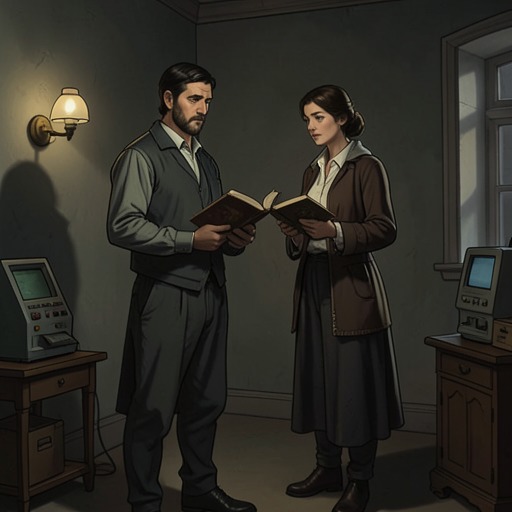
The twin sister interprets Jean-François’s vigil at the end of Bénédicte’s bed as a bid to possess the last moment: to be the last person to see her alive, receive a look from her, or witness her last breath. In her account, he might then claim that final instant as a victory or an advantage over Bénédicte’s family. The interpretation is explicitly tied to appearance: Jean-François wants hospital staff and relatives to see a loving husband and an exemplary couple, united as a household through Bénédicte’s final breath, whether the family accepts that image or not.
That insistence on visible unity is set against the sister’s description of what happens in the room. The children stand at a distance, and the visit feels to her like a stiff, funereal tableau without tenderness. When Bénédicte’s relatives leave her, by contrast, they cry and embrace one another. Lola either waits against the far wall, chewing gum, or holds her father’s hand as if comforting him. The sister sees father and daughter presented as a close pair facing Bénédicte alone in her bed. The significance of Le paraître emerges from this discrepancy: the signs of togetherness are present, but the sister does not recognize them as evidence of reciprocal comfort or intimacy with Bénédicte.
The appearance of composure
After the family has left the hospital room to telephone their mother in Condé-sur-Marne, Jean-François has Bénédicte taken to the morgue without telling them or asking whether they want to see her again. The twin sister returns in time to see the lift doors close on the bed carrying Bénédicte’s body. Her attention fixes on the brief glimpse of Bénédicte’s feet before the doors meet; she presses her forehead against the metal and breaks down. A little later, after taking a Xanax given by her eldest sister, she returns for her coat and sees Jean-François arrive with Lola and Arthur, outwardly intact and carrying a large rubbish bag.
The ensuing clearing of the room makes the contrast between performance and observed conduct concrete. In a hurried sequence, Jean-François empties the cupboards, throws Bénédicte’s clothes onto the floor, and packs away toiletries, papers, flowers, plants, magazines, water bottles, and partly used biscuits. The twin sister recalls a packet of Granola the children had brought shortly before, discarded as if Bénédicte’s death had made it inedible. The account says the clearing takes no more than four minutes. In this scene, the publicly composed husband is also the person who treats the traces of his wife’s presence as things to remove. The narrator understands the speed and practical manner of the task as incompatible with the loving, exemplary household Jean-François had wanted others to see.
Objects, clothing, and control of the image
From the window, the twin sister sees Jean-François throw the full rubbish bag into a bin and place Bénédicte’s travel bag in the car. He leaves with Lola in front and Arthur behind her. The sister describes the car’s movements as senselessly insensitive and sees its departure as an escape from the frame of her gaze and her love for Bénédicte. That framing matters: the car, the bags, and the hospital window turn an act of disposal into a visible final image, one that the surviving sister cannot reconcile with the family portrait Jean-François had sought to project.
The dispute over Bénédicte’s funeral clothes extends this conflict over who controls her appearance. Jean-François initially asks the eldest sister for advice. She recommends Bénédicte’s favorite dark-brown wool dress, high black lace-up boots, burgundy velvet jacket, lace mittens, and black stockings, imagining that Bénédicte would have wanted to depart in her finest clothes. Instead, Jean-François arrives at the funeral home late in the afternoon with garments the twin sister describes as hideous and foreign to Bénédicte: dated, faded clothes from the 1980s that she does not remember seeing her wear. The sister suspects they came from the back of a closet and had been set aside for donation. Three acquaintances, including Amélie and two retired friends, also say they do not recognize the clothes as Bénédicte’s; on hearing what happened, they weep with anger.
For the twin sister, the mismatch is not a minor failure of taste. She believes Jean-François had asked for advice in order to do the opposite, and interprets the resulting outfit as a degrading reconstruction of Bénédicte’s image: a disguise, even a bitter parody that seems to speak insultingly to her family in the name of the couple. Her reading is an accusation made by a grieving narrator, not an independently confirmed account of Jean-François’s intention. The clothes nevertheless give the conflict a visible form: while the sister’s chosen outfit would have expressed Bénédicte’s own preference and style, the clothes used for burial make her appear, to those who knew her, like someone else.
Narrative significance
Le paraître is developed through repeated contrasts between what is staged for observers and what the twin sister says she witnesses. Jean-François’s desired picture is of marital love and a household united until death; the sister remembers a distant bedside scene, the unannounced removal of the body, the four-minute clearing of the room, and funeral clothes that seem to erase Bénédicte’s familiar appearance. The finality of death makes these gestures especially charged: Bénédicte can no longer choose how she is seen, keep her belongings, or contest the image others make of her.
The concept also shapes the account’s form. Rather than offering a detached definition, the narrative accumulates objects and observed actions—the lift doors, the rubbish bag, the discarded Granola, the travel bag, the unfamiliar clothes—through which the sister judges the gulf between public display and private loss. Those details do not establish an inner motive beyond the narrator’s interpretation; they show why she experiences the performance of an exemplary family as a contradiction of Bénédicte’s isolation and of the grief felt by her relatives. Here, Le paraître is the struggle over who gets to define the visible story of a marriage after the person at its center can no longer speak.