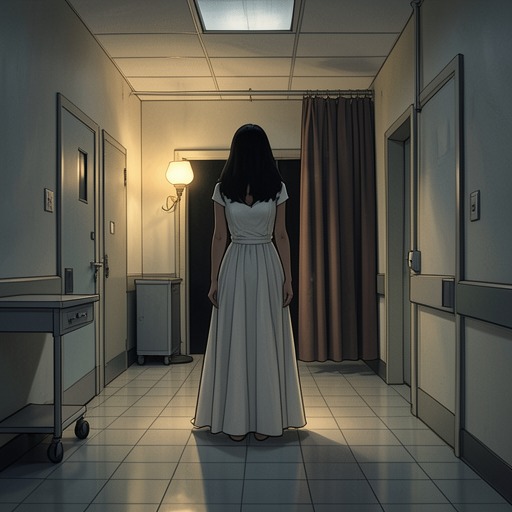
Sainte-Blandine comme « Brigadoon »
L'Amour et les ForêtsSainte-Blandine comme « Brigadoon » names the way Bénédicte Ombredanne comes to experience her stay at Sainte-Blandine: not merely as treatment, but as entry into a temporary world where she can belong, encounter herself differently, and imagine leaving her old life behind. The comparison is not a claim that the clinic literally disappears. It expresses the force of the separation she feels between its close, candid community and the ordinary world to which she must return—and the painful sense that this refuge cannot simply be carried home.
A country apart from ordinary life
During her stay, Bénédicte forms attachments to the other residents with striking speed. In retrospect, two weeks have been enough for her to love them more than anyone she sees outside the clinic. She regards Amélie, by contrast, as a hollow and conventional figure, settled into a disappointing life made up of small capitulations. That judgment also reflects Bénédicte’s recognition of her own former condition: before her overdose, she too had lived without fully confronting the compromises that shaped her days. The residents’ importance lies not in a claim that they are free of difficulty, but in the candor through which they have faced themselves.
Within the clinic, Bénédicte feels that an intimate hypocrisy has been broken open. She sees the residents as people who have had the courage either to make that rupture themselves or to let it happen to them. The community offers her a form of recognition different from the roles and expectations that have defined her life outside. Sainte-Blandine becomes, in this sense, a country apart: not because its inhabitants have no troubles, but because their shared exposure makes a different kind of connection possible.
The scale of this refuge is at once modest and immense. Bénédicte feels that she has finally found her true place inside the clinic, in the nine-square-metre room that Élisa affectionately calls her poet’s cell. The smallness of the room does not diminish the belonging she discovers there. Rather, the contrast between its confined dimensions and her sense of having arrived somewhere real gives the image its force: a few square metres can feel more habitable than the life beyond them.
A changed image of the self
The clinic’s shelter is also imaginative. Bénédicte does not describe falling in love with someone there in the usual romantic sense; she describes falling in love with a possible image of herself, and with a wider reality in which that image might exist. Her attachment to the residents is inseparable from the trust and friendship they share. Sainte-Blandine allows her to perceive that the self she has inhabited is not the only self available to her.
She imagines that, after several months, she might be ready to leave her husband, move away from Metz with her children, and begin again in unfamiliar surroundings. The distance she pictures is inward as well as geographical: she would have crossed considerable distances within herself and discovered new ways of seeing who she might be. The clinic has made the unknown appealing, not simply frightening. These are possibilities she considers, not actions the account establishes that she has taken.
Her imagined future includes leaving teaching, which she experiences as another restrictive definition of herself, and training for work in publishing. With her qualification in literature, she thinks she might become a proofreader or reader, perhaps eventually an editor valued by the authors she works with. She also distinguishes this possible occupation from writing publicly about her own life. She enjoys writing privately at night, using words to explore her inner depths, but regards that practice as intimate and fulfilling on its own terms. The prospect of turning experience into public material feels too exposing to her. The refuge thus opens several futures while leaving her limits and hesitations intact.
Leaving the refuge behind
The Brigadoon comparison acquires its full meaning when Bénédicte speaks to Éric Reinhardt on the TGV from Paris to Luxembourg. He asks whether she has seen Élisa, Aurélie, Patrick, Grégory, or the other people she met at the clinic. She admits that, although they gave her their telephone numbers and addresses, she never contacted them after leaving. She had returned to her life without wanting to look back. Their continued existence beyond her knowledge seems almost unreal to her: in her imagination, they remain at Sainte-Blandine, as though the clinic were their true and only country.
She likens that separation to the world of Brigadoon, where a place seems to emerge from the ordinary world and then disappear again. She wishes she could return, find everyone there, and have reality recede behind her, as in the film’s hundred-year interval. The longing is not only for the residents themselves. She misses the distinctive bond of friendship and trust they shared, and wants to resume the life she associates with that bond. Her account therefore makes departure feel less like leaving a building than losing access to a whole way of being with others.
Refuge against a monitored life
The contrast is sharpened by Bénédicte’s circumstances outside the clinic. Before her affair with Christian, she explains that she has no mobile phone because her husband fears she might use one to develop an independent social life. He requires her to remain reachable on the landline, knows her teaching schedule, and can track where she is. She says that she is not captive and is free to run errands, even as she describes herself as continuously traceable. Her decision to disappear from his radar for several hours brings with it the expectation that she will have to bear the consequences.
After the affair, that monitoring expands into recurrent accusations and questioning. Her husband calls repeatedly, wakes her at night, and approaches her with further interrogations in the morning or while she is showering. Months later, he still wakes her to make her recount the afternoon with Christian, insisting that this will relieve his distress. These episodes place the longing for Sainte-Blandine within a life where even rest and privacy are vulnerable to intrusion. Later, when her husband discovers her secret phone and messages, the confrontation becomes physically violent; during her cancer treatment, he also manages her medicines and prescriptions, leaving her dependent on him for their administration. The clinic’s alternative is not presented as a permanent solution to these circumstances, but it gives her a lived experience of trust and a language for imagining autonomy.
The image of Sainte-Blandine as Brigadoon holds together consolation and loss. The clinic helps Bénédicte see a wider version of herself and picture consequential changes to her work, marriage, home, and daily life. Yet the residents whom she loves remain, in her memory, inseparable from the place where she met them; she does not re-establish contact after leaving. Her refuge is therefore both emotionally real and difficult to sustain beyond its boundaries. What survives is the knowledge that another kind of life once seemed possible, even as the world outside the clinic continues to exert its pressure.