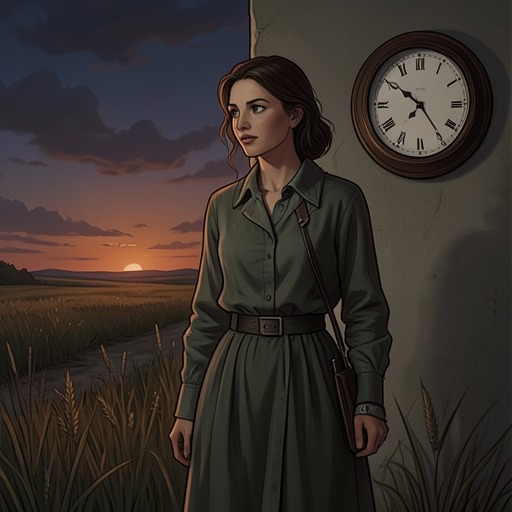
Six hours
L'Amour et les ForêtsSix hours is the span Bénédicte Ombredanne gives to March 9, 2006, from one in the afternoon until seven that evening. She remembers it not as a brief episode diminished by its duration, but as the apotheosis of her youth: a concentrated interval whose emotional force exceeds ordinary clock time. The novel makes those hours a measure both of ecstatic renewal and of the consequences that follow when the experience is carried back into her marriage.
The afternoon and its remembered scale
Bénédicte places the encounter with Christian within a precise frame: six hours on March 9, in the spring of 2006. Her comparison transforms the measure of time into a measure of intensity. In her recollection, the afternoon is not modest or incidental; it resounds like the great organs of Notre-Dame rather than a harmonium. The grand scale of that image belongs to her retrospective account, but the stated hours keep the memory anchored in a particular day and duration.
The encounter ends in intimate, ordinary gestures that sharpen the contrast between the afternoon’s intensity and its finite boundary. Bénédicte and Christian shower together, washing one another; she dresses before a large mirror, and they kiss beside a statue of a woman in the salon. She is already wearing her coat, while Christian stands bare-chested in trousers. The scene closes with departure already visible in their different states of dress, even as the kiss carries the encounter beyond a simple farewell.
Six hours as renewal
In a message afterward, Christian describes the effect of the meeting as a physical and mental return to youth. He says that, in six hours, Bénédicte has made him feel like a young man again, and pleads with her not to end the connection. His language presents the experience as something still active inside him after she has left: he imagines a creature growing within his body, feeding on his dreams and sustaining an almost continuous inner pleasure. The extravagant image conveys how radically the brief meeting has unsettled his previous sense of himself.
Christian’s appeal also gives the six-hour span an aftermath. He proposes occasional meetings in Metz, with lunches, walks in the countryside, and perhaps discreet visits to a hotel; he asks for Bénédicte’s telephone number and worries that she might disappear. His message thus turns the completed afternoon into a request for its continuation. The intensity he attributes to the encounter is not, by itself, a promise of a shared future: it is a plea, written after Bénédicte has gone, for another meeting.
Repetition in confession
That night, Bénédicte tells her husband, Jean-François, what she has experienced with Christian. The telling does not merely report the afternoon; it makes her feel that she is living it a second time, with extraordinary force and with more love than she had ever felt before. As she confesses, her answers take on the character of attacks and reproaches. She is swept up in the energy of disclosure, imagining escape from the house with her children and a departure toward Christian, without considering what her revelations might mean for her future.
The six hours therefore recur in two forms: first as the bounded encounter she remembers as a youthful apotheosis, then as an experience intensified through narration. The distinction matters. Recounting it to Jean-François neither restores the afternoon nor leaves it safely in the past; it renews Bénédicte’s feeling of being in love while bringing the secret into her marriage and exposing the family to the crisis that follows.
A contrasting farewell
Elsewhere, the novel’s embedded story of Félicien de la Vierge stages a different kind of ending. A woman offers him the pale flower she has worn in her hair and says farewell permanently; Félicien then realizes that she is married, though she denies it. This brief leave-taking does not belong to Bénédicte’s six-hour encounter, but its placement among the evidence offers a counterpoint: where Bénédicte’s afternoon becomes an experience she relives and longs to carry forward, Félicien’s scene turns on a farewell framed as final.