The Ombredanne family home
L'Amour et les ForêtsThe Ombredanne family home is both the setting of Bénédicte’s family life and the principal domestic space in which her husband’s control becomes visible. Familiar rooms—bedrooms, kitchen, living room, and office—shift in meaning as ordinary routines give way to secrecy, surveillance, and confrontation.
Setting and Domestic Routine
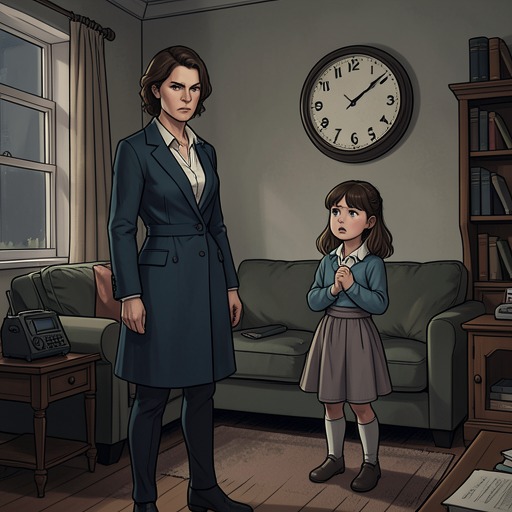
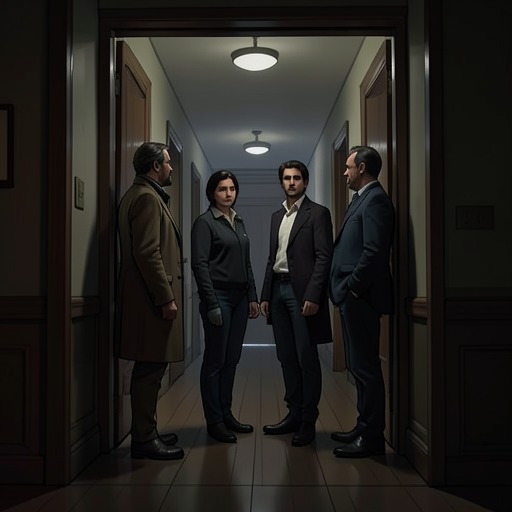
The house is introduced through a contrast between its usual evening commotion and an unsettling silence. When Bénédicte returns late from a meeting one evening in March 2006, no windows are lit. Inside, the rooms are dark, and the sounds she expects—the television, the children’s arguments and games, and the activity of clearing dinner—are absent. The empty living room and kitchen deepen her alarm before she finds Lola and Arthur hiding together beneath a duvet in their brother’s room. Their reunion briefly restores the house as a place of family affection, but the episode has already made its familiar rooms feel uncertain.
The household’s routines also carry small signs of how its members relate to one another. In the bedroom, Bénédicte finds Jean-François under the covers while his clothes lie scattered across the floor, unlike his usual care in placing them on a chair and putting his underwear away. The contrast draws attention to a disturbance in the marriage through a disruption of a domestic habit. The room, ordinarily shared and ordered, becomes the place where Bénédicte confronts the strain beneath that order.
The March 2006 Turning Point
After leaving the bedroom, Bénédicte returns to the kitchen, sends Lola and Arthur to bed, and eats quickly while standing. She then goes to the office on the ground floor and uses the computer to register on the Meetic dating website. The office’s separation from the family rooms gives her a temporary space for a decision she has not previously contemplated: to seek a life beyond her marriage. Her careful completion of the profile, including selective answers to personal questions, makes the act both deliberate and concealed.
The home thus contains two competing kinds of domestic life. Downstairs, the children’s dinner and bedtime continue; in the office, Bénédicte begins a private course of action. The contrast is not a departure from family responsibility so much as evidence that the ordinary household has left little visible room for her own desires. A room used for work becomes, for a time, a place where she can make a choice without first submitting it to her husband.
Surveillance Within the Household
Bénédicte explains to Christian that she has no mobile phone because Jean-François fears she might use one to maintain a social life or relationships beyond his reach. He has her timetable and expects her to be reachable on the landline; she describes him as knowing where she is much of the time. Her account complicates the appearance of ordinary freedom: she can go out for errands, yet her movements are closely tracked. The house is one anchor of that system, as the fixed telephone and her expected return after lessons connect her daily schedule to her husband’s oversight.
That oversight becomes more oppressive through repeated questioning at home. Jean-François calls several times a day and wakes Bénédicte at night to revisit her affair; when they are alone, his accusations and demands can continue for hours. The bedroom, which should permit rest, instead becomes a setting for renewed interrogation. The pattern turns the private interior of the house into an extension of surveillance, leaving Bénédicte little respite even when she is not away from home.
Escalation and the House as a Confined Space
The office also becomes the site of a later breach of privacy. Bénédicte hides a second phone in the bookcase behind the collected works of Mallarmé, but a message alert betrays its location. Jean-François finds the device and reads its tender messages. During the ensuing confrontation he pushes her against a wall as he takes the phone; she later tells Éric that this was the first time her husband had physically assaulted her. The hidden phone’s concealment among books, and the small sound that exposes it, make the home’s objects and quiet routines part of the crisis.
Control extends into the management of illness. Jean-François keeps Bénédicte’s prescriptions and prepares her medication on a tray with a glass of water before leaving for work, waiting until she has taken the tablets. Marie-Claire challenges this arrangement as a source of dependence and urges Bénédicte to take responsibility for the medication herself and reclaim access to the prescriptions. In this episode, care within the home is inseparable from the question of who holds authority over Bénédicte’s body and choices.
Across these episodes, the house changes from a backdrop for meals, children’s play, and sleep into a closely watched environment. Its office offers Bénédicte a brief opportunity for independent action, while its bedrooms and shared spaces repeatedly expose her to questioning and control. The home’s significance lies in this contrast: the same domestic setting that shelters family life also becomes the place where privacy and autonomy are progressively narrowed.