The conflict between women’s autonomy and maternal duty
L'Amour et les ForêtsThe conflict between women’s autonomy and maternal duty is embodied in Bénédicte Ombredanne’s decision to take several hours for herself, without her family’s permission, and in the costs she is made to bear afterward. Her excursion is neither a clean escape from family life nor a simple rejection of motherhood: it exposes how little room she has to act independently, while revealing how strongly she has been taught to measure her choices against the needs of her husband and children. The novel further complicates the conflict through her relationship with Lola, whose resistance to maternal expectations makes visible the pressures Bénédicte both endures and passes on.
Restricted freedom and the claim to time
Bénédicte tells Christian that she has no mobile phone because Jean-François fears she might use one to cultivate an independent social life. He has her schedule and expects her to be reachable by landline after her classes. She is technically free to go out for errands, she insists, but he knows where she is and keeps track of her movements. Her description distinguishes freedom in name from autonomy in practice: she is not physically confined, yet ordinary choices take place within a system of monitoring and anticipated permission.
Against that background, Bénédicte’s decision to spend the day away is a deliberate breach of routine. At thirty-six, she reflects on the wish to recover something of the freshness she had at twenty-six. She contrasts buying clothes or shoes with walking in nature, a less expensive and, to her, more substantial way to relieve pressure. Because she expects Jean-François to oppose the outing, she leaves without telling anyone. She understands the secrecy as an act of freedom, not as indifference to her family, but the concealment ensures that her private choice will later be treated as a violation requiring explanation.
The objects she wears make her decision legible to Lola. Bénédicte has put on her best dress, favorite boots, and a special ring, details that prompt her daughter to ask what happened and why she had left for the Vosges without warning. Lola is frightened by the turmoil at home and asks whether her parents are going to separate. Bénédicte reassures her that everything will be all right and promises to explain another day. Her attempt to keep adult matters from her child is also an attempt to contain the consequences of her own action, even as Lola has already sensed that something in the family has changed.
Motherhood as expected, unacknowledged labor
Bénédicte describes domestic life as a demand for constant service. She is expected to provide protection, comfort, planning, practical organization, advice, tenderness, maintenance, and security for every member of the family; in return, she experiences indifference. Her comparison of herself to a restaurant server conveys a particular form of invisibility: her work becomes noticeable chiefly when something is missing or delayed. The family’s dependence on her is therefore paired with a failure to recognize her as a person with needs of her own.
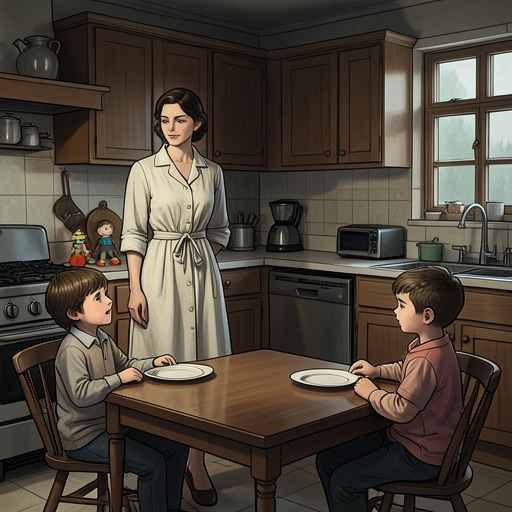
The evening of her absence gives that imbalance a concrete domestic setting. With the shopping undone and the refrigerator nearly empty, Jean-François eventually heats a frozen pizza for Arthur and Lola, but leaves it in the oven too long while pacing and shouting. The children eat quietly. Lola gives up the only caramel dessert so her brother can have it, and tells her mother about the bruised banana she ate instead. These details show the children adapting to a household disrupted by their father’s anger, while Bénédicte returns and tries first to attend to them. She asks Jean-François to postpone his accusations and shouting until she has spoken with the children; he grants her a short interval, but his rage continues to fill the house. Maternal care remains her immediate priority, even when the conditions that make it necessary are created by her husband’s behavior.
Bénédicte’s language about her six hours away registers both the exhilaration of having acted and the expectation that she must answer for it. She describes a turmoil of happiness, desire, guilt, fear, remorse, and anger, then tells Lola that she is glad she went and will accept the consequences. She also promises that neither Lola nor Arthur will be harmed. Lola objects that her mother cannot behave as if she were alone in the world. The exchange reveals the force of the competing claims: Bénédicte experiences a need for a life beyond service to the household, while Lola experiences the sudden absence as a failure of maternal responsibility. Neither perspective cancels the other.
The conflict reproduced between mother and daughter
The tension is especially sharp because Bénédicte has long invested heavily in Lola’s schooling. She has helped her daughter study each evening and valued her strong results; when Lola’s grades begin to fall and she becomes less concerned with academic achievement, Bénédicte reacts with increasing rigidity. She argues that education gives Lola the means to understand herself and resist a socially prescribed role of female obedience and dependence. In her view, refusing study in the name of an untouched, authentic self could leave Lola confined to a narrow role rather than free to invent her own life.
Yet the novel shows how Bénédicte’s fear for Lola’s future can turn into coercive pressure. Tired and increasingly inflexible, she presses her daughter to meet the standards she believes will protect her. She grows angry about Lola’s distraction, appearance, and interests, and their conversations about school become repeated confrontations rather than exchanges in which either can feel heard. Lola experiences her mother’s warnings as humiliation and attacks; Bénédicte experiences Lola’s refusal as a threat to the future she is trying to secure for her. In one argument, Lola tells her that she is preoccupied with her daughter’s life to avoid facing her own unhappy one. Bénédicte acknowledges the truth of her unhappy circumstances, but turns that recognition into a reason to insist even more fiercely that Lola not waste her opportunities. Lola leaves in anger, and Bénédicte is left distressed by the misunderstanding and unable to repair it for days.
This reversal prevents the maternal conflict from resolving into a simple opposition between a self-denying mother and a liberated daughter. Bénédicte’s own restricted position sharpens her desire to equip Lola with choices, but exhaustion and fear lead her to exercise authority in ways that constrain the girl. She can identify the danger of a life shaped by prescribed feminine roles while failing, in the moment, to make space for Lola’s different sense of herself. Her advice contains a genuine wish to protect her daughter; its delivery also becomes one more demand placed on both of them.
Surveillance, punishment, and dependence
After the outing, Jean-François’s response makes the costs of Bénédicte’s independent action endure well beyond that day. He repeatedly questions her whereabouts and account of the trip, calls her during the day, wakes her at night, and confronts her in private. The questioning becomes a routine that narrows her ability to rest or to be alone with her thoughts. Rather than treating her excursion as an isolated disagreement, he turns it into a continuing demand that she explain herself, while her fear of renewed conflict shapes what she says and does.
The pattern reappears when Jean-François finds a second phone Bénédicte has hidden behind Mallarmé’s collected works in her office library. A quiet notification alerts him to it; he finds tender messages between her and another man and reacts with rage. In explaining the discovery to Éric, Bénédicte describes being pushed against a wall as Jean-François takes the phone, an escalation from surveillance and interrogation to physical aggression. The episode shows how a private channel of communication can become a new focus for control, and how the exposure of even affectionate messages forces Bénédicte to manage her husband’s suspicions and protect the other person from them.
After her earlier affair, Jean-François alternates periods of apparent reconciliation with renewed accusations and demands for reassurance. Bénédicte spends weeks trying to persuade him that she loves him and will not leave or repeat the betrayal. At times she interprets temporary calm as evidence that their relationship might recover; the calm does not last, and he returns to questioning her, including during the night. The pattern turns her wish to preserve family life into additional emotional labor: she is expected to soothe the person whose conduct keeps her in a state of fear and uncertainty. The novel thus sets maternal and marital duties beside one another as overlapping demands, neither of which guarantees Bénédicte reciprocal care.
Illness and the limits of autonomy
The conflict persists when Bénédicte is seriously ill. During cancer treatment, Jean-François prepares her medicines, holds the prescriptions, and decides which doses she takes, arranging the pills and a glass of water for her each morning. Marie-Claire urges Bénédicte to take responsibility for her own medication and to reclaim authority over her body and treatment. The contrast is not simply between practical assistance and its absence: the sister sees the arrangement as deepening Bénédicte’s dependence by making her husband indispensable, at a point when illness has already reduced her strength.
The household history helps explain how such dependence is sustained. Marie-Claire recalls that Bénédicte had been responsible for order, homework, bedtimes, restrictions, and school expectations, while Jean-François retained the more popular role with the children and could make their mother appear despotic. Bénédicte’s strictness intensified under the pressure to keep the home impeccable, manage the children’s education, and meet the family’s expectations. During her first cancer, the family’s finances led Jean-François to dismiss the housekeeper; she was never replaced, and Bénédicte continued the housework even during her second illness. Her service to the family was not a freely chosen counterweight to her restricted life but a burden that continued as her capacity diminished.
By the end, the conflict between autonomy and maternal duty has become a painful entanglement rather than a problem Bénédicte can solve by choosing one side. She seeks room to act as a woman with desires and a life of her own, yet remains responsible for reassuring her children and carrying domestic work. She also tries to shape Lola’s future in ways intended to protect her, but the strain of that effort damages their closeness. The novel’s treatment of the conflict lies in these reversals: the mother who feels invisible can exert painful authority; the daughter who resists that authority can still be caught in the family’s turmoil; and Bénédicte’s brief act of independence brings no lasting release from the obligations and controls surrounding her.