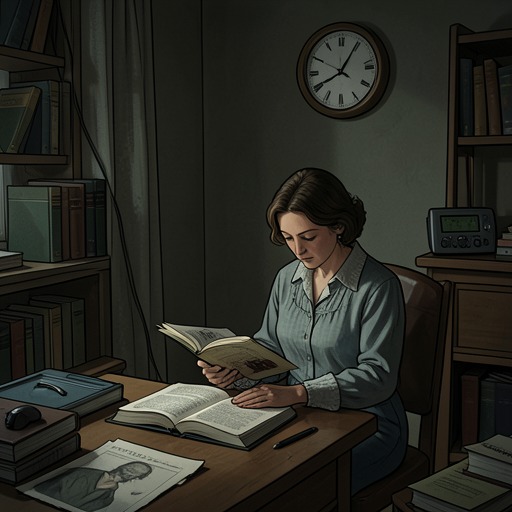
The night of May 6–7, 2006
L'Amour et les ForêtsThe night of May 6–7, 2006, is the point at which Bénédicte Ombredanne’s silence gives way to an open confrontation with Jean-François. Her confession briefly turns the direction of their struggle: instead of continuing to answer his suspicions indirectly, she tells him about her meeting with Christian and asserts how powerfully it affected her. Yet the night does not lead to her departure; by morning, the household routine has resumed, and the interrogation will continue.
Background and Trigger
In the months before the confrontation, Jean-François had sought to monitor Bénédicte’s movements. She had no mobile phone because he feared it would enable an independent social life; he knew her teaching schedule and expected her to be reachable at home. On the day she met Christian, she deliberately disappeared from his view for several hours and anticipated that she would have to face consequences.
Four days before the night of her confession, Bénédicte had been in a minor car accident that frightened her. The narrative presents the collision as a delayed catalyst: at first she did not recognize its effect, but when Jean-François woke her at three in the morning on May 6–7, something shifted. She got out of bed and began throwing nearby belongings at him, caught up in an anger that made her feel transformed.
The Confession
With the light on and standing in the bedroom, Bénédicte disclosed that she had arranged to meet a man, that she had been drawn to him, and that the encounter had become an affair. She told Jean-François that she loved Christian and was constantly thinking of him. Her husband initially seemed bewildered, asking what she meant, but she pressed on, insisting that this was the truth he had repeatedly demanded.
The argument became a full account of the afternoon. Jean-François questioned her until daybreak, and Bénédicte answered in detail, with an anger and contempt that made her replies feel like counterattacks. For her, telling the story was not only a response to his questioning: in the force of her confession, she imagined herself leaving with the children and going to join Christian. In the moment, that imagined escape seemed immediate, although she did not weigh what her disclosures might mean for her future.
The Household at Dawn
Lola and Arthur woke during the night and came to the bedroom at different times. Bénédicte tried to reassure them briefly and kissed the child who had opened the door; she also took Arthur back to bed and tucked him in. Their presence brought the children into the consequences of the confrontation, even as Bénédicte’s attention remained fixed on the conflict with their father.
When the argument ended, Bénédicte did not leave, although at points during the night she had considered doing so. Instead, she went downstairs and prepared breakfast: coffee and milk, cereal and biscuits, butter and jam. At the table, she and Jean-François exchanged neither words nor looks. The children were frightened and said nothing. Bénédicte then dressed, helped Arthur get ready for school, went to work, ate in the school cafeteria, taught her classes, and returned home later that day as if the ordinary schedule could simply resume.
Aftermath and Significance
The morning exposed a gap between the force of Bénédicte’s revolt and its practical outcome. During the night, she had felt that telling the truth might free her from the marriage; by daylight, she had not taken the available opportunity to leave, and she had returned to the routines of family and work. The confession changed what could be said between the couple, but it did not immediately change the conditions in which she lived.
Nor did it end Jean-François’s questioning. In the following weeks, he increasingly woke her at night and asked her to recount the affair again, presenting her account as necessary to relieve his distress. The night’s disclosure therefore became both an act of defiance and the material for a renewed cycle of interrogation: Bénédicte had spoken, but her words did not bring the separation or lasting release she had imagined.