« Crampe et migraine d’acier »
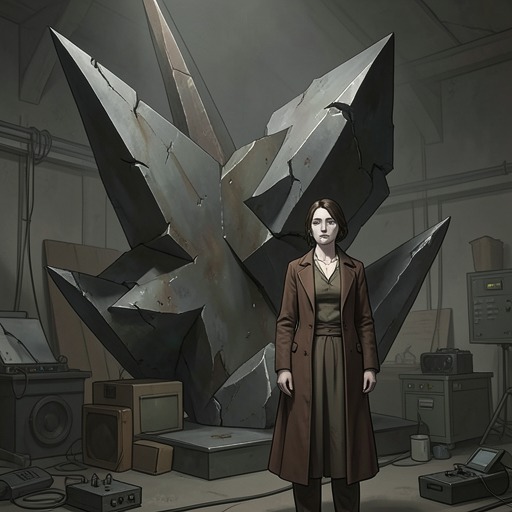
L'Amour et les Forêts« Crampe et migraine d’acier » is the name associated with the Abstract Sculpture on the Roundabout, a recently installed, angular work that Bénédicte Ombredanne gradually recognizes as a portrait of herself. Its force lies in the shift from an object she cannot interpret to an image of a life narrowed by fear, exhaustion, and control. The sculpture’s return in a mirror links that recognition to the pressures surrounding her and to a moment when she briefly acts on her own behalf.
The sculpture on the route to school
Bénédicte passes the sculpture on a roundabout while driving to the lycée. At first she examines it, wonders what it represents, and forgets it until her next journey past it. Then, after a sleepless night, she suddenly understands it as her own anticipated portrait: an abstract, repellent presence in steel. The recognition is not simply an interpretation of public art; it makes visible what she fears she is becoming.
A few days later, she imagines herself absorbed into the sculpture, trapped within its steel and oxidation. Terrified by this vision, she turns away and leaves the roundabout by another road. A car strikes her Peugeot. The accident is described as not serious, but it frightens her, and the impact is followed by a change in her mental state that she does not immediately understand. The sculpture’s image thus precedes a rupture in her ordinary movement through the world, without the narrative reducing the collision to a deliberate act.
A figure for confinement
The steel likeness resonates with the conditions of Bénédicte’s marriage. Her husband expects her to be reachable, knows her schedule, and tracks where she is; she insists that she is not captive, even as she describes her decision to disappear from his view for several hours and anticipates having to bear the consequences. The contradiction between nominal freedom and constant monitoring gives the sculpture’s imagined enclosure a concrete social context.
The narrative also describes the husband’s recurring accusations and questioning as a deep, inescapable forest of phrases. The sculpture and the verbal forest are distinct images, but both give material form to confinement: one fixes Bénédicte in steel, while the other surrounds her with an exhausting repetition from which she cannot see an exit. The expression therefore gathers not only her fear of an altered self but also the pressure of a life in which her movements and explanations are persistently scrutinized.
The image in the mirror
The sculpture returns during a night when her husband wakes her and presses her to recount the afternoon that led to his suspicions. Afterward, in the bathroom mirror, Bénédicte again sees an abstract steel figure where her reflection should be. The surrounding traffic seems to become a tumult of words and paragraphs, intensifying the sense that the interrogations continue even when she is alone. For a moment she is overwhelmed; then the vision recedes, and she sees herself again, alive, tired, and sad.
That return to her ordinary reflection precedes a private, decisive action. Bénédicte takes twelve pink Xanax grains in three swallows, hides the torn packaging, turns off the bathroom light, and lies down beside her sleeping husband. The episode connects the steel image to a crisis of exhaustion and withdrawal, while preserving a brief distinction between the monstrous figure she fears she has become and the living woman who looks back from the mirror.
Recurrence and significance
The expression links the roundabout episode to the later mirror scene, turning a passing urban object into a recurring measure of Bénédicte’s estrangement from herself. Its hard, abstract material contrasts with her ordinary reflection, yet the image is not confined to the sculpture: it appears when she is frightened by her own condition and when relentless questioning has narrowed her attention to the point of panic.
The motif also makes the costs of coercive control legible without treating the sculpture as a literal explanation of Bénédicte’s experience. Its significance accumulates through recurrence: first she recognizes a possible future self, then experiences that likeness as entrapment, and later encounters it again in the mirror before returning, temporarily, to her own face.