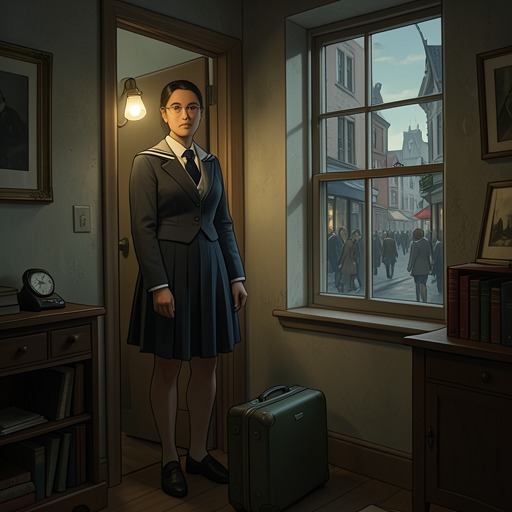
Bénédicte and Olivier's marriage falls apart
L'Amour et les ForêtsBénédicte and Olivier's marriage falls apart in 1992, but its end is prepared by a relationship Bénédicte had once treated as the great promise of her adult life. Olivier was her first and, in her understanding, only great love. Their separation exposes a deep mismatch between that ideal and the interests guiding Olivier, and leaves Bénédicte convinced that the reality she had trusted has betrayed her.
A life built around first love
In the summer of 1989, after her second year of preparatory study, Bénédicte was not admitted to École normale supérieure. Olivier had found work in Tours, and she decided against another year of preparation and moved there to live with him. She enrolled in university, intending to pursue the agrégation after completing her master's degree. For that degree, she planned to study Villiers de l'Isle-Adam, a writer she particularly admired.
They married in the spring of 1990, the year Bénédicte completed her master's degree. In July 1992, after a year of intensive work, she passed the agrégation with an excellent ranking. Her achievement came after sustained effort while Olivier was often away: he had become a traveling representative for a food-industry company and was rarely at home. The account of their early years thus places Bénédicte's serious academic ambitions alongside a marriage in which she had invested deeply, even as the ordinary demands of their life together were not evenly shared.
Her love for Olivier had made him seem like the long-awaited ideal partner, someone who could enchant everyday reality. The narrator describes Bénédicte as having been passionately in love with him, and the marriage's collapse consequently meant more to her than the end of a union. It struck at the belief that sincerity, devotion, and commitment could lead her toward the life she wanted.
Money and concealed interests
Before their marriage, Bénédicte and Olivier had agreed to pool their finances. In practice, Bénédicte's parents supplied much of the money that supported the couple's life in Tours. Olivier did not earn enough to cover all his expenses, and Bénédicte repeatedly asked her parents for additional funds, including money that helped pay for his regular nights out. Her mother sometimes asked, with evident discomfort, what the money was being spent on. Marie-Claire, Bénédicte's twin sister, also challenged her over the repeated requests, objecting that their parents should not have to work so hard to finance a lavish lifestyle for the couple.
Marie-Claire later learned that Bénédicte had noticed signs that Olivier was seeing other women and had been troubled by his absences and social life. Bénédicte nevertheless found it difficult to leave him. Her attachment persisted despite her doubts, a contrast that helps explain why the eventual separation became so devastating: recognizing that something was wrong did not make her emotionally prepared for the marriage to end.
The family farm was another source of concealed tension. During a long weekend at her parents' home, Marie-Claire got up at about three or four in the morning and saw Olivier in their mother's office, studying the farm's accounts. He did not see her. Marie-Claire was shocked by what the scene suggested, but said nothing, partly to avoid placing her twin in a difficult position. At the time, she did not know how strained Bénédicte's marriage had become and did not understand that Olivier might leave her over the farm.
Olivier was trained in agronomy, not as a farmer intending to take on the daily physical work of the land. His apparent interest was in managing the operation as a business, with enough employees to make it run without requiring him to be deeply involved in its labor. Yet the family's succession plan was longstanding and, within the family, openly understood: Bénédicte's older brother had categorically declined to take over, and their cousin, whom their parents had raised as a son, was expected to inherit the farm. Because their father was not planning to retire soon, the subject was rarely discussed, but it was not a secret. Bénédicte and Olivier had apparently never confronted the question together, leaving a crucial difference in expectation unspoken.
The announcement and separation
The decision became official at a family meeting on a Sunday in July 1992: their cousin would take over the farm when Bénédicte's father retired, a date then expected to be five years away. Olivier left the house without saying goodbye and abandoned Bénédicte about a week later, in August, just after she had passed the agrégation. He did not return. He filed for divorce in September, and the divorce was finalized in December of that year. They had no children.
The timing makes the contrast especially stark. Bénédicte had completed an exceptionally demanding year and secured a significant academic success; at the same moment, the husband she had loved left her after the family's plans for the farm made clear that he would not receive the future he appeared to want. Marie-Claire's later account connects the abandoned financial records, Olivier's interest in the farm's management, and his departure, while also acknowledging what she had not known at the time. The rupture was therefore both a sudden personal loss and the belated revelation of motives that had remained outside Bénédicte's understanding of the marriage.
The lasting break
For Bénédicte, the divorce was a catastrophe. At twenty-two, she felt that her adult life had begun with an immense failure: she had been deceived by appearances and betrayed by the person she had trusted most. She believed she would never again be able to believe in the promises she had once taken for granted. The pain was not proportionate simply to what the separation had materially taken from her; rather, it seemed to destroy something essential to her capacity for happiness.
After the divorce, she returned to Condé-sur-Marne and shut herself in her room for three months. Marie-Claire describes a depression lasting six months and says that the family never again recovered the Bénédicte they had known before it. Her spontaneity, anxious boldness, and readiness to take risks disappeared; caution replaced the movement toward life that had once been part of her temperament. The account presents this change as a lasting consequence of the rupture, not a temporary sadness that ended when the marriage did.
Bénédicte had believed that living sincerely and faithfully to her convictions would protect her from profound disappointment, as though reality could not betray a person who had acted with integrity. Olivier's departure after the farm announcement, following the earlier signs of deception and unequal dependence, shattered that confidence. The marriage's end therefore marks a decisive break in her life: she lost both the person she had regarded as her great love and the faith that reality would reward the way she had chosen to live.