Bénédicte confides in Reinhardt at their second meeting
L'Amour et les ForêtsBénédicte Ombredanne confides in Éric Reinhardt at their second meeting in a scene that transforms a tentative acquaintance into a sustained act of listening. On a Sunday in September, at Le Nemours café near the Palais-Royal, she speaks for four hours about the terrible experiences she has kept largely to herself. Reinhardt listens, encourages her to continue, and begins to understand that the calm precision of her account conceals a life from which she sees no easy way out.
A meeting she insisted on having
The meeting followed an earlier encounter at the same café in March 2008. Their first conversation had been hesitant: Reinhardt did most of the talking, while Bénédicte asked him about writing his novels. The two had found points of literary and imaginative affinity, but their contact faded in the weeks afterward. Bénédicte asked how his novel was progressing; he avoided discussing his work and was reluctant to begin a sustained correspondence, even with a reader he valued.
When Bénédicte proposed meeting again during a stay in Paris, Reinhardt did not readily commit. His text messages offered an uncertain schedule and left open the possibility that she could try again the next day. She continued to ask, day after day, without abandoning her courtesy. On the Sunday morning, only hours before her train was due to leave, she sent another message. Reinhardt understood that he could no longer evade the request and agreed to meet her early in the afternoon. He later recognized that the encounter would prove deeply affecting.
Their first meeting had also made a particular kind of openness possible. Reinhardt had spoken about his own anxieties, though he describes that account as emphatic and comically exaggerated. By letting Bénédicte see that he was not entirely well, he believes he may have made it easier for her to confide in him. The second meeting is thus not simply an unexpected disclosure: it follows an earlier exchange in which he, too, had shown vulnerability.
Four hours of disclosure
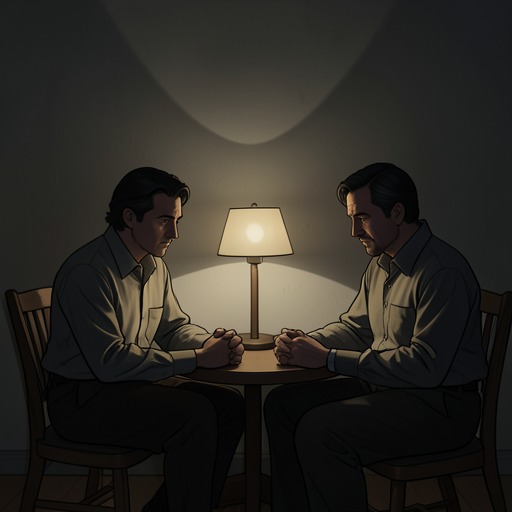
At the second meeting, Bénédicte takes the lead. Reinhardt senses that she needs to tell him her life, and he sustains the conversation with questions and affectionate encouragement. He understands that she has held these experiences inside for years and wants her to be able to release what she has kept to herself. The length of the conversation matters: this is not a brief confession but four hours in which she begins to recount the conditions and events that have shaped her recent life.
Her manner makes the stories harder, not easier, for him to receive. She relates them coolly and with what he experiences as clinical precision, itemizing facts and speaking about herself almost as if she were describing a distant case. The contrast between her controlled narration and the severity of what she describes leaves Reinhardt struggling to conceal his own distress. He feels an impulse to comfort her physically, to hold her or take her hand, while she continues to speak in a composed, detached manner.
He notices the bodily signs surrounding that composure: her angular, pallid face, features tightened by insomnia, and eyes and eyelids darkened with makeup. Her black-polished nails gather around the bowl of her wineglass. A cameo is fastened to her jacket; a round watch hangs as a pendant; and a large ring on her right ring finger calls to his mind a reliquary. These details do not interrupt the account so much as give its inward pressure a visible setting: the conversation takes place on an elegant café terrace, while the person speaking describes experiences that seem radically at odds with the setting.
Reinhardt responds by insisting that her circumstances must change and that she cannot go on being destroyed without resisting. Bénédicte agrees in principle, but tells him that, in practical terms, she cannot see a way out. She feels trapped and sometimes so discouraged that she is tempted to give up. He urges her not to surrender and to decide to fight. She does not claim that this resolves her situation; instead, she says it is genuinely complicated and promises to explain it more fully in writing.
From conversation to correspondence
The second meeting renews a connection that had nearly disappeared. Because what Bénédicte tells him has so deeply affected him, Reinhardt finds it natural afterward to keep in touch by text message and email. He wants to know how she is and offer whatever comfort he can, but he also wants to understand more fully the episodes her four-hour account could only skim over. The correspondence becomes an extension of the café conversation: a space in which she can clarify what she had begun to disclose aloud.
Over the following months, Bénédicte sends accounts of what she has experienced in recent years. At times she attaches pages from her private journal or other writing she made for herself when events were most serious. The written material gives Reinhardt fuller access to the history behind her testimony, while also showing that she had previously recorded some of it outside the conversations with him. His role is not limited to receiving these messages; he asks her to specify what had remained indistinct in the first telling and continues to offer support.
Their prospect of meeting again is constrained by her husband’s increasingly close surveillance of her life. He does not understand why she would want to return to the retired friend she had already visited in March and September. Bénédicte’s replies to Reinhardt sometimes come only after several weeks, interrupting exchanges he has experienced as intense. After her husband discovers the relationship, he tries by every means to obstruct it. Bénédicte creates a dedicated email address and opens its inbox only in the teachers’ room at her lycée. The delays that had seemed like a private hesitation acquire a concrete context: maintaining contact requires secrecy and a narrow opportunity to read and answer.
Light, departure, and the meaning of being heard
Near the end of the four hours, Bénédicte draws Reinhardt’s attention to the Esplanade in front of the Comédie-Française. She reflects on the autumn light, describing its brightness as something almost tangible, like a surface that might respond to a touch. As she reaches toward the glints on Jean-Michel Othoniel’s glass-bead carriage, Reinhardt notices the ring on her right hand. The movement briefly joins what she has been saying about beauty to a physical gesture: after recounting terrible experiences, she is still able to attend to the light and imagine touching it.
The moment does not erase the predicament she has described. Bénédicte eventually withdraws her hand, and the old, distant look disappears. Reinhardt points out that she must leave or risk missing her train. She says that she does not want to go home. He reminds her that her children are waiting for her and that they love her. The exchange sets the force of her reluctance against a family obligation that cannot simply be set aside; the account gives no indication that the conflict has been resolved by their conversation.
They agree to write to one another. Reinhardt promises that she need not worry about that, and she says she would like it very much. He gets up, takes the bill, and offers to accompany her to the station by taxi, noting that Sunday traffic is light and offering to carry her bag. The meeting ends not with a solution to what she has disclosed, but with a practical gesture of care and the promise of continued contact. Its decisive consequence is that Bénédicte’s account has found a listener willing both to receive it and to ask what remains untold.