Bague à l’œil de Bénédicte
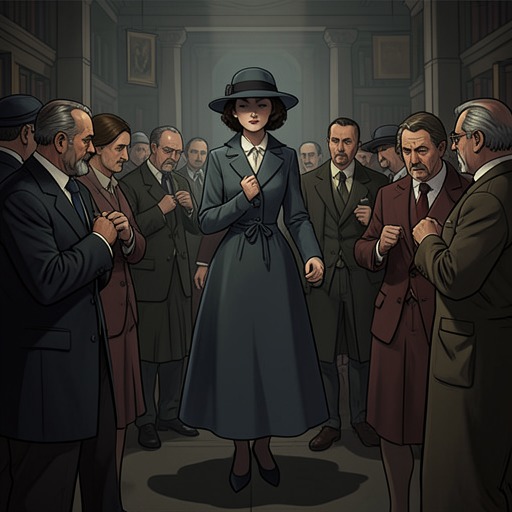
L'Amour et les ForêtsBague à l’œil de Bénédicte is a small heirloom with a painted eye at its center, passed down through the women of Bénédicte Ombredanne’s family. Its miniature image recalls a historical practice of concealing the identity of a lover, while its uncertain lineage lets Bénédicte imagine an intimate connection to the past. When she wears it to meet Christian, the ring becomes more than a keepsake: she treats its gaze as a possible omen for a clandestine encounter, and Christian reads its inheritance as a suggestion of desire repeated across generations.
Form and Inheritance
The ring is described as an early-nineteenth-century piece left to Bénédicte by her grandmother, who had received it from her own grandmother. Its central ornament is not a conventional portrait but a tiny painted eye. The distinction matters: an eye preserves the look of a person while withholding the identifying completeness of a face. The object makes concealment part of its design.
Bénédicte explains that such rings were made for a woman in love with a man who was already attached. Rather than commission his portrait, she had his eye painted so that others would not be able to identify him. The image therefore carries a specific history of hidden attachment, but the ring does not disclose the identities of the people involved. It preserves a fragment of intimacy while keeping the story around that intimacy unresolved.
The family route by which it reached Bénédicte is equally incomplete. She knows the immediate succession from grandmother to grandmother, but not whether an ancestor bought the ring from an antique dealer or inherited it through a much longer line. That uncertainty allows the object’s material continuity to coexist with a gap in family knowledge. The ring has survived; the account of how it entered the family has not.
The Ring in Bénédicte’s Hands
When the ring is noticed and its origin is asked about, Bénédicte says that she wears it for special occasions. In the encounter, the narrator holds her black-polished fingers, and the tiny old eye looks out from among them. The description makes the ring’s scale and placement part of the moment: it is a miniature gaze set against the dark detail of her manicure, not an abstract family relic displayed at a distance.
After the eye has been admired, Bénédicte withdraws her hand and the gaze disappears. The gesture briefly makes the object visible, then removes it again. Its significance thus depends on presentation and concealment: the ring can offer its image to another person, but its wearer controls when that image is seen. In a later scene, she also calls it her talismanic ring, confirming that it has a personal importance beyond its age or monetary worth.
On the day she goes to Christian, Bénédicte chooses the ring deliberately. She is already dressing with care for the meeting: she puts on her best simple brown wool dress, her burgundy velvet jacket, and a cameo bought at a market in Amsterdam while she was a student. Looking at the cameo, she decides that the occasion calls for the ring as well. Its eye gives her a way to connect the encounter before her with the love story encoded in the heirloom.
An Omen for the Meeting with Christian
Bénédicte imagines comparing the eye in the ring with Christian’s eye, as though a resemblance between them might be a good sign. The thought does not establish that the eyes actually match; it records the meaning she hopes to find in bringing the object with her. The ring turns anticipation into a personal ritual. An inherited image, already associated with a concealed love, is carried into a new and secret meeting as a possible token of encouragement.
The occasion also throws the ring’s history into uneasy parallel with Bénédicte’s own circumstances. Its original story concerns a woman drawn to a man who was already committed, and Bénédicte is preparing to meet Christian while leaving a note for her children that says she has gone shopping. The ring does not cause or explain her decision, but its history gives her a private language for approaching it: the concealed eye links romantic desire with secrecy before the meeting begins.
Christian recognizes that association and develops it in conversation. He says that he is moved by old things and by people who seem to have stepped out of another era, then admires the ring as an exceptional piece. With a teasing inference, he suggests that if it belonged to one of Bénédicte’s female ancestors, she may not be the first woman in her line to have crossed a boundary in love. His reading treats the ring not simply as beautiful workmanship but as evidence—suggestive, not conclusive—of a family history of transgression.
The Past as a Personal Connection
Bénédicte accepts the possibility that the ring’s story reaches much farther back, but she does not claim to know its provenance. She wonders whether it passed through ancestors all the way to the period associated with the eighteenth-century writer Marivaux, and she says that what she likes best in herself is what connects her to the past. She even says she would have chosen to meet Christian in 1883, a year she associates with a book she studied for her master’s thesis and with other things that appeal to her. The ring thus belongs to a broader attraction to earlier eras, not merely to the romance of its painted eye.
Its force comes from holding several incomplete meanings together. It is a documented family keepsake with a known immediate inheritance, an image connected to an anonymous love affair, and an object whose deeper family history remains uncertain. Bénédicte turns that uncertainty into imaginative possibility; Christian turns it into playful evidence of ancestral disobedience. Between them, the ring becomes a small, visible bridge between inherited secrecy and present desire, without resolving either into a fully known story.