Christian's Longbow
L'Amour et les ForêtsChristian's Longbow is both a finely customized hunting bow and the instrument through which Christian explains his philosophy of archery to Bénédicte Ombredanne. Its practical force and the attention required to use it make it more than a decorative object: in Christian's account, the shot brings body, mind, and the visible world into a single act of intention.
Construction and Power
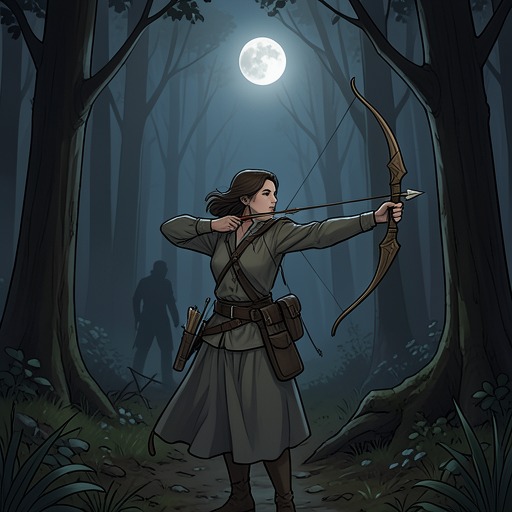
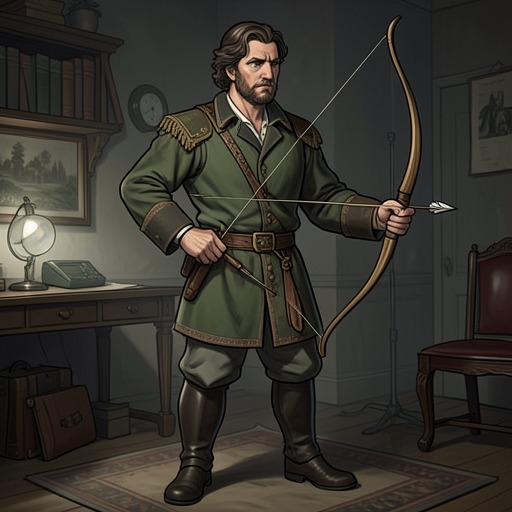
Christian takes the longbow from his collection and hands it to Bénédicte. It is a traditional wooden bow with a span of about two metres, simply made but covered in python skin by a saddler friend who works for Hermès. The contrast between its understated wooden form and its carefully chosen covering gives the weapon an individual, crafted character. Bénédicte admires its appearance and finds it gentler-looking than its proportions and power suggest.
Christian explains that the bow has a draw weight of thirty-three pounds and can propel an arrow with enough force to kill a cow or a wild boar at a distance of one hundred metres. The disclosure changes the terms of their first impression: what looked to Bénédicte like a poetic instrument is also a serious hunting weapon. Christian reassures her that he does not hunt either animal and presents the longbow not as a treacherous weapon but as one that places hunter and animal on equal terms.
The bow's string is also part of its particular construction. Christian says that his saddler friend made it from an elephant's ear, and cautions that a badly aligned bow can cause the string to cut the archer's veins—a mishap he has experienced several times. His expertise thus includes awareness of the weapon's risks as well as its beauty and power.
Christian's Practice and Philosophy
Christian has practiced archery since childhood and owns a collection of bows. He offers to teach Bénédicte, and the longbow becomes the occasion for an explanation that extends beyond technique. He describes the traditional bow as an instinctive weapon: the archer sees the target, raises the bow, draws, and releases in one fluent movement rather than pausing to calculate the shot. In his demonstration, he brings an imaginary string toward his lips and imitates the arrow's passage through the air, making the principle bodily and immediate.
For Christian, the arrow continues the archer's arm and mind. The archer must become attuned both to the weapon and to the visible world, so that thought, posture, and release converge on the target. He presents a successful shot as the realization of an intention: the arrow links the target with the archer's inner attitude, and the act depends on a kind of inward rightness. Archery therefore supplies him with a model for a presence in the world that he seeks even when he is not holding a bow.
This account also distinguishes the longbow from the compound bow, which Bénédicte dismisses as cumbersome and unpoetic. Christian shares her preference for the traditional instrument and contrasts its immediate release with the compound bow's mechanism, in which the string is locked while the archer aims. The contrast makes the longbow's meaning depend not simply on its shape but on its mode of use: instinct and continuous movement stand against a pause for mechanical assistance and deliberate aiming.
Teaching Bénédicte
When Bénédicte is ready to try archery, Christian does not give her his own full-sized longbow. He says that she will use a smaller bow intended for an adolescent because she does not have his reach and will not be strong enough to draw his. Bénédicte challenges that assumption, but the distinction establishes that instruction must take account of the archer's physical capacities. The longbow remains the model for the lesson even though she begins with a more suitable bow.
Christian gives her a sequence of practical directions. She places her feet at right angles for stability, with the left foot toward the target, and rests the arrow against a mark on the string. He warns her not to touch the arrow's tip while drawing because doing so could send it off course. He asks her to keep the bow arm as straight as possible and both eyes open, then to draw the string with her fingertips and release it gently, without adding a push. The precision of these instructions complements his emphasis on instinct: an apparently fluid shot depends on deliberate preparation and controlled release.
Christian then fires several arrows at the target, demonstrating the practice before Bénédicte shoots. The longbow thus serves as the lesson's central reference point—from his account of the weapon's construction and power to the specific bodily adjustments required to use a bow safely and accurately.
Narrative Significance
The longbow brings together the scene's conversation, instruction, and shared attention. Bénédicte first responds to its appearance; Christian's explanation reveals its dangerous capability, and his demonstration turns that abstract power into a set of coordinated actions. The object gives them a common subject through which admiration can become curiosity and a lesson can begin.
Its larger significance rests on Christian's interpretation of the shot. The longbow makes intention visible through an arrow's movement toward a target, while requiring the archer to attend to body, weapon, and present surroundings at once. That link between inward state and outward action is why Christian treats archery as more than a technical skill: the bow offers him a concrete practice for the focused presence he says he seeks in everyday life.